
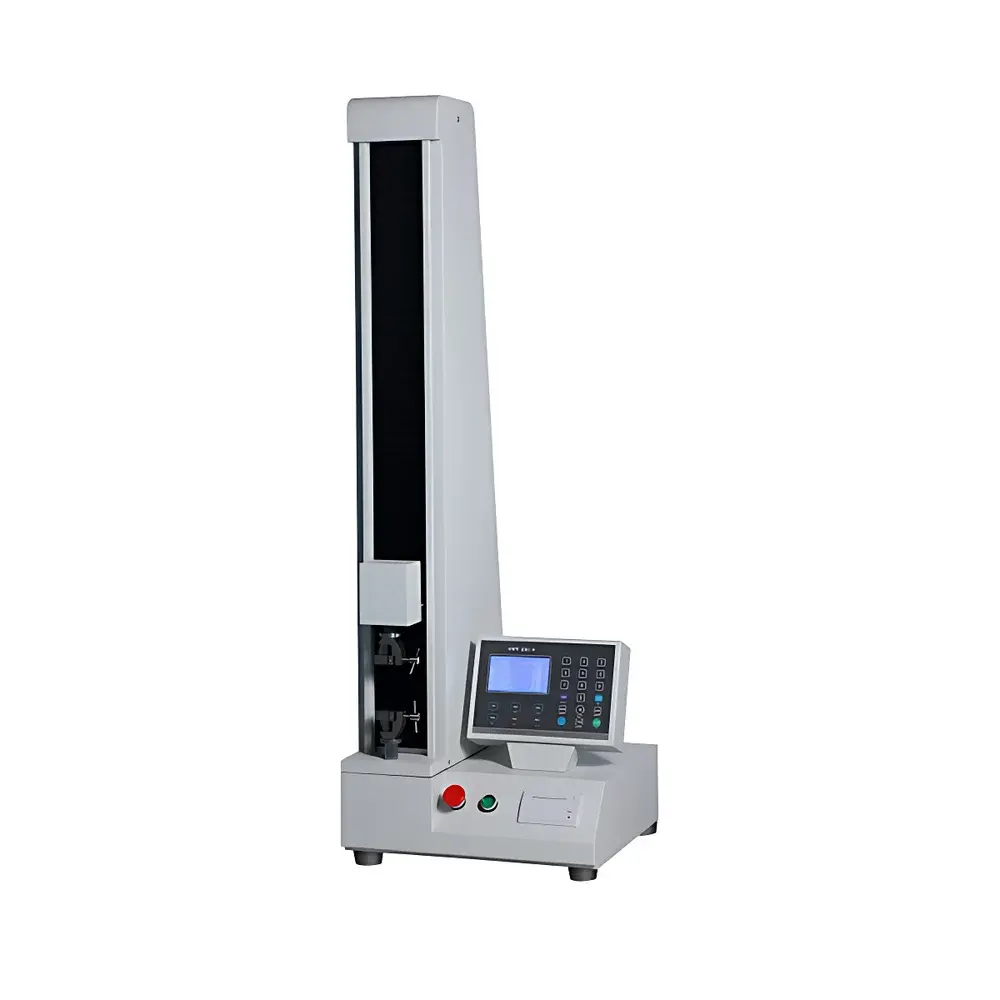
GBPI GBH-1 Advanced Single-Column Universal Tensile Tester
| Brand | GBPI |
|---|---|
| Origin | Guangdong, China |
| Manufacturer Type | Original Equipment Manufacturer (OEM) |
| Country of Origin | China |
| Model | GBH-1-aa |
| Pricing | Upon Request |
| Load Capacity | 0–500 N (optional up to 1500 N) |
| Elongation Range | Up to 1400% |
| Force Accuracy | ±0.5% of reading (Class 0.5) |
| Test Speed | 1–500 mm/min, continuously variable |
| Displacement Accuracy | ±0.5% of reading |
| Effective Specimen Width | 30 mm (customizable to 50 mm) |
| Effective Travel Distance | 750 mm |
| Dimensions (W×D×H) | 460 × 525 × 1430 mm |
| Power Consumption | 1000 W |
| Supply Voltage | AC 220 V, 50 Hz |
| Net Weight | 86 kg |
Overview
The GBPI GBH-1 Advanced Single-Column Universal Tensile Tester is an electromechanical force measurement system engineered for precision mechanical property evaluation of flexible packaging materials and thin-sheet substrates. Based on the principle of controlled uniaxial loading under defined displacement rate, the instrument applies calibrated tensile, compressive, or shear forces to specimens while synchronously recording load–displacement data in real time. Its modular architecture supports standardized test protocols across ASTM, ISO, GB, YBB, and JIS standards—making it suitable for quality assurance laboratories, regulatory testing facilities, academic research groups, and R&D departments in packaging, pharmaceutical, food, and polymer industries. The system operates under closed-loop digital control using a high-resolution AC servo motor and precision ground ball screw transmission, ensuring minimal hysteresis, zero drift in position control, and long-term repeatability.
Key Features
- Single-column, desktop-mounted structural design with high rigidity and compact footprint (460 × 525 × 1430 mm), optimized for laboratory space efficiency without compromising mechanical stability.
- Class 0.5 force measurement accuracy (±0.5% of full scale) validated per JJG 139 and ISO 7500-1; displacement resolution supported by encoder feedback at 100 Hz sampling rate.
- Continuously variable crosshead speed from 1 to 500 mm/min, enabling compliance with low-speed peel (e.g., ASTM F88), high-speed tear (e.g., ASTM D1938), and quasi-static tensile (e.g., GB/T 1040.3) test requirements.
- Dual configuration options: integrated controller (space-saving, streamlined appearance) or external control unit (facilitating firmware upgrades, standalone operation, and hardware maintenance).
- Multi-channel transducer interface supporting simultaneous acquisition from multiple load cells or extensometers—enabling extension of testing capabilities beyond standard tension/compression modes.
- Comprehensive safety architecture including mechanical limit switches, overload cutoff, emergency stop circuitry, and software-enforced operational boundaries.
- High-torque AC servo drive system coupled with preloaded ball screw assembly ensures smooth loading profiles, reduced wear, and extended service life (>10,000 cycles under nominal load conditions).
Sample Compatibility & Compliance
The GBH-1 accommodates a broad spectrum of specimen geometries and material classes—including biaxially oriented polypropylene (BOPP), metallized polyester films, aluminum-laminated composites, medical-grade nonwovens, pressure-sensitive adhesives, thermoformed trays, and elastomeric sealants. Standardized fixtures include pneumatic clamps (optional), wedge-action grips, peel arms, puncture probes, and three-point bending fixtures. All test methods align with internationally recognized regulatory frameworks: ASTM D882 (tensile properties of thin plastic sheeting), ASTM F904 (peel resistance of flexible barrier materials), ISO 37 (vulcanized rubber tensile testing), GB/T 2792 (180° peel strength), YBB00112003 (pharmaceutical packaging adhesion), and USP (container closure integrity verification prerequisites). Data traceability complies with GLP and GMP documentation expectations, including audit trails for method parameters, operator ID, calibration logs, and environmental metadata.
Software & Data Management
The embedded Windows-based control software provides full IEC 62304-compliant test sequencing, real-time curve visualization (load vs. displacement, stress vs. strain), and post-test analytical tools. Raw data export is natively supported in CSV and Excel-compatible formats; user-defined report templates allow automated generation of summary tables, statistical summaries (mean, SD, CV%), pass/fail flags against specification limits, and overlay comparisons across batches or material lots. The software architecture supports FDA 21 CFR Part 11 readiness through electronic signatures, role-based access control, and immutable audit logs for all critical actions—including test initiation, parameter modification, result approval, and calibration events. Data structures are open and hierarchical, permitting direct API-level access for integration into LIMS or MES platforms.
Applications
- Quantitative assessment of tensile strength, elongation at break, Young’s modulus, and yield point for polymer films per GB/T 1040 and ASTM D882.
- Evaluation of heat seal integrity via seal strength and hot tack performance (GB/T 2792, ASTM F88, QB/T 2358).
- Measurement of interlayer adhesion in laminates using 90° or 180° peel tests (GB/T 2790, ASTM D3330).
- Tear propagation resistance determination according to Elmendorf (GB/T 16578.1) and trouser-tear (ASTM D1938) methodologies.
- Mechanical characterization of medical packaging components including pouch seals, blister lidding, and Tyvek® substrates per ISO 11607-2.
- Compression behavior analysis of foam cushions, corrugated board liners, and molded pulp trays (GB/T 6344, GB/T 7122).
FAQ
What standards does the GBH-1 support for pharmaceutical packaging testing?
It fully supports YBB series standards (YBB00112003, YBB00102003, YBB00132002, YBB00202004), USP , and ISO 11607-2 for seal strength, peel adhesion, and package integrity validation.
Can the GBH-1 perform multi-specimen sequential testing without manual intervention?
Yes—the software supports batch-mode execution with auto-reset positioning, programmable dwell times, and conditional branching logic based on prior test outcomes.
Is calibration traceable to national metrology institutes?
All factory calibrations are performed using NIST-traceable deadweight standards and documented per ISO/IEC 17025; on-site recalibration services include CNAS-accredited certificates.
Does the system meet requirements for regulated environments such as FDA-regulated labs?
With optional 21 CFR Part 11 module enabled, it delivers full electronic record integrity, signature authentication, and change-control history required for FDA, EMA, and PMDA submissions.
What maintenance intervals are recommended for long-term accuracy retention?
Annual verification of force and displacement sensors is advised; routine inspection of grip surfaces, ball screw lubrication, and encoder alignment should occur every 6 months under continuous operation.






