
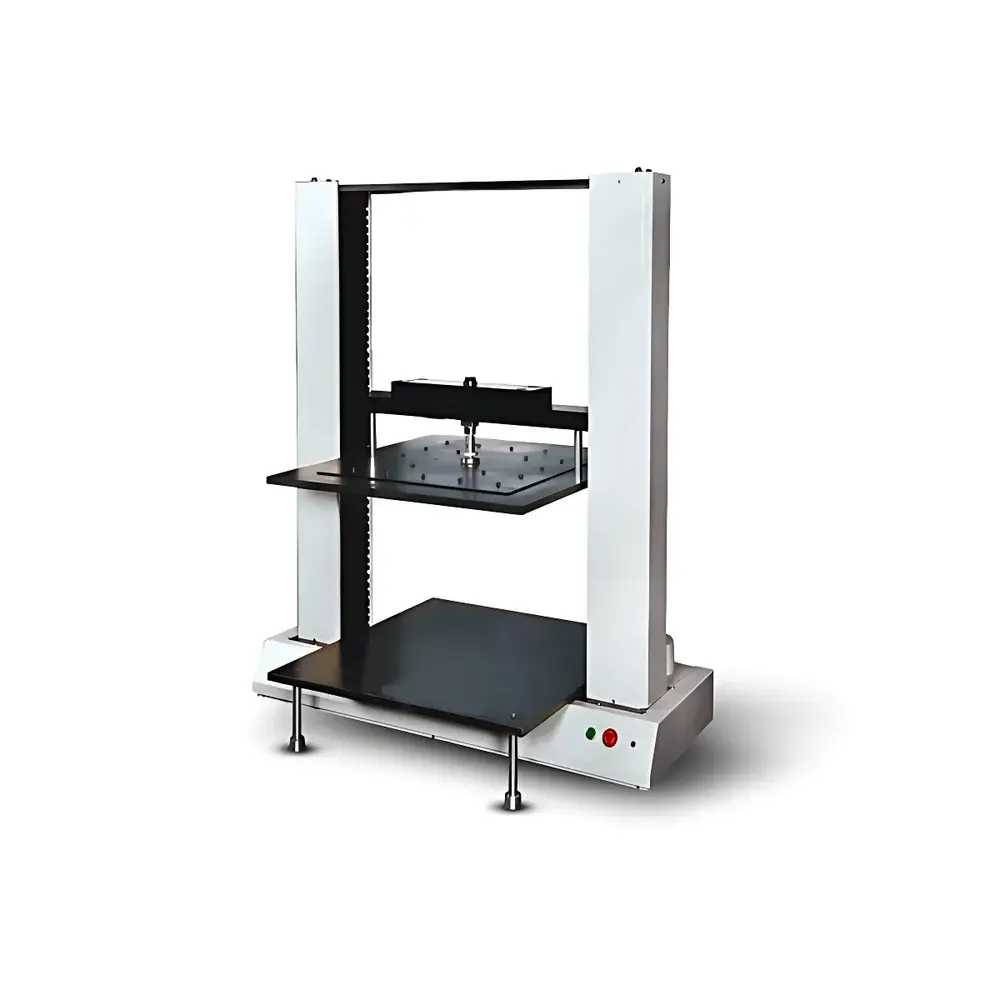
GBPI GBN2000Z Corrugated Board Crush Resistance Tester
| Brand | GBPI |
|---|---|
| Origin | Guangdong, China |
| Manufacturer Type | Direct Manufacturer |
| Region Classification | Domestic (China) |
| Model | GBN2000Z |
| Pricing | Upon Request |
| Test Capacity | 20 kN |
| Effective Force Range | 0.04–100% of full scale |
| Force Accuracy | ±1% of reading (Class 1) |
| Resolution | 0.001 N |
| Crosshead Speed | 0–500 mm/min, continuously variable |
| Speed Accuracy | ±1% of set value |
| Effective Test Space | 800 × 800 × 800 mm |
| Displacement Accuracy | ±1% of reading |
| Dimensions | 1250 × 850 × 1450 mm |
| Power Consumption | 1000 W |
Overview
The GBPI GBN2000Z Corrugated Board Crush Resistance Tester is a precision-engineered universal compression testing system designed specifically for evaluating the compressive strength, deformation behavior, and stacking performance of corrugated fiberboard, honeycomb board, and other structural packaging materials. It operates on the fundamental principle of uniaxial quasi-static compression under controlled displacement or load rate, adhering to standardized mechanical test methodologies defined in international packaging performance standards. The instrument complies with key regulatory and industry benchmarks including GB/T 16491 (Chinese general-purpose testing machines), GB 4857.16 (packaging—compression testing of complete packages), ASTM D642 (standard test method for determining compressive resistance of shipping containers), ASTM D4169 (performance testing of shipping containers and systems), TAPPI T804 (flat crush resistance of corrugated board), ISO 2872 (packaging—compression testing of complete, filled transport packages), ISO 12048 (corrugated fiberboard—determination of edge crush resistance), and JIS Z0212 (transport packages—compression test). Its robust dual-column frame architecture ensures high rigidity and minimal deflection during high-load testing up to 20 kN, enabling reliable data acquisition across the full operational range.
Key Features
- Fully automated operation with programmable test sequences: automatic crush detection, auto-return to initial position, and emergency stop termination.
- Integrated embedded computing module — enables standalone operation without external PC; all test control, real-time data acquisition, and result calculation occur onboard.
- High-contrast LCD display with intuitive menu navigation showing real-time force (N/kgf/lbf), displacement (mm), strain rate, and system status.
- Built-in thermal printer for immediate hard-copy reporting with customizable headers, sample IDs, and timestamped results.
- Triple-unit force display capability (N, kgf, lbf) with seamless switching and automatic unit-based calibration traceability.
- Real-time multi-curve overlay visualization: load vs. displacement, stress vs. strain, and time-based parameter plots; supports zoom, pan, and cursor-based point interrogation.
- Comprehensive sensor calibration interface supporting independent verification and adjustment of load cell, encoder, and displacement transducer outputs.
- Acoustic and visual fault alerts with dedicated emergency stop button compliant with IEC 60204-1 safety standards.
Sample Compatibility & Compliance
The GBN2000Z accommodates standard and custom-sized specimens per ISO 7263, TAPPI T811, and GB/T 6546 for edge crush testing (ECT), flat crush testing (FCT), and box compression testing (BCT). Its 800 × 800 × 800 mm test chamber permits evaluation of full-size shipping containers, palletized loads, and large-format corrugated panels. All hardware and firmware are designed to support GLP-compliant workflows: audit trails for user actions, test method versioning, electronic signatures (when paired with validated software), and raw data immutability. While the base system meets Class 1 accuracy per ISO 7500-1 and GB/T 16825.1, optional calibration certification (traceable to CNAS-accredited laboratories) is available upon request to satisfy ISO/IEC 17025 or FDA 21 CFR Part 11 requirements in regulated environments.
Software & Data Management
The GBPI proprietary testing software — delivered preloaded on included 4 GB USB drive — provides a Windows-compatible interface (XP SP3 through Windows 10 x64) with COM port (RS-232) communication support. It features editable report templates (DOCX, XLSX, PDF export), batch test sequencing, statistical summary generation (mean, SD, CV%, min/max), and compliance-ready metadata tagging (operator ID, environmental conditions, calibration date). Raw ASCII data files (.txt) retain full-resolution timestamps and synchronized force/displacement sampling at ≥100 Hz. Software validation documentation, IQ/OQ protocols, and 21 CFR Part 11 configuration guides are available under NDA for pharmaceutical and medical device packaging QA/QC labs.
Applications
- Edge crush resistance (ECT) and flat crush resistance (FCT) of single-, double-, and triple-wall corrugated board per TAPPI T811 and ISO 3037.
- Compression strength assessment of finished RSC, HSC, and die-cut shipping containers under static and dynamic stacking simulation.
- Quality conformance testing for ISO 9001-certified packaging suppliers and Tier-1 logistics providers.
- Material development R&D for recycled fiber blends, bio-based liners, and high-strength fluting configurations.
- Stability validation of e-commerce packaging under ISTA 3A/6-FE protocols when integrated with environmental chamber staging.
- Regulatory submission support for FDA, Health Canada, and EMA packaging dossiers requiring mechanical performance evidence.
FAQ
Is the GBN2000Z compatible with Windows 11 and USB-to-serial adapters?
Yes — while native RS-232 communication is supported, certified FTDI-based USB-to-serial adapters enable full functionality on Windows 11 systems; driver installation and port mapping are documented in the software manual.
Can test methods be password-locked to prevent unauthorized modification?
Yes — administrator-level access control allows method locking, user role assignment (operator, supervisor, admin), and change logging per ISO/IEC 17025 clause 7.2.2.
What is the recommended recalibration interval for routine QC use?
GBPI recommends annual calibration verification against traceable deadweight standards; intervals may be adjusted per internal risk assessment or regulatory requirement (e.g., every 6 months in GMP environments).
Does the system support third-party LIMS integration?
Yes — ASCII-formatted output files and optional OPC UA server add-on enable direct ingestion into LabVantage, Thermo Fisher SampleManager, and STARLIMS via configurable field mapping.
Are replacement load cells and displacement sensors available as spare parts?
Yes — all critical sensing components are modular and field-replaceable; part numbers and cross-references are listed in the Maintenance Manual (Rev. 4.2, included on USB drive).







