
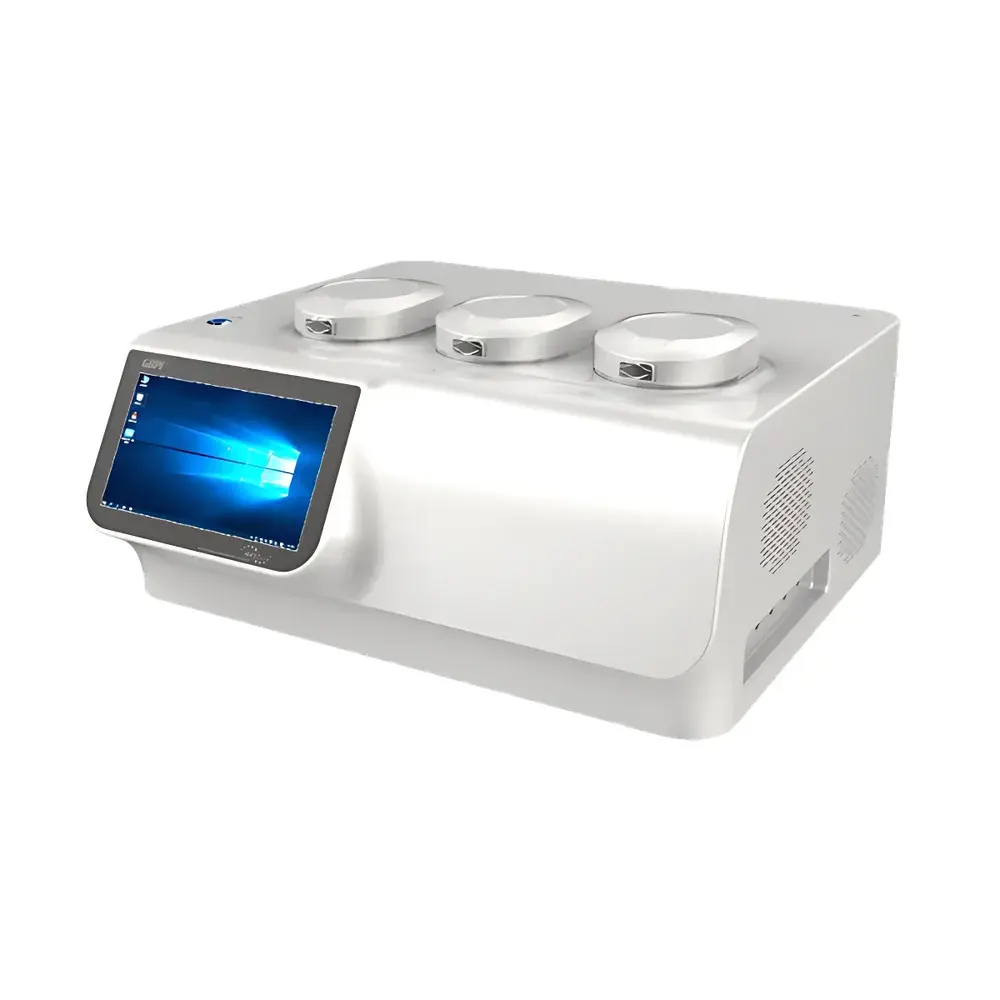
GBPI W413 2.0B Infrared Water Vapor Transmission Rate (WVTR) Tester
| Brand | GBPI |
|---|---|
| Origin | Guangdong, China |
| Manufacturer Type | Direct Manufacturer |
| Origin Category | Domestic (China) |
| Model | GBPI W413 2.0B |
| Pricing | Upon Request |
Overview
The GBPI W413 2.0B Infrared Water Vapor Transmission Rate (WVTR) Tester is an engineered analytical instrument designed for precise, traceable, and regulatory-compliant measurement of water vapor permeation through packaging and functional barrier materials. It operates on the principle of infrared (IR) moisture detection—where water vapor diffusing across a test specimen is carried by a dry carrier gas (ultra-high-purity nitrogen) into a dual-beam non-dispersive infrared sensor. This sensor quantifies water concentration based on absorption at the characteristic 2.7 µm wavelength, enabling direct, real-time, and interference-free mass flux calculation. The system complies with core international standards including ASTM F1249-2013, ISO 15106-2:2005, JIS K7129-2008, and Chinese national standards GB/T 26253-2010 and YBB 00092003-2015—making it suitable for use in GLP, GMP, and FDA-regulated environments where method traceability and data integrity are mandatory.
Key Features
- High-accuracy IR sensor calibrated using GBW(E)130543/4 certified reference materials—traceable to China’s National Institute of Metrology and validated under CNAS-accredited procedures.
- Integrated electromagnetic programmable temperature control (15–45 °C), achieving ±0.1 °C stability without external chiller units—reducing footprint, maintenance overhead, and thermal lag.
- Dual-stream humidity control system delivering precise RH setpoints from 0% (dry gas only) to 100%, with ±1% RH regulation accuracy across the full 30–90% RH operating range.
- Single-test-chamber architecture optimized for rapid equilibration and high-throughput screening; achieves resolution down to 0.001 g/(m²·24h), enabling reliable quantification of ultra-high-barrier substrates such as aluminum foil and metallized films.
- Onboard 7-inch color touchscreen interface with embedded Windows-based software—eliminating dependency on external PCs while supporting real-time visualization of five synchronized parameter curves (temperature, RH, WVTR, gas flow, voltage).
- Pneumatic sample clamping mechanism ensures repeatable 50.24 cm² test area sealing (Φ100 mm specimen) for materials up to 3 mm thick—including rigid sheets, flexible laminates, molded containers, and medical device substrates.
Sample Compatibility & Compliance
The W413 2.0B accommodates diverse physical forms: flat films (e.g., PET, PE, PP, PVDC-coated, AlOx-sputtered), composite laminates, foils, rubber sheets, ceramic wafers, pharmaceutical blister lidding, sterile pouches, and rigid packaging (e.g., trays, cups, bottles). Its design supports testing per USP , ISO 15106 series, and EU Pharmacopoeia Chapter 3.2.3 for container closure integrity assessment. All firmware and software modules conform to Annex 11 (Computerized Systems) and GMP Annex 11 requirements, incorporating role-based user access, electronic signatures (21 CFR Part 11 compliant), and immutable audit trails for all critical events—including method changes, calibration actions, result modifications, and report generation.
Software & Data Management
The proprietary GBPI TestSuite v3.2 software provides full lifecycle data governance: automated report generation (PDF/Excel export), customizable templates aligned with ISO/IEC 17025 reporting clauses, SQL-backed local database with encrypted storage, and configurable retention policies. Audit trail records capture timestamped operator ID, action type, pre- and post-value states, and IP/device origin for every data point. Calibration history, sensor diagnostics, and environmental logs are archived alongside test results—ensuring full reconstructability during regulatory inspections or internal quality audits.
Applications
This instrument serves as a primary metrology tool across regulated and industrial sectors: pharmaceutical packaging validation (blister, sachet, vial stopper), food packaging shelf-life modeling (retort pouches, vacuum-sealed trays), electronics encapsulation (solar backsheet, OLED barrier films), medical transdermal patch development, and R&D of next-generation biodegradable films. Its sensitivity and reproducibility support QC release testing, stability studies (ICH Q1/Q5), and formulation optimization where moisture-induced degradation—oxidation, hydrolysis, delamination—is a critical failure mode.
FAQ
What carrier gas is required, and what purity specification must it meet?
Ultra-high-purity nitrogen (≥99.999% N₂) is mandatory; inlet pressure must be ≥0.1 MPa and flow rate controllable between 5–100 mL/min.
Does the system support multi-specimen sequential testing?
No—the W413 2.0B features a single test chamber; however, three specimens can be loaded and tested individually with automated sequence execution and batch reporting.
Is external PC connectivity required for operation or data export?
Not required—the integrated touchscreen enables standalone operation, though optional Ethernet/USB interfaces allow networked data backup and remote monitoring.
How is sensor drift mitigated during extended runtime?
The IR detector includes automatic zero-point compensation and over-range protection logic; routine verification uses NIST-traceable humidity standards and GBW(E)130543/4 certified permeation references.
Can test methods be saved and recalled with version control?
Yes—method templates store all parameters (T/RH setpoints, duration, flow, pass/fail criteria) with revision timestamps, author attribution, and change history logged in the audit trail.





