
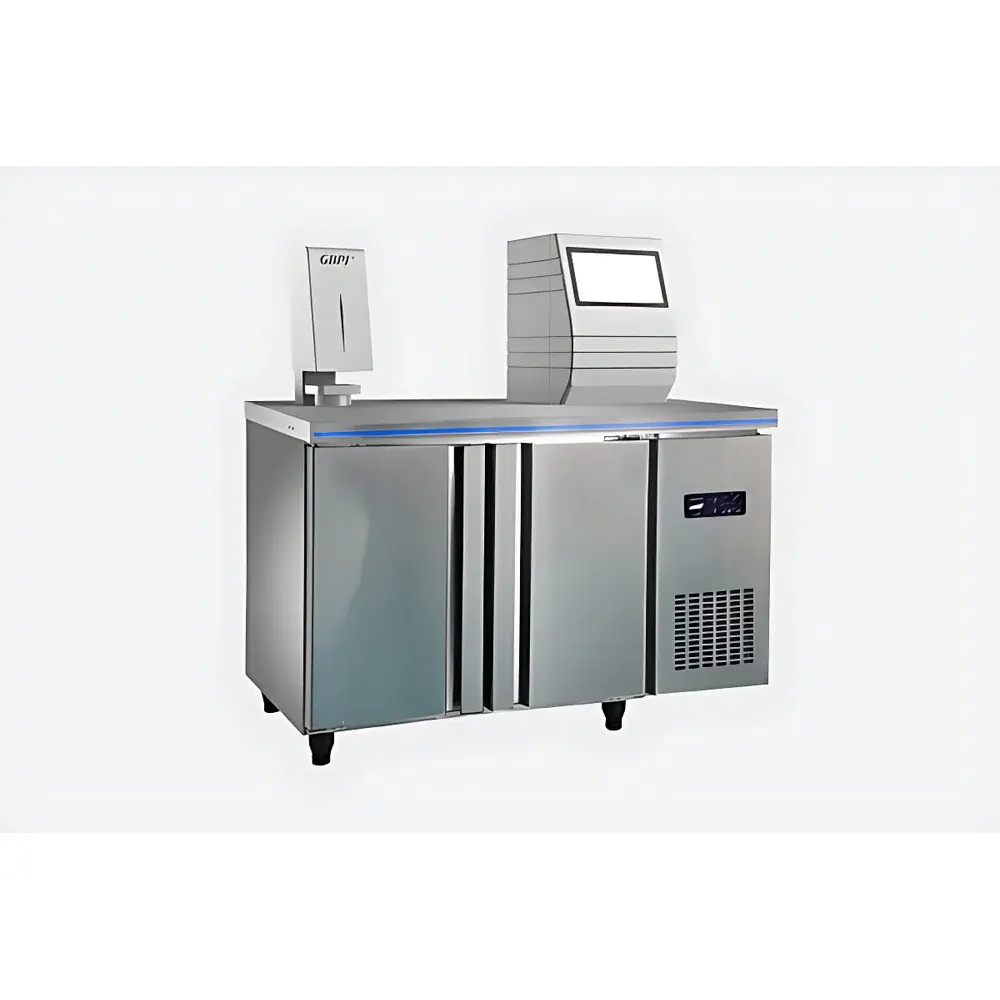
GBPI GB-KF30010 Aerosol Filtration Efficiency Tester for Protective Masks
| Brand | GBPI |
|---|---|
| Origin | Guangdong, China |
| Manufacturer Type | OEM/ODM Manufacturer |
| Region | Domestic (China) |
| Model | GB-KF30010 |
| Pricing | Upon Request |
| Filtration Efficiency Range | 0–99.999% |
| Flow Rate Range | 10–100 L/min (Accuracy Class 2.5) |
| Sampling Frequency | 1–9999 cycles/min (adjustable) |
| Test Aerosol Concentration | 20–30 mg/m³ |
| Count Median Diameter (CMD) | NaCl aerosol (0.075 ± 0.02) µm |
| Geometric Standard Deviation (GSD) | NaCl ≤ 1.86 |
| Dynamic Concentration Range | 0.001–100 mg/m³ (±1% accuracy) |
| Differential Pressure Sensor Range | 0–500 Pa |
| Dimensions | 460 mm × 525 mm × 1430 mm |
| Power Supply | AC 220 V, 50 Hz |
| Environmental Control | Integrated temperature & humidity sensor (operating range: 25 °C ± 5 °C, 30 %RH ± 10 %RH) |
Overview
The GBPI GB-KF30010 Aerosol Filtration Efficiency Tester is a fully integrated, laboratory-grade instrumentation system engineered for precise quantitative assessment of particulate filtration efficiency (PFE) in respiratory protective devices—including surgical masks, medical face masks, N95-equivalent respirators, and general-purpose protective textiles. It operates on the principle of controlled aerosol challenge under constant airflow, measuring upstream and downstream particle concentrations via calibrated optical particle counting to determine fractional filtration performance across defined particle size distributions. The instrument complies with core Chinese national standards governing respiratory protection evaluation, including GB/T 32610–2016 (Daily Protective Masks), GB 2626–2006 (Respiratory Protection—Non-powered Air-purifying Particulate Respirators), GB 19082–2009 (Medical Protective Gowns), GB 19083–2010 (Medical Protective Masks), GB 24539–2009 (Chemical Protective Clothing), and YY 0469–2011 (Surgical Masks). Its dual-aerosol capability—supporting both sodium chloride (NaCl) and paraffin oil challenge agents—enables compliance with salt- and oil-based test protocols required for certification against multiple regulatory tiers.
Key Features
- Cold-generation dual aerosol system: Independent, programmable NaCl and oil aerosol generators produce stable, monodisperse or polydisperse challenge aerosols with certified count median diameter (CMD) and geometric standard deviation (GSD) per ISO 16890 and EN 1822 traceability principles.
- High-fidelity real-time concentration monitoring: Dual-channel PM2.5 optical sensors with ±1% full-scale accuracy provide continuous upstream/downstream aerosol mass concentration data synchronized with particle counting.
- Electrostatic neutralization module: Built-in bipolar ionizer ensures consistent charge equilibrium of test aerosols, minimizing electrostatic capture artifacts and improving measurement reproducibility across material types.
- Leak-tight pneumatic test chamber: Fully sealed flow path with stainless-steel manifolds, silicone gasketed sample holders, and pressure-relief interlocks prevent operator exposure during high-concentration challenge testing.
- Automated differential pressure measurement: Integrated 0–500 Pa precision differential pressure transducer enables simultaneous determination of air resistance (ΔP) at standardized flow rates (e.g., 85 L/min for medical masks per YY 0469).
- Environmental monitoring suite: Onboard temperature and relative humidity sensors continuously log ambient conditions to verify conformance with test method requirements (25 °C ± 5 °C, 30 %RH ± 10 %RH).
- Computer-controlled operation: Dedicated Windows-based software manages parameter configuration, real-time data acquisition, automatic PFE calculation (PFE = [1 − Cdown/Cup] × 100%), statistical reporting, and audit-ready data export (CSV, PDF, XML).
Sample Compatibility & Compliance
The GB-KF30010 accommodates flat, circular, or rectangular mask/filter media specimens up to Ø100 mm using a pneumatically actuated clamping mechanism with mechanical overtravel protection. It supports standardized test formats for flat filter coupons, complete mask assemblies (with simulated facial seal), and layered textile composites. All hardware and firmware are designed to meet GLP-aligned documentation practices, supporting 21 CFR Part 11-compliant electronic records when deployed with validated software configurations. Test reports include metadata traceability—operator ID, calibration certificate numbers, environmental logs, and raw channel data—to satisfy accreditation requirements for CNAS, CMA, and ISO/IEC 17025 accredited laboratories.
Software & Data Management
The proprietary GBPI TestSuite v4.x software provides role-based user access control, configurable test templates (e.g., “GB 2626 Salt Mode”, “YY 0469 Oil Mode”), and automated pass/fail evaluation against threshold criteria. Data integrity safeguards include immutable timestamping, cryptographic hash logging, and version-controlled method files. Export modules generate compliant reports containing uncertainty budgets (per GUM guidelines), instrument calibration status, and raw time-series concentration waveforms. Audit trails record all user actions—including parameter edits, result deletions, and software updates—with IP address and session duration metadata.
Applications
This system serves as a primary reference instrument in regulatory testing laboratories (e.g., NIFDC, CNI, provincial CDCs), third-party certification bodies (e.g., SGS, BV, TÜV), and R&D departments within mask manufacturers and textile innovators. Typical use cases include pre-market validation of new filter media formulations, batch release testing per ISO 13485 quality management systems, comparative analysis of electret decay under humidity stress, and development of ASTM F2299/F2101–aligned methodologies. Its modular architecture allows integration into larger lab automation frameworks via TCP/IP or Modbus RTU interfaces.
FAQ
What aerosol generation methods does the GB-KF30010 support?
It employs cold nebulization for both NaCl and oil aerosols, eliminating thermal degradation risks and enabling repeatable CMD control without phase separation.
Can the system be used for quantitative fit testing?
No—it is designed exclusively for filter media evaluation under planar or static mask configurations, not anthropomorphic leakage assessment.
Is external calibration required for the PM2.5 sensors?
Yes; annual traceable calibration against NIST-traceable gravimetric standards is recommended and supported through GBPI’s certified service network.
Does the software support multi-language UI?
English and Simplified Chinese interfaces are available; additional language packs may be commissioned under OEM agreements.
What maintenance intervals are specified for the aerosol generators?
NaCl generator reservoirs require cleaning after every 50 hours of operation; oil generator nozzles must be ultrasonically cleaned biweekly when operating above 30 mg/m³ average concentration.






