
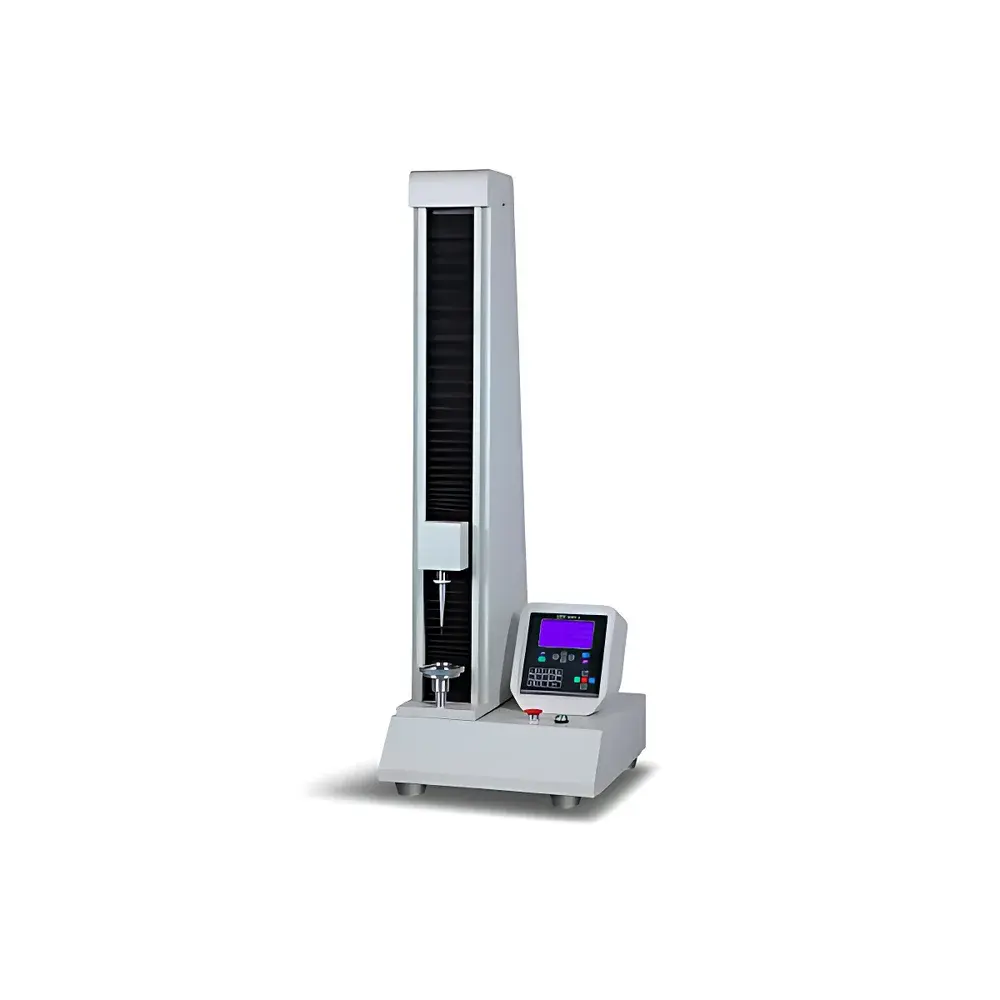
GBPI GBH-2Q Medical Packaging Performance Tester
| Brand | GBPI |
|---|---|
| Origin | Guangdong, China |
| Manufacturer Type | Manufacturer |
| Country of Origin | China |
| Model | GBH-2Q |
| Instrument Type | Electromechanical Tensile Testing Machine |
| Maximum Test Load | 0.5 kN |
| Force Range | 0–300 N (optional 0–500 N) |
| Elongation Capacity | up to 1400% |
| Force Accuracy | ±1% of reading (Class 1) |
| Travel Distance | 700 mm |
| Displacement Resolution | ±1% of reading |
Overview
The GBPI GBH-2Q Medical Packaging Performance Tester is a precision electromechanical tensile testing system engineered for comprehensive mechanical evaluation of primary and secondary packaging materials used in pharmaceutical, biotechnology, and medical device industries. It operates on the fundamental principle of controlled uniaxial force application—applying calibrated tension, compression, peel, puncture, tear, or flexural loads to specimens while continuously recording load-displacement response curves. Designed to meet stringent regulatory expectations for material qualification and process validation, the GBH-2Q supports deterministic assessment of seal integrity, film toughness, laminate adhesion, and pouch durability—critical parameters influencing sterility maintenance, shelf-life stability, and patient safety. Its modular architecture enables traceable, repeatable, and auditable testing aligned with Good Manufacturing Practice (GMP) and Good Laboratory Practice (GLP) frameworks.
Key Features
- Electromechanical drive system with imported AC servo motor and high-precision ball-screw loading mechanism ensures smooth, low-drift force application and long-term mechanical stability.
- Dual-column desktop configuration provides rigid structural support, minimizing frame deflection during high-load or high-speed tests (0–500 mm/min, infinitely variable).
- Multi-function test capability: tensile strength, elongation at break, peel strength (90°/180°), heat seal strength, puncture resistance, tear propagation (Elmendorf & trouser methods), compression, bending, and shear—all programmable via unified software interface.
- Digital control unit offers both built-in and external configurations—supporting standalone operation or seamless PC integration via RS232 serial communication.
- High sampling rate of 100 Hz captures transient mechanical events (e.g., seal failure onset, brittle fracture) with temporal fidelity required for root-cause analysis.
- Load cell sub-channel architecture allows simultaneous or sequential use of multiple transducers (e.g., 300 N and 1500 N sensors), extending dynamic range without hardware replacement.
- Comprehensive safety suite includes mechanical limit switches, overload cutoff, emergency stop, and software-enforced parameter boundaries—fully compliant with IEC 61000-6-2/6-4 EMC and ISO 13857 safeguarding standards.
- Modular fixture system supports standard 30 mm specimen width (expandable to 50 mm); optional pneumatic clamping enhances repeatability for low-thickness films (<25 µm) and heterogeneous laminates.
Sample Compatibility & Compliance
The GBH-2Q accommodates a broad spectrum of flexible and semi-rigid packaging substrates—including PET/AL/PE laminates, Tyvek®-based sterilization wraps, PVC/PVDC blister foils, hydrocolloid wound dressings, silicone-coated release liners, and nonwoven surgical drapes. Its test protocols align with over 35 internationally recognized standards, including ISO 37 (rubber tensile properties), ASTM F88 (seal strength of flexible barrier materials), ASTM D882 (tensile properties of thin plastic sheeting), ASTM D1938 (tear propagation resistance), YBB00112003 (Chinese pharmacopoeial requirements for pharmaceutical packaging), and GB/T 1040 (plastics tensile testing). All measurement uncertainty budgets are documented per ISO/IEC 17025 guidelines, supporting metrological traceability to national standards (e.g., CNAS-accredited calibration certificates available upon request).
Software & Data Management
GBPI’s proprietary testing software delivers full lifecycle data governance—from test method definition and real-time curve visualization to statistical reporting and audit trail generation. The platform supports 21 CFR Part 11-compliant user access controls, electronic signatures, and immutable audit logs for all test modifications, result exports, and calibration events. Raw data (load, displacement, time) is stored in open ASCII format, enabling direct import into Excel, MATLAB, or LIMS systems. Advanced features include multi-curve overlay comparison, automatic peak detection, modulus calculation (secant/tangent), yield point identification, and customizable report templates with embedded company logos and QA approval workflows. Data export complies with ASTM E1447 and ISO/IEC 17025 documentation requirements for regulated environments.
Applications
- Validation of heat-seal parameters for sterile barrier systems (SBS) per ISO 11607-2.
- Quantification of delamination resistance in multilayer pouches under accelerated aging conditions.
- Assessment of puncture resistance for needle-penetration packaging used in prefilled syringes.
- Tensile property mapping across roll-to-roll production batches to detect extrusion or coating inconsistencies.
- Comparative evaluation of bioresorbable polymer films (e.g., PLGA, PCL) for drug-eluting implant packaging.
- Supporting FDA submission dossiers with mechanically robust, protocol-driven test evidence.
FAQ
What regulatory standards does the GBH-2Q directly support?
It natively implements test sequences for ASTM F88, ASTM D882, ISO 37, YBB00112003, GB/T 1040, and GB/T 8808—with preloaded method templates, pass/fail criteria, and report formats matching agency expectations.
Can the system be integrated into an existing LIMS or MES environment?
Yes—via RS232 or optional USB-to-serial adapter; raw data output is ASCII-delimited and fully scriptable for automated ingestion into enterprise systems.
Is calibration traceability provided with the instrument?
Each unit ships with a factory calibration certificate traceable to NIM (National Institute of Metrology, China); third-party ISO/IEC 17025 calibration services are available globally.
What is the recommended maintenance interval?
Preventive maintenance is advised every 12 months or after 5,000 test cycles—covering ball-screw lubrication, sensor zero-check, and firmware verification.
Does the software support multi-language interfaces?
English and Simplified Chinese UIs are included; additional language packs (e.g., Spanish, German) can be deployed upon request for multinational QA teams.



