
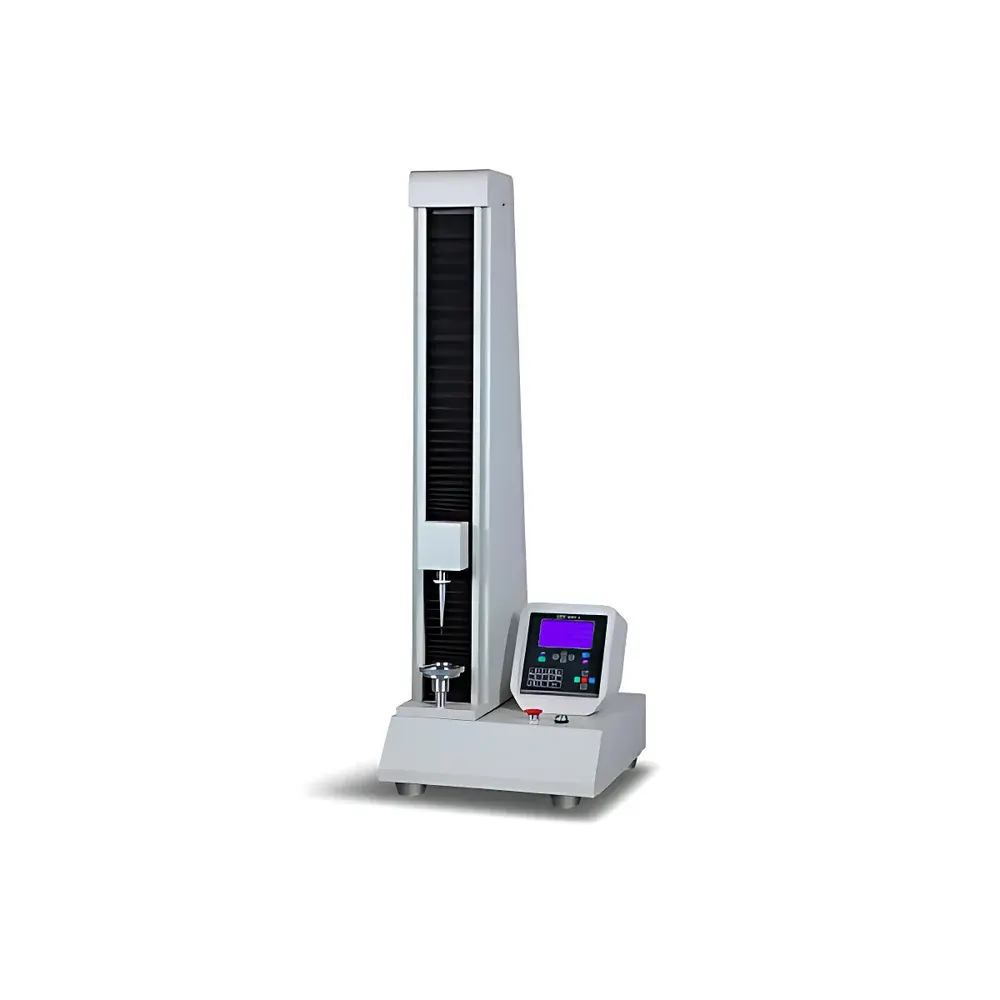
GBPI GBH-4A Electronic Tensile Testing Machine
| Brand | GBPI |
|---|---|
| Origin | Guangdong, China |
| Manufacturer Type | Direct Manufacturer |
| Model | GBH-4A |
| Maximum Test Force | 1.5 kN |
| Force Range | 0–500 N (optional 0–1500 N) |
| Extension Capacity | up to 1400% |
| Force Accuracy | ±0.5% of reading (Class 0.5) |
| Crosshead Travel | 750 mm |
| Displacement Resolution | ±0.5% of reading |
| Test Speed | 0–500 mm/min, continuously variable |
| Effective Specimen Width | 30 mm (customizable to 50 mm) |
| Power Supply | AC 220 V, 50 Hz |
| Rated Power | 1000 W |
| Net Weight | 70 kg |
| Dimensions (W×D×H) | 600 × 600 × 1300 mm |
Overview
The GBPI GBH-4A Electronic Tensile Testing Machine is a precision-engineered single-column universal testing system designed for static mechanical property evaluation of flexible and semi-rigid materials in research laboratories, quality control departments, and regulatory compliance environments. It operates on the principle of controlled uniaxial force application via a high-stiffness ball-screw-driven crosshead, coupled with real-time load and displacement transduction using calibrated strain-gauge-based load cells and digital encoder feedback. The instrument complies with fundamental metrological requirements defined in JJG 139 (Chinese Verification Regulation for Universal Testing Machines) and supports full traceability under ISO/IEC 17025-accredited calibration frameworks. Its architecture integrates a digitally synchronized servo-motor control loop, enabling stable low-speed creep testing (<1 mm/min) and high-speed dynamic rupture analysis (up to 500 mm/min), all within a compact desktop footprint optimized for space-constrained lab settings.
Key Features
- Class 0.5 force measurement accuracy per GB/T 228.1 and ASTM E4 — verified across the full 0–500 N range (extendable to 0–1500 N with optional load cell)
- Dual-mode control architecture: internal embedded controller (standalone operation) or external PC-based interface via RS232 serial communication
- High-resolution displacement sensing with ±0.5% linearity error over 750 mm travel — achieved through optical encoder feedback on the precision-ground ball screw
- Modular fixture ecosystem: standard tensile grips (30 mm width), puncture fixtures, right-angle tear blades, heat-seal testers, and optional pneumatic clamping systems for repeatable specimen alignment
- Real-time data acquisition at 100 Hz sampling rate — ensuring fidelity in transient event capture (e.g., yield point, necking onset, fracture)
- Comprehensive safety subsystems including mechanical limit switches, overload cut-off, emergency stop circuitry, and software-enforced operational boundaries
- Energy-efficient AC servo drive system with zero positional drift during dwell periods — critical for long-duration relaxation or creep protocols
- Open data structure supporting direct export to CSV/Excel formats; native support for GLP-compliant audit trails when used with validated software configurations
Sample Compatibility & Compliance
The GBH-4A accommodates specimens ranging from thin polymer films (≥12 µm) to laminated pharmaceutical foils, nonwovens, elastomeric sheets, and paperboard substrates. Standard test widths (30 mm) align with ISO 37, ASTM D882, and GB/T 1040.1 requirements for film tensile characterization. Optional 50 mm jaw sets enable compliance with ASTM D828 (paper tearing) and GB/T 453 (burst strength correlation). The system satisfies mandatory verification criteria outlined in JJG 139 and supports routine performance qualification per ISO 17025 Annex A.2 for accredited testing laboratories. All mechanical components meet RoHS Directive 2011/65/EU material restrictions, and electrical design conforms to IEC 61000-6-3 EMC emission standards.
Software & Data Management
The included Windows-compatible software provides ISO 17025-aligned data handling: automatic timestamping, user-defined operator ID logging, version-controlled method templates, and electronic signature-capable report generation. Raw force-displacement curves are stored in binary format with metadata embedding (test speed, gauge length, environmental temperature/humidity if externally linked). Curve overlay functionality allows comparative analysis across batches or material grades. Statistical modules compute tensile strength, elongation at break, Young’s modulus, yield stress, and tear propagation energy per ASTM D1938 or GB/T 2791. Audit trail records include all parameter changes, calibration events, and report exports — fully compliant with FDA 21 CFR Part 11 when deployed with validated Windows OS configurations and domain-authenticated user accounts.
Applications
- Quantitative assessment of seal integrity in flexible packaging (ASTM F88, GB/T 2792)
- Evaluation of puncture resistance for medical pouches (ISO 11607-2, YBB00112003)
- Tensile property mapping of biodegradable films under accelerated aging conditions (GB/T 16578.1)
- Peel adhesion testing of pressure-sensitive tapes (ASTM D3330, GB/T 7122)
- Mechanical screening of lithium-ion battery separator membranes (GB/T 36235)
- Teaching laboratory implementation for materials science curricula requiring hands-on stress-strain experimentation (GB/T 17200)
FAQ
Does the GBH-4A support GLP-compliant data archiving?
Yes — when configured with validated software and networked Windows environments, it maintains full audit trails, electronic signatures, and immutable raw data storage per OECD GLP Principles.
Can the system be integrated into an existing LIMS platform?
Yes — ASCII-based data export (CSV/TXT) and RS232 protocol support enable bidirectional integration with common LIMS vendors via middleware or custom API adapters.
What calibration documentation is provided upon delivery?
Each unit ships with a factory calibration certificate traceable to NIM (National Institute of Metrology, China) standards, including as-found/as-left verification reports for both load and displacement channels.
Is third-party ISO 17025 accreditation support available?
GBPI provides technical documentation packages (IQ/OQ protocols, uncertainty budgets, and maintenance logs) required for laboratory accreditation audits.
How is thermal drift compensated during extended tests?
The load cell incorporates temperature-compensated strain gauges, and the control firmware applies real-time thermal offset correction algorithms based on internal sensor feedback.



