
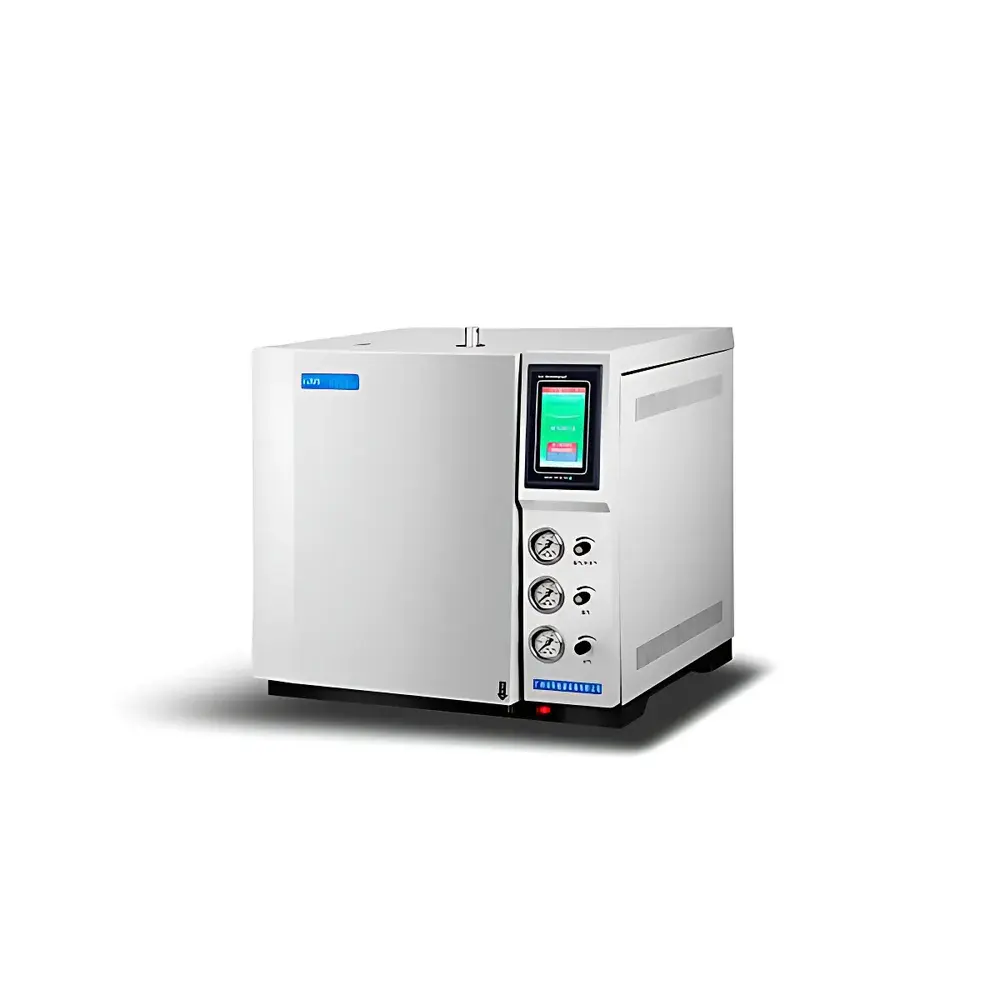
GBPI GC-9802C Laboratory Gas Chromatograph
| Brand | GBPI |
|---|---|
| Origin | Guangdong, China |
| Manufacturer Type | Direct Manufacturer |
| Instrument Type | Benchtop Laboratory Gas Chromatograph |
| Application Scope | General-Purpose Organic Solvent Analysis |
| Oven Temperature Range | 40–400 °C |
| Maximum Ramp Rate | 0–40 °C/min |
| Cooling Rate | 450 °C → 50 °C in ~6 min |
| Carrier Gas Flow Control Range | 0–1200 mL/min |
| Carrier Gas Pressure Control Range | 0–970 kPa |
| Injector Maximum Operating Temperature | 400 °C |
| Injector Total Flow Setting Range | 0–1200 mL/min |
| Detector | FID (Hydrogen Flame Ionization Detector), Mt ≤ 1×10⁻¹¹ g/s (n-hexadecane), Baseline Drift ≤ 0.02 mV/h, Noise ≤ 0.02 mV |
| Column | OV-1701 Capillary Column (50 m × 0.32 mm ID × 0.5 µm film thickness), Max Temp: 400 °C |
| Display | Integrated LCD with Real-Time Temperature Monitoring |
| Data System | PC-Based Workstation with Chromatographic Acquisition & Quantitative Analysis Software |
| Compliance | QBT 2929, GB/T 10004–2008, YBB 00132002 |
Overview
The GBPI GC-9802C is a benchtop laboratory gas chromatograph engineered for precision, reproducibility, and operational robustness in routine organic solvent analysis. It employs partition-based separation via capillary column chromatography, where volatile and semi-volatile analytes are vaporized, carried through a temperature-programmable column by an inert carrier gas (typically high-purity nitrogen), and differentially retained based on polarity, molecular weight, and interaction with the stationary phase (e.g., OV-1701). Detection occurs via hydrogen flame ionization (FID), offering wide linear dynamic range (10⁷), low detection limits (~10⁻¹¹ g/s), and exceptional stability for quantitative assessment of residual solvents, purity profiles, and compositional ratios. Designed for compliance-driven environments—including packaging QC labs, pharmaceutical excipient testing, and environmental monitoring—the GC-9802C delivers trace-level resolution without requiring cryogenic cooling or complex automation.
Key Features
- Programmable oven with ±0.1 °C temperature accuracy and 0.1 °C resolution, supporting multi-step ramping up to 40 °C/min and rapid cooling from 450 °C to 50 °C in approximately six minutes.
- Dual independent pressure and flow control for carrier, makeup, and detector gases—enabling precise retention time reproducibility and method transfer across instruments.
- FID detector with built-in auto-ignition, real-time baseline compensation, and configurable H₂/air/N₂ ratios optimized for sensitivity and signal-to-noise ratio.
- Modular single-unit chassis design minimizes thermal mass interference and simplifies field maintenance; all critical components—including injector, column oven, and detector—are accessible without disassembly.
- Integrated 4.3-inch LCD interface displaying real-time oven, injector, and detector temperatures, along with system status indicators (e.g., flame status, pressure alarms, error codes).
- Comprehensive hardware safety architecture: dual overtemperature protection (software-controlled ramp limit + independent thermal cutoff), gas leak detection circuitry, and automatic shutdown on flame-out or pressure deviation beyond ±5% setpoint.
- Low-noise pneumatic and electronic subsystems reduce acoustic emissions to <45 dB(A) at 1 m—suitable for shared laboratory spaces without dedicated sound-dampened enclosures.
Sample Compatibility & Compliance
The GC-9802C is validated for direct injection of liquid samples containing volatile organic compounds (VOCs) including alcohols, esters, ketones, hydrocarbons, chlorinated solvents, and aromatic compounds. It supports headspace analysis (with optional autosampler integration), split/splitless injection modes, and compatibility with standard 0.32 mm ID fused-silica capillary columns up to 60 m length. The instrument meets Chinese national and industry standards relevant to packaging material testing (QBT 2929 for residual solvents in plastic films; GB/T 10004–2008 for composite packaging; YBB 00132002 for pharmaceutical packaging), and its data acquisition architecture supports audit-ready workflows aligned with GLP principles. While not pre-certified for FDA 21 CFR Part 11, the workstation software allows configuration of user roles, electronic signatures, and immutable audit trails when deployed under controlled IT governance.
Software & Data Management
The GC-9802C operates with GBPI ChromaView Pro—a Windows-based chromatography data system (CDS) compliant with ISO/IEC 17025 documentation requirements. It provides real-time chromatogram visualization with adjustable scaling, overlay comparison, peak integration using tangent skim or valley-to-valley algorithms, and customizable calibration curves (linear, quadratic, or weighted). Raw data files (.cdf) retain full acquisition metadata—including timestamps, method parameters, and detector voltage logs—for retrospective reprocessing. Reports are exportable in PDF, CSV, and Excel formats, with embedded instrument identification, analyst name, sample ID, and pass/fail flags against predefined specification limits. Optional add-ons include spectral library search (NIST-compatible), sequence batch processing, and LIMS connectivity via ASTM E1384-compliant XML export.
Applications
- Quantification of residual solvents in flexible packaging films, laminates, and coated papers per ISO 10936 and GB/T 10004–2008.
- Purity verification of industrial-grade acetone, ethanol, ethyl acetate, toluene, and xylene used in pharmaceutical manufacturing and ink formulation.
- Batch release testing of cleaning agents and degreasers for VOC content prior to use in cleanroom environments.
- Environmental monitoring of air and water extracts for EPA Method 8260B-targeted compounds (e.g., benzene, chloroform, styrene).
- Academic research in polymer science, where solvent retention kinetics and diffusion coefficients are derived from calibrated elution profiles.
- Forensic analysis of ignitable liquid residues in fire debris samples following ASTM E1618 protocols.
FAQ
What types of detectors can be installed on the GC-9802C?
The base configuration includes an FID. Optional detectors—such as TCD (thermal conductivity), ECD (electron capture), or NPD (nitrogen-phosphorus)—can be retrofitted subject to mechanical and electrical compatibility verification.
Is the instrument compatible with third-party chromatography columns?
Yes—it accepts standard 1/4″ or 1/8″ fittings and supports all commercially available fused-silica capillary columns with maximum operating temperatures up to 400 °C.
Does the system support unattended operation?
Manual injection is standard; however, the GC-9802C features RS-232 and USB interfaces enabling integration with external autosamplers (e.g., CTC PAL or Gerstel MPS) via OEM-defined command protocols.
Can raw chromatographic data be exported for regulatory submission?
Yes—raw .CDF files contain full acquisition metadata and are fully portable. When combined with configured audit trails and electronic signatures, they satisfy data integrity expectations under ALCOA+ principles.
What maintenance intervals are recommended for optimal performance?
FID jet cleaning every 200 injections; column trimming every 3–6 months depending on sample matrix cleanliness; carrier gas filter replacement every 6 months; annual calibration verification using certified reference standards (e.g., n-alkane mixtures).




