
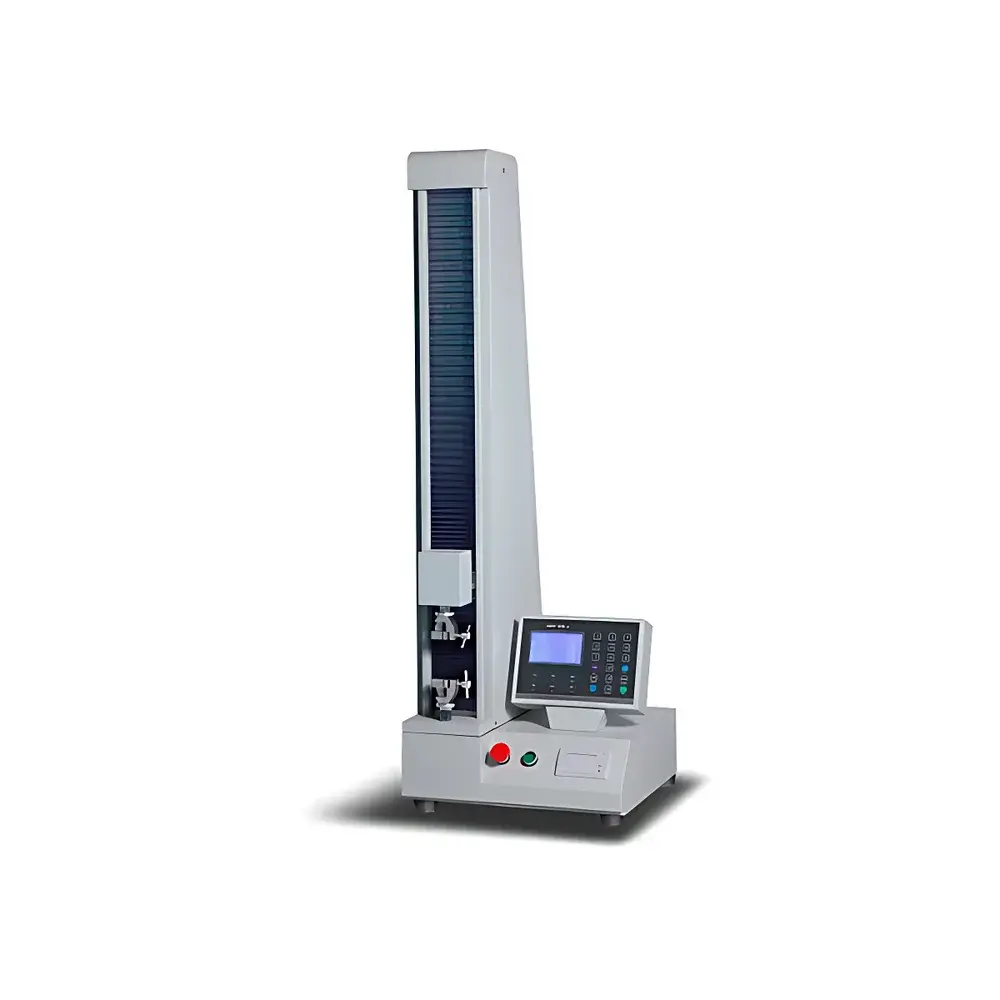
GBPI GBL-H4 Single-Column Electronic Tensile Testing Machine for Plastic Films and Flexible Packaging Materials
| Brand | GBPI |
|---|---|
| Origin | Guangdong, China |
| Manufacturer Type | Direct Manufacturer |
| Model | GBL-H4 |
| Maximum Test Load | 0.5 kN |
| Force Range | 0–300 N (optional 0–500 N) |
| Elongation Capacity | up to 1400% |
| Force Accuracy | ±1% of reading (Class 1) |
| Crosshead Travel | 700 mm |
| Displacement Resolution | ±1% of reading |
| Effective Sample Width | 30 mm (customizable to 50 mm) |
| Test Speed | 0–500 mm/min, continuously variable |
| Sampling Rate | 50 Hz |
| Power Supply | AC 220 V, 50 Hz |
| Power Consumption | 300 W |
| Dimensions (W×D×H) | 600 × 500 × 1300 mm |
| Weight | 65 kg |
Overview
The GBPI GBL-H4 is a single-column, microprocessor-controlled electronic tensile testing machine engineered for precision mechanical characterization of thin, flexible materials commonly used in packaging, medical device, pharmaceutical, and consumer goods industries. It operates on the fundamental principle of uniaxial tensile loading—applying controlled, linear force to a standardized specimen while simultaneously measuring load response and axial displacement. Designed in strict compliance with international mechanical testing standards—including ASTM D882 (tensile properties of thin plastic sheeting), ASTM F88 (seal strength of flexible barrier materials), ISO 527-3 (plastics—determination of tensile properties—films and sheets), and numerous Chinese national standards (e.g., GB/T 1040.3, GB/T 2792, YBB00112003)—the GBL-H4 delivers traceable, repeatable, and auditable data suitable for QC release, R&D validation, and regulatory submission workflows.
Key Features
- Modular multi-function testing capability: supports tensile, peel (90° and 180°), heat seal strength, tear (including trouser and Elmendorf methods), puncture, and burst testing—all within a single platform via interchangeable fixtures.
- High-fidelity real-time acquisition: 50 Hz sampling rate ensures accurate capture of transient force peaks and deformation events, critical for evaluating brittle fracture, adhesive debonding, or viscoelastic relaxation behavior.
- Intuitive human-machine interface: backlit LCD display presents live load–displacement curves, peak force, elongation at break, modulus (secant/tangent), and energy-to-break—without requiring external software during routine operation.
- Integrated thermal printer: generates immediate hard-copy reports compliant with GLP documentation requirements, including test ID, date/time stamp, operator ID, sample ID, and raw curve snapshot.
- Robust mechanical architecture: precision-ground lead screws, high-rigidity aluminum alloy frame, and imported load cell (ISO 7500-1 Class 1 certified) ensure long-term stability and minimal hysteresis across the full force range.
- Comprehensive safety system: includes emergency stop button, mechanical limit switches, and software-enforced upper/lower travel boundaries—meeting IEC 61000-6-2 EMC and EN 61010-1 safety directives for laboratory equipment.
Sample Compatibility & Compliance
The GBL-H4 accommodates specimens up to 50 mm wide and 700 mm effective travel length, making it ideal for ASTM D882-compliant film strips (15 mm × 150 mm), heat-sealed pouches per ASTM F88, and peel substrates per ASTM D3330. Its 30 mm standard jaw width aligns with GB/T 2792 and ISO 8510-2 for adhesive tape testing. All mechanical and electrical design elements conform to JJG 139 (Chinese metrological verification regulation for tensile testing machines), ensuring suitability for accredited calibration laboratories. The system supports audit-ready traceability through optional calibration certificates (NIST-traceable load cell and extensometer verification), and its firmware architecture enables secure user access control—essential for FDA 21 CFR Part 11–compliant environments when paired with validated PC-based software.
Software & Data Management
The included Windows-compatible software (delivered on 4 GB USB drive) provides advanced post-test analysis: automatic yield point detection, stress–strain curve derivation, statistical batch reporting (mean, SD, CV%), and export to CSV, PDF, or XML formats. Data integrity safeguards include electronic signatures, immutable audit trails, and password-protected method templates—fully aligned with ISO/IEC 17025 and GMP Annex 11 requirements. Optional integration with LIMS platforms is supported via RS232 serial protocol (standard) or TCP/IP Ethernet (upon request). All software modules undergo annual regression testing to maintain compatibility with Windows 7–11 LTS versions.
Applications
This instrument serves as a primary mechanical testing solution across regulated and non-regulated sectors: evaluating seal integrity of blister packs and sachets (pharma/biotech); quantifying puncture resistance of medical gowns and sterile barrier systems; validating tensile strength retention of biodegradable films under accelerated aging; verifying peel adhesion consistency of labelstocks and pressure-sensitive tapes; and characterizing tear propagation resistance in multilayer laminates used in food packaging. Its compact footprint and ergonomic tabletop configuration enable seamless deployment in QC labs, pilot production lines, and university materials science teaching facilities.
FAQ
What standards does the GBL-H4 comply with?
It meets over 30 national and international standards, including GB/T 1040.3, ASTM D882, ASTM F88, ISO 527-3, and YBB pharmaceutical packaging standards—validated via built-in test method libraries.
Can the system be calibrated to meet ISO/IEC 17025 requirements?
Yes—optional NIST-traceable calibration certificates and uncertainty budgets are available for both load cell and displacement measurement subsystems.
Is the software compliant with FDA 21 CFR Part 11?
The standalone software is not Part 11–certified out-of-the-box; however, a validated version with electronic signature, audit trail, and role-based access control is available under separate qualification protocol.
What is the maximum specimen thickness the standard grips can accommodate?
Standard pneumatic or manual wedge grips accept specimens up to 2.5 mm thick; custom jaws for thicker composites or foams are offered as optional accessories.
Does the system support automated test sequencing for unattended operation?
Yes—the software supports programmable multi-step tests (e.g., pre-load → dwell → ramp → hold → return) with conditional logic and pass/fail criteria based on real-time parameter thresholds.



