
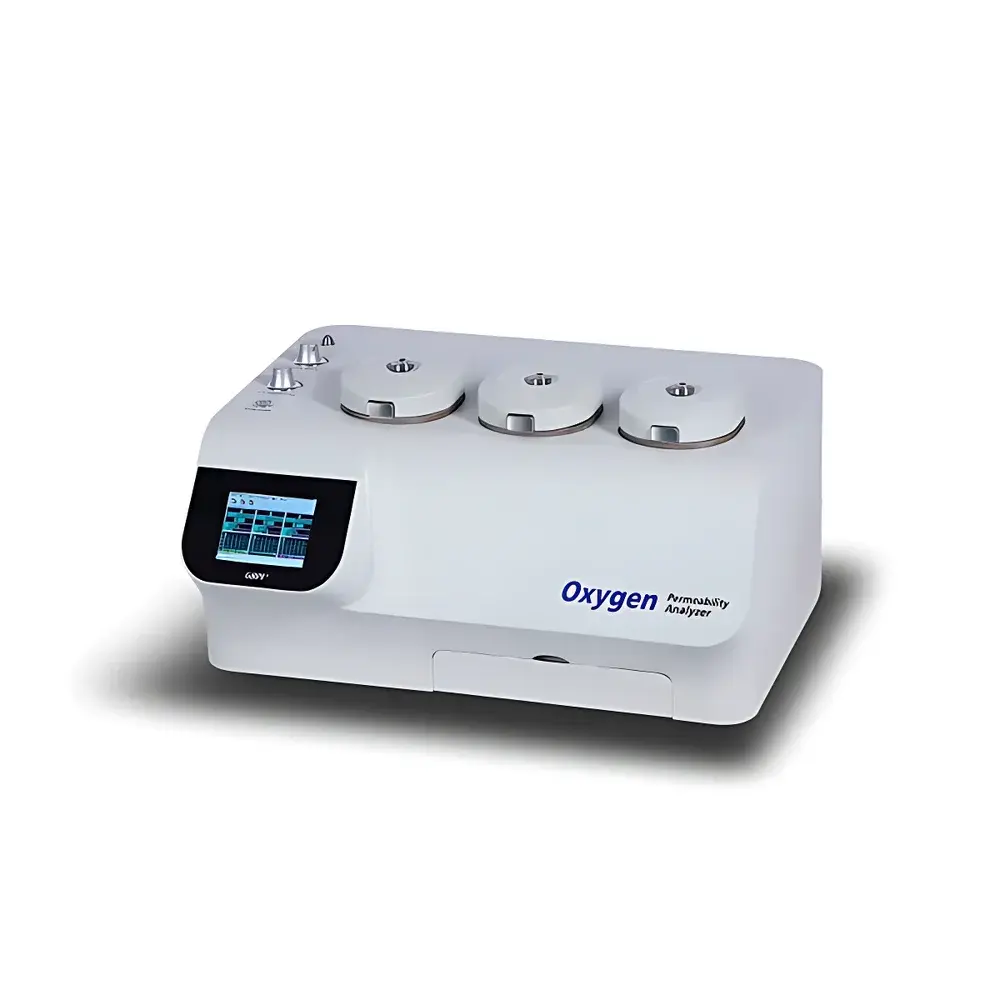
GBPI Y310P Oxygen Transmission Rate (OTR) Tester for Pharmaceutical and Food Packaging Films
| Brand | GBPI |
|---|---|
| Origin | Guangdong, China |
| Manufacturer | GBPI Packaging Instruments Co., Ltd. |
| Model | Y310P |
| Test Range | 0.02–16,500 cm³/(m²·24h) (film) |
| O₂ Resolution | 0.001 cm³/(m²·24h) |
| Temperature Control | 15–45 °C (5–50 °C optional), ±0.1 °C accuracy |
| Humidity Control | 30–90% RH (100% RH optional), ±1% RH accuracy |
| Test Area | 50.24 cm² |
| Specimen Size | Ø100 mm |
| Max Thickness | ≤3 mm |
| Sample Capacity | 1–3 independent chambers |
| Carrier Gas Pressure | 0.1–0.2 MPa |
| Power | 750 W, AC 220 V, 50 Hz |
| Dimensions | 700 × 560 × 370 mm |
| Weight | 100 kg |
Overview
The GBPI Y310P Oxygen Transmission Rate (OTR) Tester is a gravimetric- and coulometric-based instrument engineered for precise, traceable, and compliant measurement of oxygen permeability through flexible barrier materials used in pharmaceutical, food, medical device, and electronics packaging. It operates on the principle of dynamic gas transmission under controlled temperature and relative humidity conditions, utilizing a calibrated electrochemical oxygen sensor to quantify real-time O₂ flux across a sealed test specimen. The system conforms to the fundamental mass transport model described in ASTM F1307 and ISO 15105-2, where oxygen permeation is determined by measuring the steady-state concentration gradient across the film under defined partial pressure differentials. Designed for regulatory-grade applications, the Y310P supports both film/sheet testing and container-level OTR evaluation via modular accessories—enabling direct assessment of bottles, pouches, trays, and blister cavities per ASTM F2622 and ASTM F1927.
Key Features
- Triple-chamber independent testing architecture: Each chamber operates autonomously with individual start/stop control, enabling concurrent analysis of up to three dissimilar specimens and generation of three discrete, audit-ready reports.
- High-resolution coulometric oxygen sensor (imported, long-life design): Delivers detection sensitivity down to 0.001 cm³/(m²·24h), validated for ultra-high-barrier materials including aluminum foil, SiOₓ-coated PET, and multilayer laminates.
- Dual-stream humidity control system: Precisely blends dry and saturated nitrogen streams to achieve stable, repeatable RH setpoints from 30% to 100% RH (±1% RH tolerance), critical for evaluating hygroscopic polymers such as EVOH and PVDC.
- Electromagnetic step-programmable temperature control: Maintains thermal stability within ±0.1 °C across 15–45 °C (optional 5–50 °C range), minimizing thermal drift during extended 24–168 h permeation cycles.
- ARM-based embedded controller: Enables full instrument operation without host PC dependency—including real-time curve logging, method execution, and pass/fail evaluation—enhancing lab workflow continuity and cybersecurity resilience.
- GMP-aligned software architecture: Compliant with Annex 11 (EU GMP) and FDA 21 CFR Part 11 requirements, featuring role-based access control (administrator, operator, reviewer), electronic signatures, and immutable audit trails for all system events, method changes, and data modifications.
Sample Compatibility & Compliance
The Y310P accommodates flat specimens (films, foils, sheets, laminates) up to 3 mm thick and Ø100 mm in diameter, as well as rigid and semi-rigid containers (bottles, cups, blister packs, stand-up pouches) when fitted with optional permeation fixtures. Its mechanical sealing interface ensures leak-tight integrity across diverse surface geometries and material compliances—from brittle ceramic substrates to elastic hydrogel films. Regulatory alignment includes full support for pharmacopoeial standards: YBB00082003-2015 (Chinese Pharmacopoeia), USP , and ISO 15105-2; food contact compliance per GB/T 19789-2005 and ASTM D3985; and industrial barrier validation per DIN 53380-3 and JIS K-7126-B. All hardware and firmware are traceably calibrated using NIST-traceable reference standards certified by the National Institute of Metrology (China) under GBW(E)130497/8.
Software & Data Management
GBPI OTR Studio v4.2 is a Windows-native application built on a SQL Server Express backend, supporting automated report generation in PDF, Excel, and Word formats with configurable templates. Real-time visualization includes synchronized plots of OTR, O₂ concentration, temperature, and RH—each scalable, draggable, and toggleable for comparative overlay analysis. Raw data are stored in encrypted, timestamped records with automatic backup to network drives or NAS. The software enforces ALCOA+ principles: Attributable, Legible, Contemporaneous, Original, Accurate, Complete, Consistent, Enduring, and Available. Audit trail entries log user login/logout, method parameter edits, calibration events, and result approvals—including IP address, workstation ID, and digital signature metadata.
Applications
- Pharmaceutical primary packaging qualification: OTR validation of cold-form blisters, Alu-Alu laminates, and child-resistant pouches per ICH Q5C stability protocols.
- Food packaging shelf-life modeling: Quantification of O₂ ingress into retort pouches, vacuum-sealed meat trays, and modified-atmosphere packaging (MAP) films.
- Medical device packaging integrity: Barrier performance verification of Tyvek®/PET-PE pouches, sterilization wrap composites, and transdermal patch backing layers.
- Advanced materials R&D: Permeability screening of graphene-enhanced PE, biodegradable PLA-PBAT blends, and OLED encapsulation barriers.
- Regulatory submission support: Generation of GLP-compliant datasets for FDA 510(k), CE Marking technical files, and PMDA dossier submissions.
FAQ
What calibration standards are supported?
The Y310P accepts both certified reference films (e.g., 125 µm LDPE standard membrane) and certified O₂/N₂ gas mixtures (99.999% purity) for dual-mode verification. Calibration routines are fully guided within the software interface.
Is container testing possible without modification?
No—container testing requires optional permeation fixtures (e.g., bottle adapter kits, pouch clamping modules) and must be configured in the method editor prior to run initiation.
Does the system meet 21 CFR Part 11 requirements?
Yes. Full electronic signature capability, audit trail integrity, and role-based permissions are implemented at firmware and application layers, with third-party validation documentation available upon request.
What maintenance intervals are recommended?
Oxygen sensor replacement every 18–24 months under normal use; annual recalibration against certified standards; quarterly verification of humidity generator output and temperature uniformity across test chambers.
Can test data be exported to LIMS?
Yes—via CSV or XML export with configurable field mapping; optional OPC UA or REST API integration is available under enterprise licensing.





