
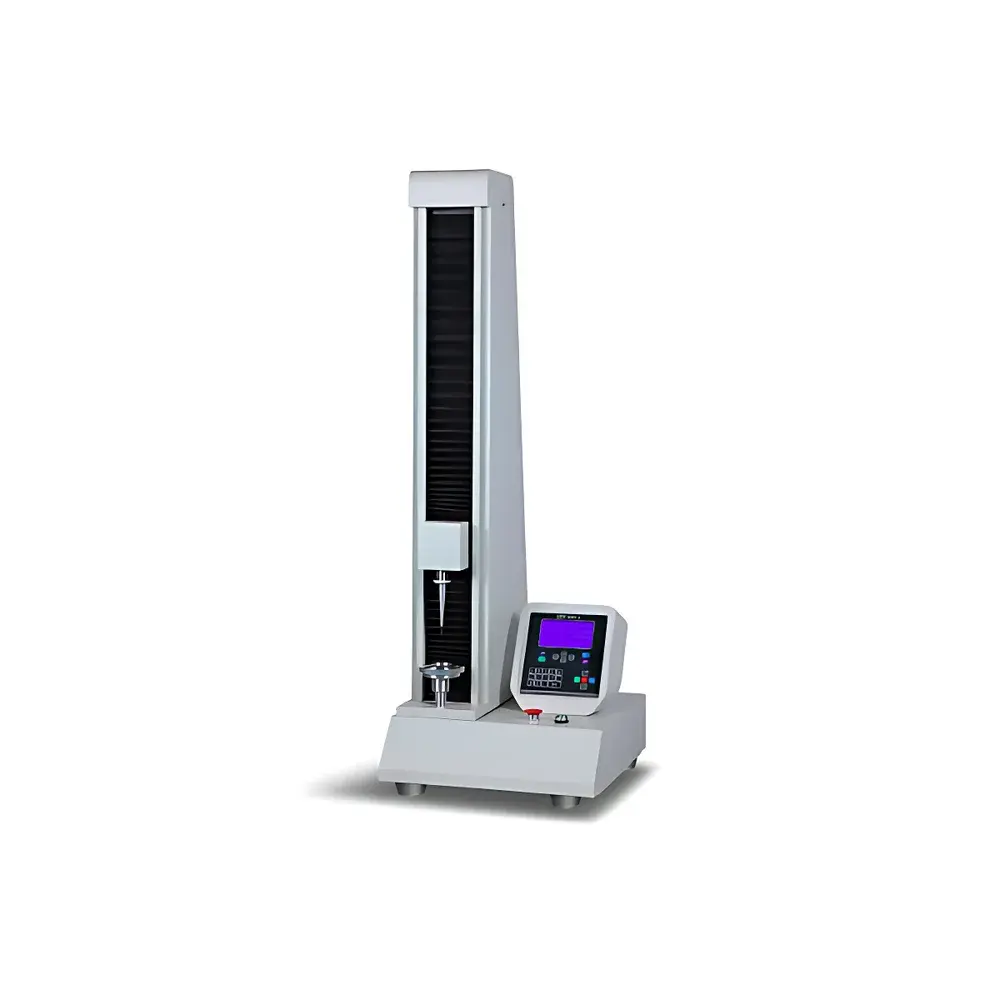
GBPI GBH-1I Advanced Single-Column Electromechanical Tensile Testing Machine
| Brand | GBPI |
|---|---|
| Origin | Guangdong, China |
| Manufacturer Type | Direct Manufacturer |
| Model | GBH-1I |
| Max Load Capacity | 1.5 kN |
| Force Range | 0–500 N (optional 0–1500 N) |
| Force Accuracy | ±0.5% of reading (Class 0.5) |
| Elongation Capacity | up to 1400% |
| Crosshead Travel | 750 mm |
| Displacement Resolution | ±0.5% of reading |
| Test Speed | 0–500 mm/min, continuously variable |
| Effective Specimen Width | 30 mm (customizable to 50 mm) |
| Dimensions (W×D×H) | 600 × 600 × 1300 mm |
| Weight | 70 kg |
| Power Supply | AC 220 V, 50 Hz, 1000 W |
Overview
The GBPI GBH-1I is a high-precision, single-column electromechanical tensile testing machine engineered for routine and research-grade mechanical property evaluation of flexible packaging materials and thin-sheet specimens. It operates on the fundamental principle of controlled uniaxial force application via a digitally regulated servo-motor-driven ball-screw actuation system, enabling precise load control, displacement tracking, and real-time stress–strain curve generation. Designed in strict compliance with international mechanical testing standards—including ASTM E4 (load verification), ASTM D882 (tensile properties of thin plastic sheeting), ISO 37 (rubber vulcanized or thermoplastic), and multiple Chinese national standards (e.g., GB/T 1040, GB/T 8808, GB/T 2792)—the GBH-1I delivers traceable, reproducible results suitable for quality assurance, regulatory submission, and academic investigation. Its rigid dual-post desktop architecture ensures structural stability during high-speed or high-elongation tests, while its modular hardware design supports seamless integration into GLP-compliant laboratory workflows.
Key Features
- Continuously variable crosshead speed from 0 to 500 mm/min—enabling precise matching to material deformation kinetics across ductile, brittle, and viscoelastic regimes.
- Class 0.5 force measurement accuracy (±0.5% of reading) validated per ISO 7500-1 and ASTM E4, supported by high-resolution load cell signal conditioning and auto-zero drift compensation.
- Digital servo control system with 100 Hz data acquisition rate ensures high-fidelity capture of peak loads, yield points, and fracture events—even during rapid tearing or burst tests.
- Multi-function test capability: tensile, peel (90°/180°), tear (Elmendorf, trouser, straight-edge), puncture, compression, flexural, and shear—configured via intuitive software-defined test protocols.
- Modular transducer support: accommodates up to four independent load or displacement channels; compatible with optional pneumatic clamps, environmental chambers, and extensometers.
- Two deployment options: integrated controller (compact, space-saving) or external control unit (facilitates standalone operation and future firmware/hardware upgrades).
- Comprehensive safety architecture: hardware-based emergency stop, mechanical limit switches, overload cut-off, and software-enforced travel boundaries ensure operator and equipment protection.
- High-rigidity ball-screw transmission system with preloaded linear guides minimizes backlash and thermal drift—critical for long-duration creep or relaxation studies.
Sample Compatibility & Compliance
The GBH-1I is optimized for specimens ≤1.5 mm thick and ≤50 mm wide, including polymeric films (PET, PE, PP, BOPP), laminated structures (aluminum foil/paper/plastic composites), medical packaging (sterile barrier systems), adhesive tapes, nonwovens, rubber sheets, and paperboard substrates. It meets mandatory metrological requirements under JJG 139 (Chinese verification regulation for universal testing machines) and supports audit-ready documentation for ISO/IEC 17025-accredited labs. All test methods align with FDA-relevant packaging performance criteria (e.g., YBB pharmaceutical packaging standards) and are fully traceable to NIST-traceable force calibration artifacts. The system’s architecture permits full compliance with 21 CFR Part 11 when paired with validated software—supporting electronic signatures, audit trails, and user access controls.
Software & Data Management
The embedded Windows-based testing software provides ISO 17025-aligned data integrity features: automatic timestamped test logs, raw-data export in CSV/Excel format, customizable report templates (PDF/HTML), and overlay-capable multi-curve comparison. All measurements—load, displacement, time, strain rate—are stored with metadata (operator ID, calibration date, environmental conditions). The open API allows integration with LIMS or MES platforms. Raw waveform data is retained at full 100 Hz resolution, enabling post-test reanalysis of transient phenomena such as necking onset or adhesive failure propagation. Calibration certificates, uncertainty budgets, and method validation records can be archived within the software’s secure document vault.
Applications
- Quality control of flexible packaging integrity: seal strength (ASTM F88), peel adhesion (ASTM D903), puncture resistance (ASTM F1306), and tear propagation (ASTM D1938).
- Regulatory testing for pharmaceutical primary packaging (YBB standards), food contact materials (GB 4850), and medical device pouches (ISO 11607).
- Material development R&D: tensile modulus, elongation at break, yield stress, and energy-to-break quantification per GB/T 1040.1–2018 and ISO 527-1.
- Educational laboratories: hands-on instruction in mechanical behavior of polymers, interfacial adhesion mechanics, and standardization principles.
- Contract testing services requiring auditable, repeatable, and statistically robust datasets for client submissions.
FAQ
What standards does the GBH-1I support out-of-the-box?
It includes preloaded test methods for all referenced GB, ASTM, ISO, JIS, and YBB standards listed in the technical documentation—no custom scripting required.
Can the system be calibrated externally?
Yes. The load cell and displacement encoder are designed for third-party calibration using NIST-traceable deadweight and laser interferometry standards.
Is FDA 21 CFR Part 11 compliance available?
Full compliance is achievable with optional software validation package, including electronic signature modules, audit trail configuration, and role-based access control.
What maintenance is required for long-term accuracy?
Annual verification per ASTM E74 and ISO 7500-1 is recommended; routine checks include ball-screw lubrication, clamp jaw alignment, and encoder zero-point validation.
Does the GBH-1I support automated batch testing?
Yes—through scriptable test sequences, barcode-triggered specimen identification, and scheduled auto-export to network drives or cloud repositories.



