
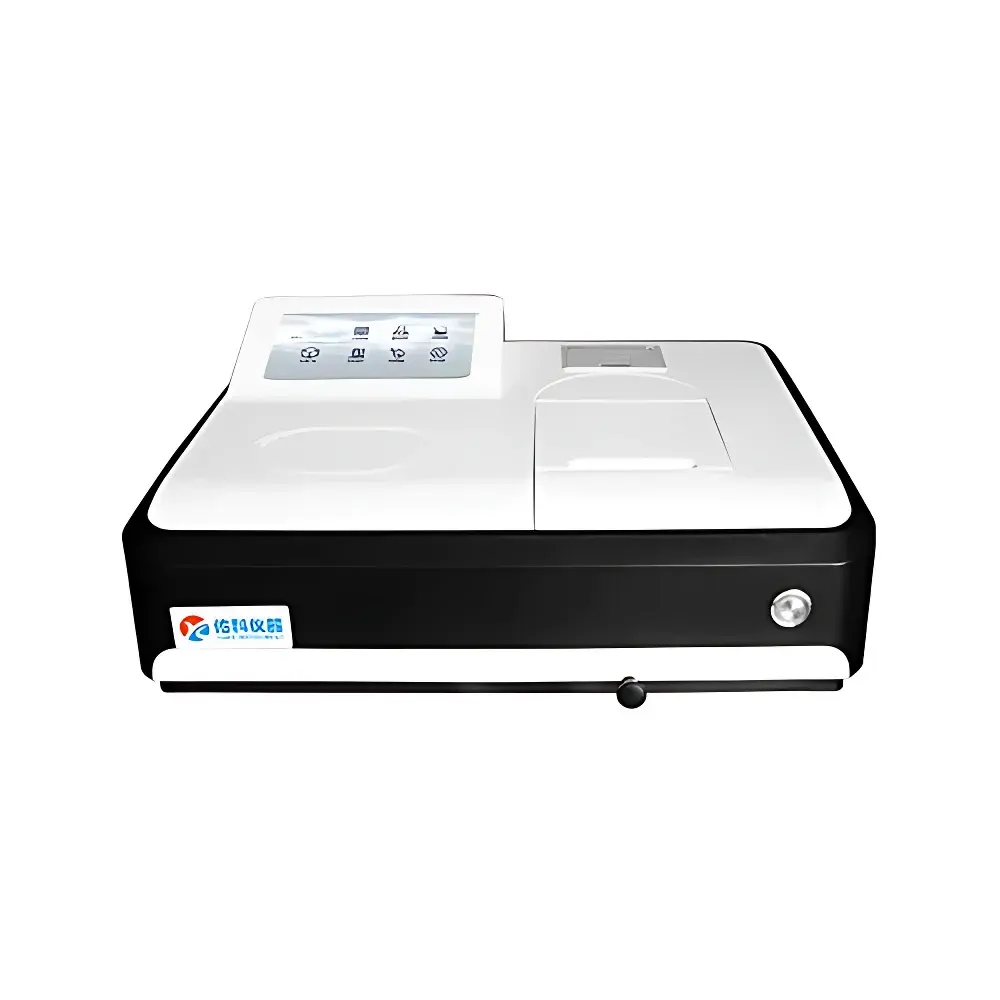
Yoke IT1000HCHO(K) Formaldehyde Analyzer
| Brand | Yoke |
|---|---|
| Origin | Shanghai, China |
| Manufacturer Type | OEM/ODM Manufacturer |
| Country of Origin | China |
| Model | IT1000HCHO(K) |
| Measurement Principle | Photometric Method (Acetylacetone Chromogenic Reaction) |
| Measurement Range | 0.01–2 mg/m³ |
| Sampling Method | Integrated Air Sampler (Passive/Active Mode) |
| Response Time | < 15 min (including color development and measurement) |
| Operating Temperature | 25 °C (calibration reference temperature) |
| Display | 5.6-inch TFT Color Touchscreen |
| Data Storage | ≥5000 records |
| Pre-installed Calibration Curves | 5 factory curves + 195 user-expandable curves |
| Light Source | Cold LED with Narrow-band Interference Filter (Lifespan ≥100,000 h) |
| Microprocessor | ARM9 core |
| Internal Memory | 512 MB |
| Interfaces | USB 2.0, RS-232 |
| Printer | Built-in Thermal Printer |
| Compliance Standard | GB/T 15516–1995 |
Overview
The Yoke IT1000HCHO(K) Formaldehyde Analyzer is a portable, laboratory-grade photometric instrument engineered for quantitative determination of gaseous formaldehyde (HCHO) in ambient air, indoor environments, and occupational settings. It operates on the internationally recognized acetylacetone chromogenic reaction—where formaldehyde reacts with acetylacetone under acidic conditions and heat to form a stable yellow-colored derivative (3,5-diacetyl-1,4-dihydrolutidine), measurable at 412 nm via spectrophotometry. This method is standardized in GB/T 15516–1995 and aligns with the analytical principles referenced in ISO 16000-23 (Indoor air — Part 23: Determination of formaldehyde) and ASTM D5197–22 (Standard Test Method for Determination of Formaldehyde in Air by Active Sampling onto Solid Sorbent, Thermal Desorption, and Quantitative Analysis by Gas Chromatography). The system integrates an internal air sampling module, precision optical path design, and temperature-controlled reaction chamber to ensure reproducible colorimetric development under controlled 25 °C calibration conditions.
Key Features
- 5.6-inch high-resolution TFT color touchscreen with intuitive GUI navigation—designed for one-handed operation and rapid parameter selection without external software.
- Dual-mode sampling architecture: supports both passive diffusion and active pump-assisted sampling (flow rate configurable per protocol requirements), enabling flexibility across residential, commercial, and industrial monitoring scenarios.
- High-stability optical system featuring cold LED illumination and narrow-band interference filters (FWHM < 8 nm), minimizing spectral drift and ensuring long-term photometric repeatability (RSD ≤ 2.5% at 0.5 mg/m³).
- Onboard thermal printer enables immediate hard-copy output of real-time readings, stored datasets, or calibration reports—critical for field audits and GLP-compliant documentation.
- ARM9-based embedded platform with 512 MB flash memory ensures robust multitasking, fast data processing, and seamless handling of up to 5000 measurement records with timestamps, operator IDs, and environmental metadata.
- Expandable calibration framework: includes five pre-validated factory curves traceable to NIM (National Institute of Metrology, China); users may import or generate custom multi-point calibration curves—including segmented K-coefficient adjustment for non-linear response compensation.
- USB 2.0 and RS-232 interfaces support bidirectional data exchange with LIMS, Excel-compatible export, and firmware updates—fully compatible with Windows-based lab management systems.
Sample Compatibility & Compliance
The IT1000HCHO(K) is validated for use with standard formaldehyde absorption solutions (e.g., 2,4-dinitrophenylhydrazine or acetylacetone reagents) and compatible with commercially available Lab-YY pre-formulated reagent kits. Sample introduction follows EPA TO-11A and GB/T 15516–1995 protocols: air is drawn through a midget impinger containing 10 mL absorbing solution at 0.5–1.0 L/min for 10–30 minutes, followed by color development at 60 °C for 15 min. Instrument compliance extends to quality assurance frameworks requiring audit trails: all measurements log date/time, ambient temperature, operator code, curve ID, and raw absorbance values. While not FDA 21 CFR Part 11-certified out-of-the-box, its data structure supports integration into Part 11–compliant workflows via secure USB export and timestamped CSV logs.
Software & Data Management
No proprietary desktop software is required—the device functions autonomously with full onboard data handling. All stored entries include measurement ID, HCHO concentration (mg/m³), sampling duration, flow rate (if active mode used), calibration curve applied, and system diagnostic flags. Data export is performed via USB mass-storage mode; files are saved as UTF-8 encoded CSV with header rows compliant with ISO/IEC 11179 metadata conventions. Internal memory retains full history even during power loss. Firmware supports over-the-air updates via USB stick, with version rollback capability and SHA-256 checksum verification.
Applications
- Indoor air quality (IAQ) assessment in schools, offices, hospitals, and residential buildings per WHO guidelines (0.1 mg/m³ ceiling limit) and China’s GB/T 18883–2022.
- Post-construction verification testing following renovation or furniture installation, aligned with LEED IEQ Credit 3.2 and Green Building Evaluation Standard GB/T 50378.
- Workplace exposure monitoring in plywood manufacturing, textile finishing, and resin synthesis facilities—supporting OSHA PEL (0.75 ppm ≈ 0.9 mg/m³) and ACGIH TLV-TWA (0.3 ppm) evaluations.
- Educational laboratories for environmental chemistry courses, where method validation, LOD/LOQ determination, and inter-laboratory comparison exercises are conducted.
- Third-party inspection agencies performing accredited testing under CNAS-CL01 (ISO/IEC 17025) requiring documented uncertainty budgets and traceable calibration.
FAQ
What is the detection limit and quantification limit of the IT1000HCHO(K)?
Based on GB/T 15516–1995 methodology and typical system noise characteristics, the practical limit of detection (LOD) is 0.008 mg/m³ (S/N = 3), and the limit of quantification (LOQ) is 0.01 mg/m³ (S/N = 10).
Can the instrument be calibrated using NIST-traceable formaldehyde gas standards?
No—this is a liquid-phase colorimetric analyzer; calibration relies on aqueous formaldehyde standards prepared gravimetrically from certified reference materials (e.g., NIST SRM 2585), not gaseous standards.
Is the built-in thermal printer compatible with continuous label printing?
The printer supports single-sheet receipt-style output only; it does not support roll-fed continuous labels or barcode generation.
Does the device meet CE or UKCA marking requirements?
It complies with IEC 61010-1:2010 for electrical safety and EMC Directive 2014/30/EU when operated within specified environmental conditions (15–30 °C, RH ≤ 80%), though formal CE marking is not affixed due to manufacturer’s market focus on domestic and APAC regulatory pathways.
How often must the optical system be recalibrated?
Photometric zero and span checks are recommended before each measurement session; full wavelength and linearity verification using neutral density filters is advised every 6 months or after 500 operating hours.
Related Products







