
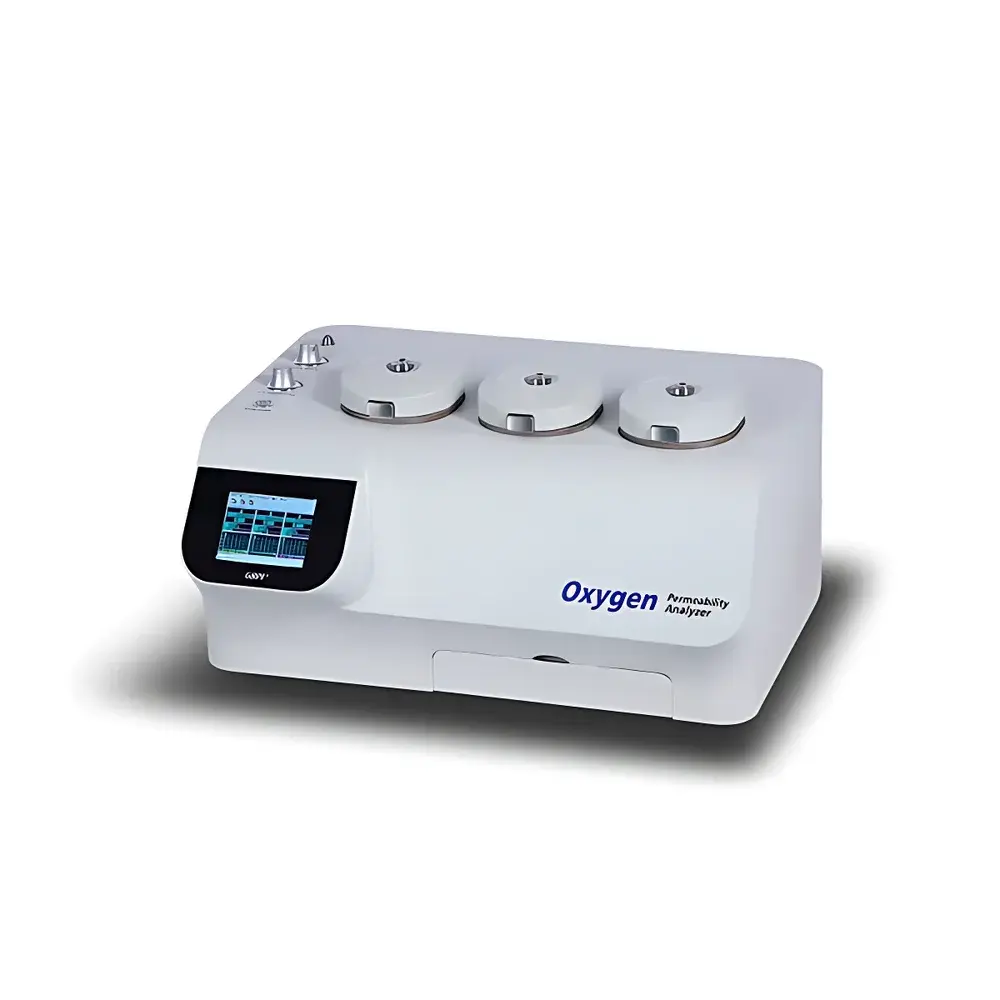
GBPI Y310G Oxygen Transmission Rate (OTR) Tester
| Brand | GBPI |
|---|---|
| Origin | Guangdong, China |
| Manufacturer | GBPI Packaging Instruments Co., Ltd. |
| Model | Y310G |
| Test Range | 0.02–16,500 cm³/(m²·24h) (film) |
| O₂ Resolution | 0.001 cm³/(m²·24h) |
| Temperature Control | 15–45 °C (optional 5–50 °C), ±0.1 °C accuracy |
| Humidity Control | 30–90 %RH (optional 0–100 %RH), ±1 %RH accuracy |
| Test Area | 50.24 cm² |
| Specimen Size | Ø100 mm |
| Max Thickness | ≤3 mm |
| Sample Capacity | 1–3 independent chambers |
| Carrier Gas Pressure | 0.1–0.2 MPa |
| Power Supply | AC 220 V, 50 Hz, 750 W |
| Dimensions | 700 × 560 × 370 mm |
| Weight | 100 kg |
Overview
The GBPI Y310G Oxygen Transmission Rate (OTR) Tester is a gravimetric and coulometric sensor-based instrument engineered for precise, traceable measurement of oxygen permeability through packaging materials under controlled temperature and humidity conditions. It operates on the principle of dynamic gas transmission testing: a conditioned test specimen separates two gas streams — an oxygen-rich carrier gas (typically 99.999% O₂) on the upstream side and high-purity nitrogen on the downstream side. Oxygen molecules permeating through the sample are carried by the nitrogen stream to a high-stability electrochemical oxygen sensor, where concentration is quantified in real time. The resulting signal is integrated over time and normalized to specimen area and duration to yield OTR in standard units (cm³/(m²·24h)). This methodology complies with fundamental mass-transfer theory and aligns with internationally recognized steady-state diffusion models described in ASTM D3985 and ISO 15105-2.
Key Features
- Traceable metrology infrastructure: Certified reference materials (GBW(E)130497/8) approved by the State Administration for Market Regulation (SAMR) enable in-house calibration and verification against national standards — ensuring data comparability across laboratories and regulatory submissions.
- Dual independent environmental control: Electromagnetic programmable step-control heating/cooling system maintains temperature stability within ±0.1 °C; dual-stream (dry/wet gas blending) humidity regulation achieves ±1 %RH precision across 30–90 %RH (optionally 0–100 %RH), critical for evaluating moisture-sensitive barrier layers.
- Modular multi-chamber architecture: Three isolated test cells operate concurrently or independently, each with autonomous start/stop, data logging, and report generation — enabling comparative studies of heterogeneous materials or accelerated throughput without cross-contamination.
- ARM-based embedded control system: Fully functional standalone operation without PC dependency; real-time display of OTR, O₂ concentration, temperature, and RH curves with zoom, pan, and overlay functions via 7-inch LCD touchscreen interface.
- GMP-compliant software platform: Role-based access control (Administrator, Operator, Reviewer), full audit trail (system, method, and run-level), electronic signatures, and 21 CFR Part 11–ready data integrity safeguards — validated for GLP/GMP-regulated environments including pharmaceutical primary packaging qualification.
- Extended application flexibility: Optional permeation mask extends upper detection limit to 260,000 cm³/(m²·24h); dedicated fixtures support rigid and semi-rigid containers (bottles, trays, pouches) per ASTM F1307 and ISO 15105-1 protocols.
Sample Compatibility & Compliance
The Y310G accommodates flat specimens up to 3 mm thick and Ø100 mm diameter, including monolayer polymers (e.g., PET, PE, PP), metallized films (AlOx, SiOx), laminates, foils, elastomers, ceramics, and medical-grade hydrogels. Container testing requires optional adapters conforming to ASTM F2622 (for flexible packages) and ASTM F1927 (for rigid containers). Regulatory compliance includes full alignment with Chinese pharmacopoeial standard YBB00082003-2015, GB/T 19789-2005, DIN 53380-3, JIS K-7126-B, and key international references: ASTM D3985 (film), ASTM F1307 (containers), ASTM F1927 (rigid), ASTM F2622 (flexible), and ISO 15105-1 & -2. All hardware and firmware designs incorporate fail-safes — including automatic sensor over-range protection and pressure interlocks — to prevent damage during abnormal operating conditions.
Software & Data Management
GBPI OTR Studio v4.x is a Windows-based application supporting Windows 7/10/11 (with native RS232 or USB-to-serial compatibility). It features intuitive workflow configuration, customizable test methods (including ramped T/RH profiles), real-time curve visualization, and automated pass/fail evaluation against user-defined limits. All raw sensor outputs, environmental logs, and metadata are stored in encrypted SQLite databases with immutable timestamps. Reports export natively to PDF, Excel (.xlsx), and Word (.docx) formats; CSV exports support third-party statistical analysis (e.g., JMP, Minitab). Audit trails record every user action — login/logout, parameter modification, calibration event, data export — with operator ID, timestamp, and pre/post-value context. Data backups follow ALCOA+ principles (Attributable, Legible, Contemporaneous, Original, Accurate, Complete, Consistent, Enduring, Available).
Applications
The Y310G serves as a core analytical tool across regulated and industrial sectors requiring quantitative barrier performance assessment. In pharmaceutical development, it supports container-closure integrity validation for blister packs, IV bags, and prefilled syringe stoppers per USP and ICH Q5C. Food packaging engineers use it to benchmark shelf-life predictions for snack pouches, dairy cartons, and modified-atmosphere packaging (MAP). Electronics manufacturers evaluate moisture-sensitive encapsulation films for OLED displays and photovoltaic backsheets. Medical device firms assess oxygen permeation through wound dressings, transdermal patches, and sterile barrier systems per ISO 11607-1. Academic and government labs apply it in polymer science research, nanocomposite barrier optimization, and biodegradable film degradation kinetics under accelerated aging protocols.
FAQ
What gases are required for operation?
High-purity oxygen (≥99.999%) and nitrogen (≥99.999%), each supplied via dedicated cylinders with dual-stage stainless-steel regulators delivering 0–0.4 MPa output pressure.
Is external PC hardware mandatory?
No — the ARM-embedded controller enables full test execution, monitoring, and reporting without a connected computer. A PC is only required for advanced data analysis, long-term archival, or GMP audit documentation.
How is instrument calibration performed?
Using certified standard reference films (e.g., 125 µm polyethylene) or NIST-traceable O₂ permeation standards. Calibration is executed via guided software workflow: users input certified reference values after routine measurement, and the system computes correction factors applied in real time.
Can the Y310G test medical device packaging per ISO 11607?
Yes — when configured with appropriate container fixtures and validated test methods, it meets the oxygen transmission requirements specified in ISO 11607-1 Annex B for sterile barrier systems, including pouches, trays, and peel-open lids.
What maintenance intervals are recommended?
Oxygen sensor replacement every 18–24 months under continuous use; annual verification of temperature/humidity sensors using NIST-traceable probes; quarterly inspection of sealing gaskets and gas pathways for integrity and contamination.






