
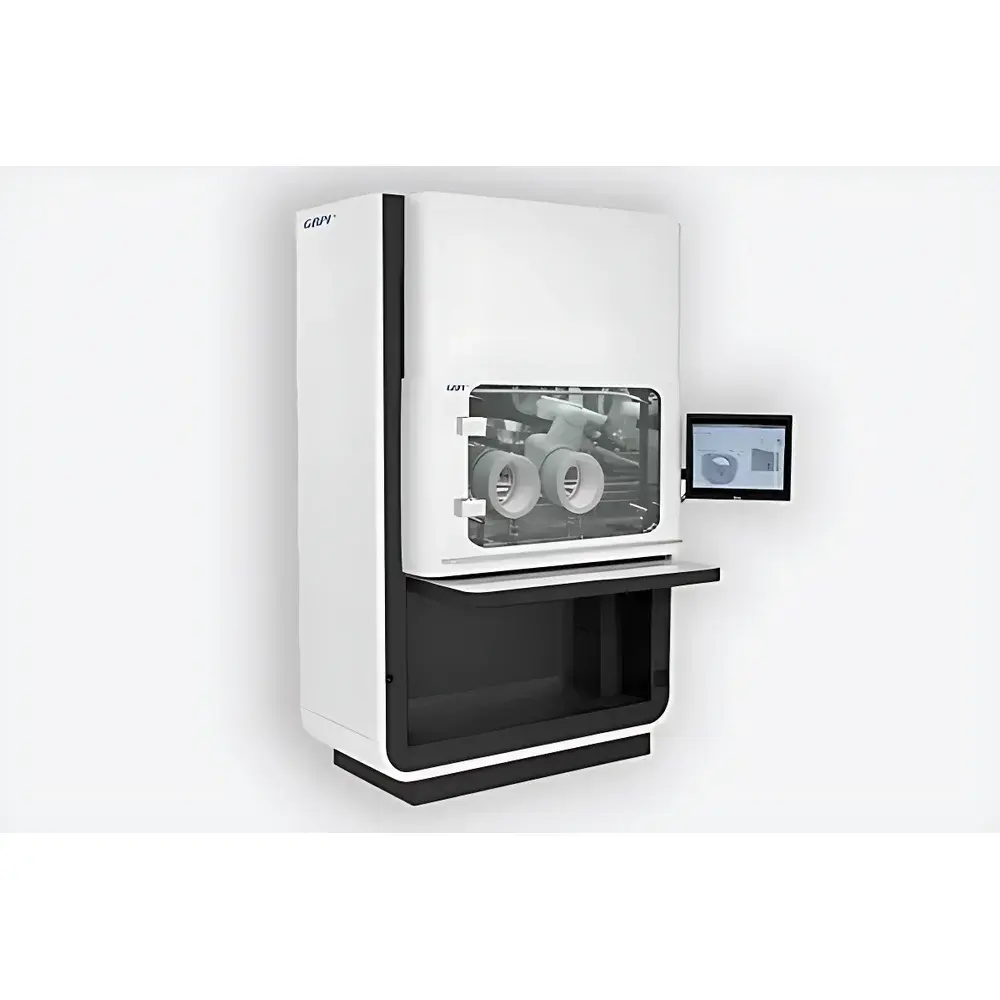
GBPI GB-XF1000T Bacterial Filtration Efficiency (BFE) Tester for Medical Masks
| Brand | GBPI |
|---|---|
| Model | GB-XF1000T |
| Instrument Type | Aerosol Detector |
| Origin | Guangdong, China |
| Manufacturer | Guangzhou GBPI Packaging Testing Instruments Co., Ltd. |
| Compliance | YY 0469–2004, YY/T 0969–2013, ASTM F2100, ASTM F2101, EN 14683 |
| Sampling Method | Dual-channel parallel Andersen cascade impactor (6-stage) with simultaneous control of A/B flow paths |
| Aerosol Generation | Microbial aerosol generator with mass median aerodynamic diameter (MMAD) = 3.0 ± 0.3 µm, GSD ≤ 1.5 |
| Flow Rate (A/B) | 28.3 L/min ±2.5% (resolution: 0.1 L/min) |
| Nebulizer Flow | 8–10 L/min ±2.5% (resolution: 0.1 L/min) |
| Peristaltic Pump Flow | 0.006–3.0 mL/min ±2.5% (resolution: 0.001 mL/min) |
| Pressure Monitoring | Upstream pressure (–20 to 0 kPa),雾室 negative pressure (–90 to –120 Pa), cabinet negative pressure (–50 to –200 Pa), all ±2.0–2.5% accuracy |
| Temperature Range | –40 to 99 °C (±2.5%) |
| Aerosol Chamber | 600 mm × 85 mm Ø × 30 mm |
| Positive Control | 2200 ± 500 CFU total viable count |
| Cabinet Airflow | ≥5 m³/min |
| Noise Level | <65 dB(A) |
| Power Supply | AC 220 V ±10%, 50 Hz |
| Power Consumption | <1500 W |
| Net Weight | ~150 kg |
| Dimensions (main unit) | 1180 × 650 × 1300 mm (W×D×H) |
| Adjustable Stand Height | ±100 mm |
| Data Storage Capacity | >100,000 test records |
| Display | 10.4″ industrial-grade high-brightness TFT touchscreen |
| Interface | USB port for data export via U-disk |
| Safety Features | Interlocked negative-pressure cabinet, built-in leakage protection, flame-retardant insulation, front-access tempered glass door, LED internal lighting |
| Filter Efficiency | ≥99.99% for particles ≥0.3 µm (HEPA) |
Overview
The GBPI GB-XF1000T Bacterial Filtration Efficiency (BFE) Tester is a fully integrated, regulatory-compliant aerosol testing system engineered for quantitative assessment of bacterial particle retention performance in medical face masks and respirator materials. It operates on the principle of controlled microbial aerosol generation followed by dual-path, parallel sampling through standardized six-stage Andersen cascade impactors — enabling precise determination of filtration efficiency as defined by colony-forming unit (CFU) reduction across biologically relevant particle size ranges (0.6–7.0 µm). The instrument implements ISO/IEC 17025-aligned measurement traceability through calibrated mass flow controllers, real-time pressure monitoring, and temperature-compensated volumetric sampling. Its design conforms to the physical and procedural requirements of YY 0469–2004, YY/T 0969–2013, ASTM F2101, ASTM F2100, and EN 14683, supporting both routine quality control and metrological validation in GLP- and GMP-regulated environments.
Key Features
- Negative-pressure biosafety cabinet with interlocked access door, maintaining stable cabinet pressure between –50 Pa and –200 Pa during operation to prevent operator exposure to bioaerosols.
- Dual independent sampling channels (A and B), each equipped with a six-stage Andersen impactor, enabling simultaneous upstream (challenge) and downstream (filtered) microbial collection under identical flow conditions (28.3 L/min ±2.5%).
- Integrated microbial aerosol generator producing Staphylococcus aureus or other specified test organisms with tightly controlled aerosol characteristics: mass median aerodynamic diameter (MMAD) = 3.0 ± 0.3 µm and geometric standard deviation (GSD) ≤ 1.5 — consistent with ASTM F2101 specifications.
- High-precision peristaltic pump (0.006–3.0 mL/min, resolution 0.001 mL/min) for accurate delivery of bacterial suspension to the nebulizer head, ensuring reproducible aerosol concentration and particle size distribution.
- Embedded industrial microcomputer with 10.4-inch high-brightness capacitive touchscreen interface, supporting intuitive parameter configuration, real-time monitoring of all critical process variables (flow, pressure, temperature, cabinet vacuum), and automated test sequencing.
- Comprehensive safety architecture including built-in RCD (residual-current device), flame-retardant thermal insulation between inner and outer cabinet walls, LED task lighting, and adjustable-height stainless-steel support stand with dual-mode casters (lockable + swivel).
- Onboard data logging capacity exceeding 100,000 complete test records, with timestamped metadata (operator ID, sample ID, environmental conditions, calibration status), exportable via USB flash drive in CSV format for audit-ready traceability.
Sample Compatibility & Compliance
The GB-XF1000T accepts flat mask material specimens (typically 100 mm × 100 mm or circular 90 mm diameter) mounted in standardized test holders compatible with ASTM F2101 and YY/T 0969–2013 fixtures. It supports both qualitative (pass/fail) and quantitative (percentage BFE) evaluation using viable culture-based endpoints. All airflow paths, aerosol chambers, and impactor stages are constructed from non-reactive, autoclavable stainless steel or anodized aluminum to minimize surface adhesion and cross-contamination. The system meets essential requirements for use in ISO/IEC 17025-accredited laboratories and satisfies documentation prerequisites for FDA 21 CFR Part 11 compliance when paired with validated electronic record management protocols. Routine verification includes daily flow calibration checks, pressure sensor zeroing, and positive control recovery validation (2200 ± 500 CFU target).
Software & Data Management
The embedded control firmware provides role-based user authentication, configurable test templates, and automatic calculation of BFE (%) using the formula: BFE (%) = [1 − (CFUdownstream / CFUupstream)] × 100. Raw sensor outputs (differential pressures, thermistor readings, flow transducer voltages) are logged at 1 Hz and archived with each test session. Audit trails capture all operator actions, parameter modifications, and system alerts. Exported CSV files include column headers compliant with LIMS ingestion standards (e.g., “Test_ID”, “Date_Time”, “Upstream_CFU”, “Downstream_CFU”, “BFE_%”, “Flow_A_Lmin”, “Temp_C”, “Cabinet_Pa”). Optional firmware updates are delivered via secure HTTPS download and require digital signature verification prior to installation.
Applications
- Regulatory conformance testing of surgical masks, procedure masks, and community face coverings per YY 0469–2004 and YY/T 0969–2013.
- Material screening and R&D validation for melt-blown polypropylene, electrospun nanofibers, and hybrid filter media.
- Annual metrological verification of production-line BFE testers in certified calibration laboratories.
- Comparative efficacy studies of antiviral or antimicrobial-treated mask substrates under standardized challenge conditions.
- Supporting submissions to NMPA, FDA, or EU Notified Bodies requiring full traceability of filtration performance data.
FAQ
What biological agent is recommended for BFE testing according to ASTM F2101?
Staphylococcus aureus ATCC 6538 is the standard test organism specified in ASTM F2101; alternative strains may be used if scientifically justified and validated against reference methods.
Is the GB-XF1000T suitable for viral filtration efficiency (VFE) testing?
No — this instrument is specifically designed and validated for bacterial aerosol challenges. VFE requires distinct aerosol generation, detection, and containment protocols (e.g., MS2 bacteriophage, Pseudomonas fluorescens), which fall outside its current scope and regulatory alignment.
How often must the HEPA filter be replaced?
Filter replacement intervals depend on usage frequency and aerosol load; GBPI recommends inspection every 500 operational hours and replacement when differential pressure exceeds 250 Pa or integrity testing (e.g., DOP/PAO scan) indicates >0.01% penetration at 0.3 µm.
Can test data be integrated into a laboratory information management system (LIMS)?
Yes — exported CSV files follow ANSI X12-compliant field naming conventions and can be ingested directly by most modern LIMS platforms via scheduled import scripts or API gateways.
Does the system support GLP-compliant electronic signatures?
The base firmware does not implement 21 CFR Part 11 electronic signature functionality; however, it provides full audit trail data required for integration with third-party e-signature modules deployed at the enterprise IT level.







