
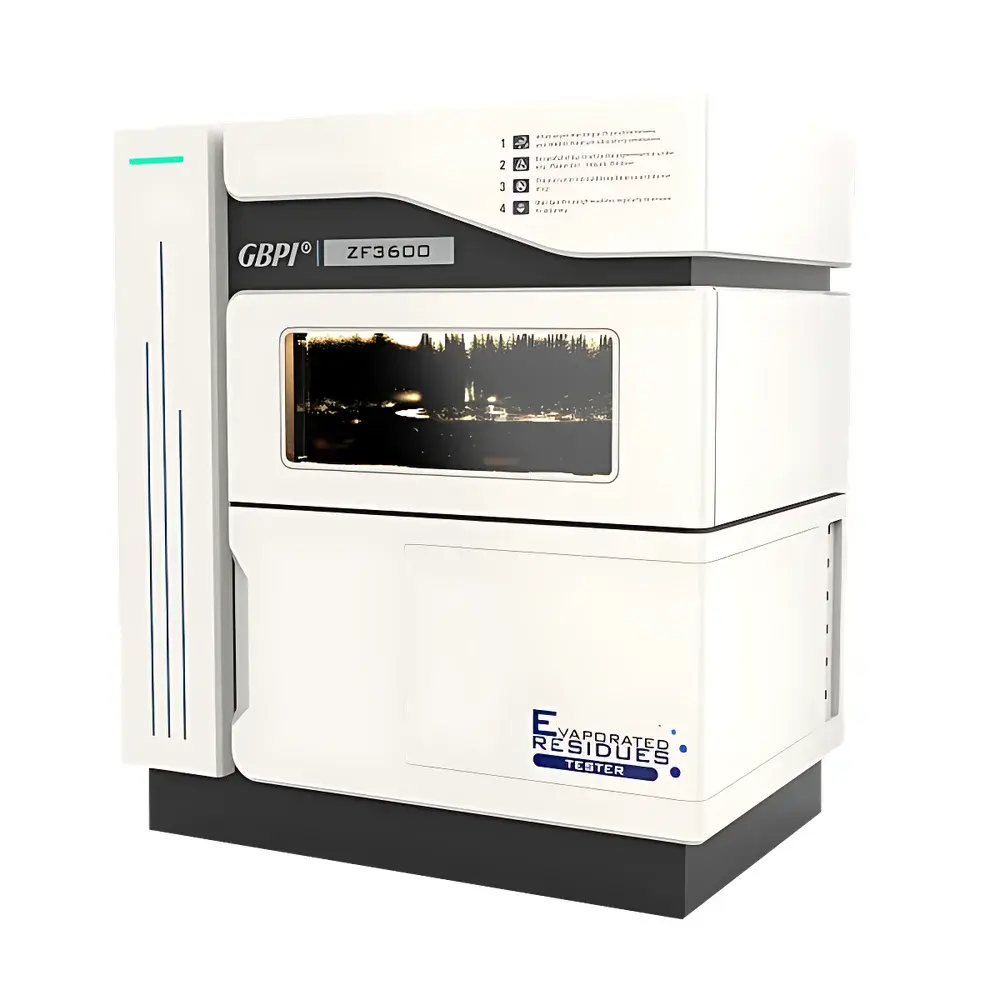
GBPI ZF3600-Q Total Evaporable Residue Analyzer with Integrated Gravimetric Constant-Weight System
| Brand | GBPI |
|---|---|
| Origin | Guangdong, China |
| Manufacturer Type | Manufacturer |
| Country of Origin | Domestic (China) |
| Model | ZF3600-Q |
| Pricing | Upon Request |
| Measurement Range | 0–80 g |
| Balance Resolution | 0.01 mg |
| Balance Capacity | 0–220 g |
| Constant-Weight Tolerance | 0.3 mg (user-configurable) |
| Water Bath Temp Range | Ambient to 100 °C |
| Drying Chamber Temp Range | Ambient to 125 °C |
| Temperature Control Accuracy | ±0.5 °C |
| Sample Positions | 36 |
| Evaporating Dish Volume | 50 mL or 100 mL (selectable) |
| Pneumatic Interface | Φ8 mm |
| Dimensions (L×W×H) | 1200 × 850 × 1335 mm |
| Power Supply | 220 V, 50 Hz |
| Rated Power | 7000 W |
| OS | Windows 10 Pro 64-bit |
Overview
The GBPI ZF3600-Q Total Evaporable Residue Analyzer is an integrated gravimetric system engineered for precise, automated determination of non-volatile residue (NVR), total migration, and total dissolved solids (TDS) in regulatory-compliant testing environments. It operates on the principle of sequential solvent evaporation, thermal drying, desiccation-controlled cooling, and iterative high-precision weighing until constant mass is achieved—fully conforming to the fundamental gravimetric methodology defined in pharmacopoeial and food-contact material standards. Unlike conventional benchtop procedures requiring manual intervention at each stage, the ZF3600-Q implements a closed-loop, dual-chamber architecture: a water bath chamber for controlled low-temperature evaporation below solvent boiling points, and a thermostatically regulated drying chamber (up to 125 °C) for residual moisture removal. The system eliminates environmental interference—including ambient humidity fluctuations and air currents—by isolating the weighing module within a thermally stabilized, water-jacketed enclosure. This design ensures metrological integrity throughout the entire gravimetric cycle, supporting compliance with ISO/IEC 17025 traceability requirements and GLP/GMP data integrity expectations.
Key Features
- Integrated dual-zone thermal control: independent water bath (ambient–100 °C) and drying chamber (ambient–125 °C), both regulated to ±0.5 °C via electromagnetic PID control.
- Automated liquid handling: pneumatically actuated dispensing with ≤0.1 mL residual volume per cycle; compatible with aqueous solutions, ethanol, hexane, acetic acid, chloroform, and other organic solvents specified in EN 1186-3:2002 Method A and GB 31604.8–2016.
- Triple high-accuracy balances (imported, 0.01 mg resolution, 220 g capacity), each housed in a vibration-damped, temperature-stabilized compartment with active water-circulation shielding.
- 36-position parallel processing capability: individual dish tracking, independent parameter assignment per position, and synchronized multi-cycle gravimetric convergence.
- Closed-loop solvent recovery system: integrated recirculating chiller (30 min cooldown to ambient), large-capacity coolant reservoir, and condensate collection bottle achieving >90% solvent recovery efficiency.
- Full GMP-aligned software architecture: role-based access control, electronic signatures, audit trail (per 21 CFR Part 11), configurable test protocols, and real-time visualization of mass vs. time, temperature, and humidity curves.
Sample Compatibility & Compliance
The ZF3600-Q accommodates diverse sample matrices across pharmaceutical, food packaging, tobacco, and environmental testing domains. Liquid samples include purified water (as defined in Ph. Eur. 9.0 and ChP 2020 Vol. II), extractants from plastic packaging (GB 31604.8–2016), migration simulant solutions (e.g., 3% acetic acid, 10% ethanol, olive oil per EN 1186), and Korean MOHW Chapter IV Section 2–8 extracts. Solid samples—such as herbal powders, excipients, and filter media—are processed under “drying loss” or “extractables” protocols aligned with ChP 2020 Vol. IV and USP–NF . For water quality analysis, the instrument fulfills GB 8538–2016 (mineral water), DZ/T 0064.9–2021 (groundwater), and GB/T 5750.4–2006 (drinking water) requirements for total dissolved solids quantification. All operational parameters—including dwell times, ramp rates, and convergence thresholds—are programmable to match method-specific clauses in ASTM D5907, ISO 3262-13, and FDA Guidance for Industry on Food Contact Substances.
Software & Data Management
Running on Windows 10 Pro 64-bit, the proprietary GBPI Control Suite implements a modular, icon-driven interface compliant with Annex 11 and EU GMP Annex 11 principles. Each test sequence generates a structured metadata-rich dataset including timestamped balance readings, chamber temperature logs, humidity profiles, and pneumatic valve actuation records. Audit trails capture user login/logout events, parameter modifications, report generation, and electronic signature applications—retained for ≥36 months with immutable hash verification. Reports are exportable in PDF/A-2b, CSV, and XML formats; customizable templates support client-specific headers, regulatory disclaimers, and digital certification stamps. Remote diagnostics and firmware updates are enabled via secure TLS-encrypted connection to GBPI’s authorized IoT platform, allowing qualified personnel to monitor instrument status, retrieve calibration logs, and download SOPs or training videos without onsite access.
Applications
- Pharmaceutical water systems: Purified water and water-for-injection (WFI) residual solids assessment per ChP 2020 and EP 9.0.
- Food contact materials: Total migration testing of plastics, coatings, and adhesives per GB 31604.8–2016 and EN 1186 series.
- Tobacco industry: Non-volatile residue evaluation in cigarette tipping paper per GB/T 9740–2008.
- Environmental labs: Dissolved solids quantification in surface water, groundwater, and wastewater per GB 8538–2016 and DZ/T 0064.9–2021.
- Chemical QC: Solvent purity verification, assay residue checks, and drying loss validation for reagents and intermediates.
- Biopharma manufacturing: Extractables screening of single-use bioreactor bags and filtration assemblies using simulated extraction protocols.
FAQ
What regulatory standards does the ZF3600-Q support out-of-the-box?
The system includes preloaded method templates for ChP 2020 (Vol. II & IV), USP , EP 9.0, GB 31604.8–2016, EN 1186-3:2002, and GB 8538–2016, with full configurability for custom SOPs.
Can the instrument handle hazardous organic solvents safely?
Yes—integrated fume extraction ports, explosion-proof pneumatic components, solvent-resistant internal coatings, and automatic leak detection ensure safe operation with chlorinated and flammable solvents.
Is external balance calibration required between tests?
No—the built-in three-point auto-calibration routine executes before each weighing sequence using NIST-traceable internal weights; external verification is recommended quarterly per ISO/IEC 17025.
How is data integrity maintained during power interruption?
The system features uninterruptible power supply (UPS)-ready architecture with non-volatile memory buffering; all active measurements and state variables are preserved and resumed upon recovery.
Does the software meet 21 CFR Part 11 requirements for electronic records?
Yes—full implementation includes role-based permissions, biometric or PKI-based e-signatures, tamper-evident audit logs, and electronic record retention with version control and digital fingerprinting.





