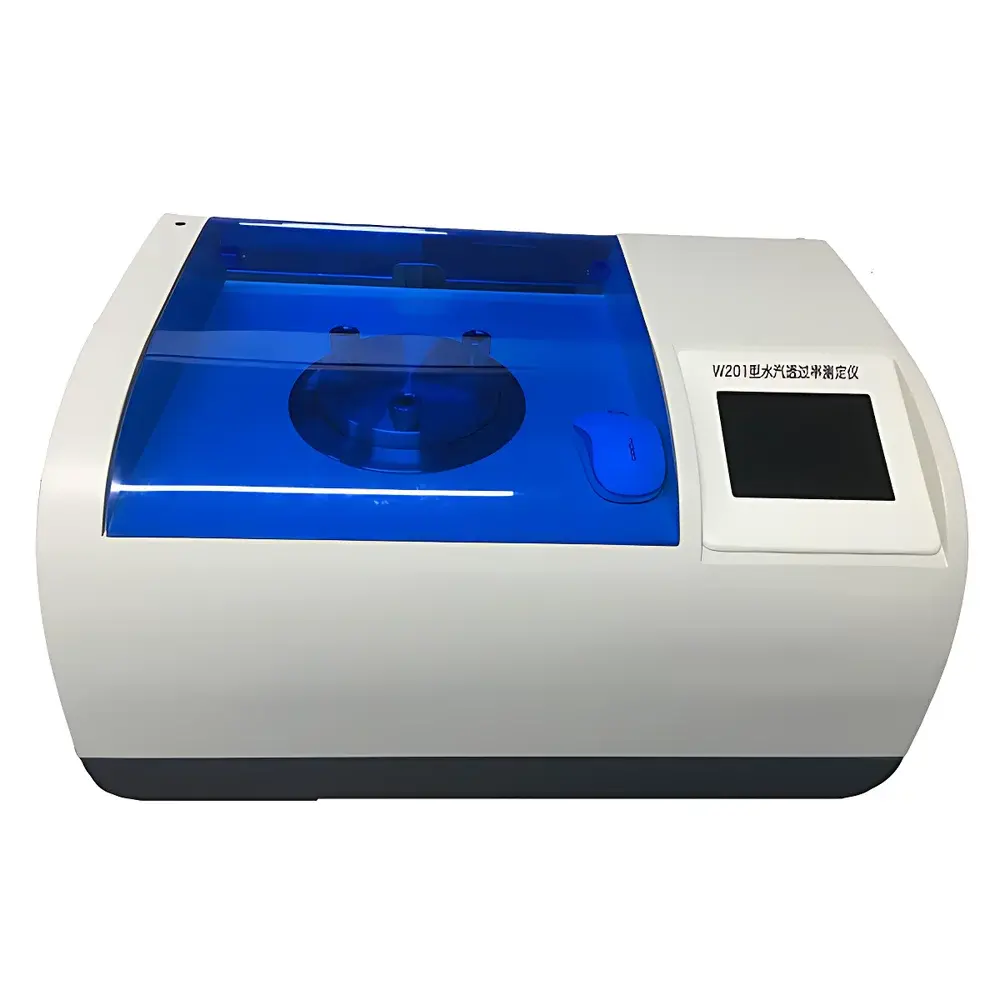
GBPI W201-1 Electrolytic Water Vapor Transmission Rate (WVTR) Tester
| Brand | GBPI |
|---|---|
| Origin | Guangdong, China |
| Manufacturer Type | Direct Manufacturer |
| Regional Category | Domestic (China) |
| Model | W201-1 |
| Price Range | USD 7,000 – 14,000 |
| Measurement Principle | Electrolytic Sensor-Based WVTR |
| Compliant Standards | GB/T 21529, ISO 15106-3, DIN 53122-2, YBB 00092003-2015, ASTM E 398 |
| WVTR Range | 0.001–100 g/(m²·24h) |
| Resolution | 0.001 g/(m²·24h) |
| Temperature Control | 15–45 °C (optional up to 60 °C), ±0.1 °C accuracy |
| Humidity Control | 0% RH and 30–90% RH, ±1% RH accuracy |
| Sample Area | 50.24 cm² (Φ100 mm) |
| Max. Sample Thickness | ≤2 mm |
| Carrier Gas | Ultra-high-purity N₂ (99.999%), ≥0.1 MPa supply pressure |
| Gas Flow Rate | 0–100 mL/min |
| Dual Test Chambers | Independent or cross-chamber operation |
| Data Logging | Real-time curves for WVTR, humidity, temperature, and sensor signal |
| Software Features | Automated baseline correction, dual calibration modes (standard gas + certified reference film), GLP-compliant audit trail, USB-based firmware update & data export |
| Power | 220 V, 50 Hz (110 V optional) |
| Dimensions | 610 × 550 × 400 mm |
| Weight | 80 kg |
| Power Consumption | 500 W |
Overview
The GBPI W201-1 Electrolytic Water Vapor Transmission Rate (WVTR) Tester is a precision-engineered instrument designed for quantitative determination of water vapor permeation through packaging materials and rigid or flexible containers under controlled temperature and humidity conditions. It operates on the electrolytic detection principle defined in ISO 15106-3 and ASTM E 398: water vapor diffusing across a conditioned test specimen is carried by a dry nitrogen carrier gas stream to a high-sensitivity dual-electrode electrolytic moisture sensor. The sensor generates a current proportional to the water vapor concentration, enabling direct calculation of WVTR in g/(m²·24h). This method delivers high reproducibility, low detection limits (0.001 g/(m²·24h)), and minimal interference from ambient fluctuations—making it suitable for R&D labs, QC departments, and regulatory submission testing in pharmaceutical, food, medical device, and photovoltaic industries.
Key Features
- Electrolytic sensor architecture with long-term stability and traceable calibration via dual-mode verification (certified reference films and standard gas injection).
- Programmable electromagnetic temperature control system offering ±0.1 °C accuracy across 15–45 °C (extended range to 60 °C available), eliminating external chillers or heaters.
- Dual-stream humidity control delivering precise, stable RH setpoints from 0% to 90% RH (±1% RH tolerance) without condensation risk or drift.
- Dual independent test chambers supporting concurrent evaluation of two dissimilar specimens—or cross-chamber validation using identical samples for inter-chamber repeatability assessment.
- Embedded standalone operating system enabling full test execution, real-time monitoring, and data storage without continuous PC connection; USB interface supports firmware updates, backup, and diagnostic logging.
- Modular software architecture with discrete functional modules: parameter setup, baseline acquisition, calibration management, automated test execution, curve-based trend analysis, and customizable reporting compliant with internal QA requirements.
- Comprehensive hardware safeguards including over-range detection, power-failure data retention, operational error prompts, and auto-shutdown upon protocol completion or anomaly detection.
Sample Compatibility & Compliance
The W201-1 accommodates flat sheet materials—including polymer films (e.g., PET, PE, PP, PVDC, EVOH), metallized substrates (aluminum foil, vacuum-deposited Al), laminates, paperboard, ceramic thin films, and solar backsheet composites—as well as rigid and semi-rigid containers (bottles, pouches, trays, blister packs, and tubs) when used with optional fixture kits. All testing adheres strictly to internationally recognized standards: GB/T 21529 (China), ISO 15106-3 (electrolytic method), DIN 53122-2 (German industrial standard), YBB 00092003-2015 (Chinese pharmaceutical packaging regulation), and ASTM E 398 (standard test method for water vapor transmission of plastic film and sheeting). Instrument design supports GLP-aligned workflows, with timestamped audit trails, user-access controls, and electronic signature readiness for FDA 21 CFR Part 11–governed environments.
Software & Data Management
The GBPI W201-1’s native software provides full lifecycle data handling—from method definition and instrument qualification to raw signal visualization and statistical summary. Real-time graphical overlays display WVTR, chamber humidity, temperature, and sensor output simultaneously, allowing users to identify transient anomalies or environmental coupling effects. Calibration history, operator logs, and test metadata are embedded into each result file. Export formats include CSV, PDF, and XML for LIMS integration. Audit-trail functionality records all critical actions (e.g., parameter changes, calibration events, report generation) with user ID and timestamp—essential for GMP audits and regulatory submissions. Firmware updates and configuration backups are performed securely via USB, ensuring continuity during lab IT infrastructure transitions.
Applications
This instrument serves core barrier performance evaluation across regulated and industrial sectors: shelf-life modeling for pharmaceutical blister packaging and IV bags; specification verification of high-barrier films used in flexible food packaging; quality release testing of solar panel backsheet materials per IEC 61215; moisture ingress assessment of lithium-ion battery enclosures; and permeation characterization of medical-grade wound dressings and transdermal patches. Additional validated use cases include WVTR testing of automotive fuel tanks, convenience food containers (e.g., cup noodles, disposable cups), and cosmetic sachets—where material integrity directly correlates with product stability, safety, and consumer compliance.
FAQ
What carrier gas is required, and why must it be ultra-high-purity nitrogen?
Ultra-high-purity nitrogen (99.999%) is mandatory to prevent sensor poisoning and ensure baseline stability. Trace oxygen, hydrocarbons, or moisture in lower-grade gases interfere with electrolytic sensor response and compromise measurement accuracy.
Can the W201-1 test irregular or three-dimensional packages without custom fixtures?
No. Flat-sheet testing is performed natively; container testing requires application-specific sealing fixtures (sold separately) to maintain leak-tight boundary conditions and uniform diffusion area definition.
Is the instrument compliant with 21 CFR Part 11 for electronic records and signatures?
While the W201-1 supports audit-trail generation and user authentication, full Part 11 compliance requires site-specific validation protocols, including documented IQ/OQ/PQ, role-based access configuration, and electronic signature implementation—performed by the end-user’s QA team.
How often does the electrolytic sensor require recalibration or replacement?
Sensor recalibration is recommended before each testing session using certified reference films or standard gas. Under normal usage and proper maintenance, sensor service life exceeds 18 months; GBPI provides sensor replacement kits with factory calibration certificates.
Does the dual-chamber configuration support simultaneous testing at different temperature/humidity conditions?
No. Both chambers share a common environmental control system and operate at identical T/RH setpoints. Independent condition control requires two separate instruments or a multi-zone platform.