
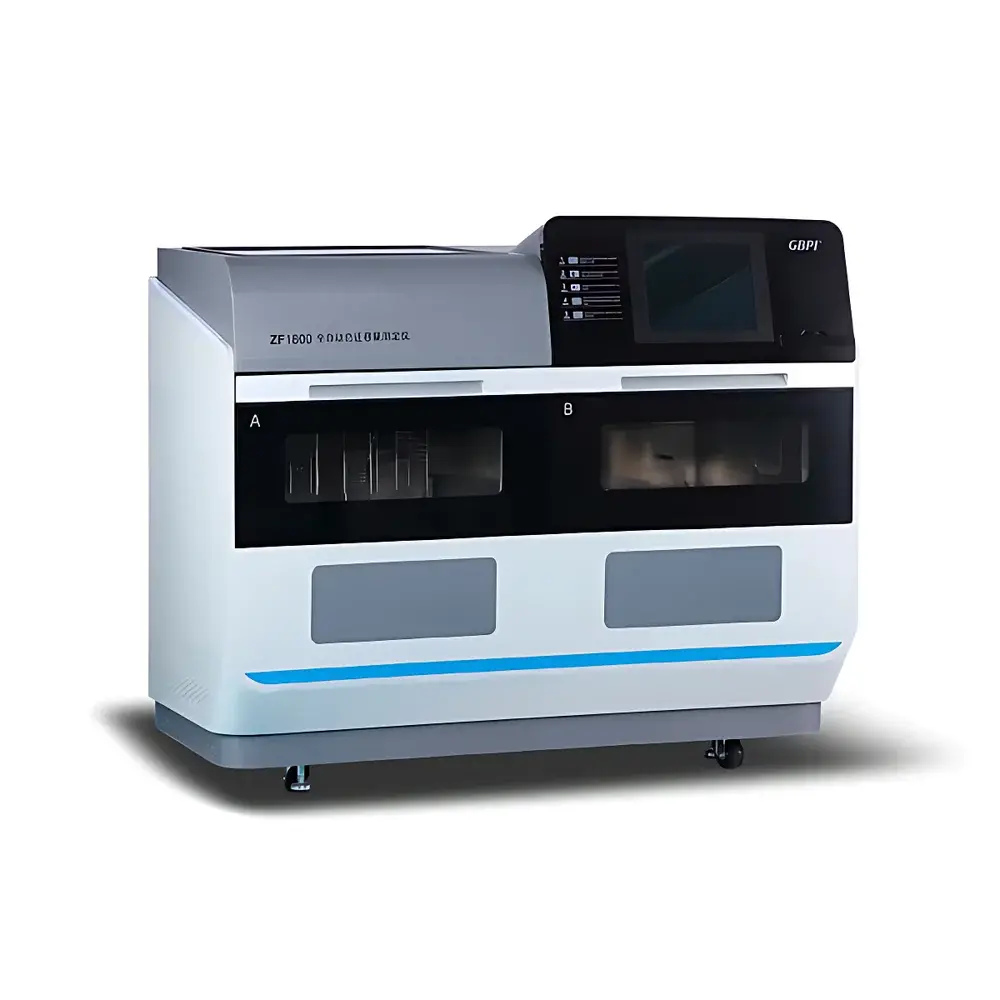
GBPI ZF1800D Total Migration Tester Compliant with GB 31064.8–2016
| Brand | GBPI |
|---|---|
| Origin | Guangdong, China |
| Manufacturer Type | Direct Manufacturer |
| Region of Origin | Domestic (China) |
| Model | ZF1800D |
| Pricing | Upon Request |
| Measurement Range | 0.2–167,000 mg/dm² |
| Resolution | 0.0001 g/dm² |
| Balance Capacity | 0–200 g |
| Balance Resolution | 0.1 mg |
| Water Bath Temp Control | Ambient to 100 °C |
| Heating Chamber Temp Control | Ambient to 120 °C |
| Cooling Chamber Temp Control | Ambient |
| Temp Accuracy | ±0.5 °C |
| Chamber Temp Uniformity | ±5 °C |
| Sample Capacity | 1–18 independent test positions |
| Gravimetric Stabilization Time | 2.5 h (standard) |
| Evaporating Dish Volume | 0–200 mL |
| Dimensions (L×W×H) | 180 × 90 × 120 cm |
| Power Supply | 220 V, 50 Hz |
| Rated Power | 5000 W |
Overview
The GBPI ZF1800D Total Migration Tester is an automated, regulatory-compliant analytical system engineered for precise determination of total migration levels from food contact materials (FCMs) into food simulants, in strict accordance with the Chinese national standard GB 31064.8–2016. It implements a gravimetric evaporation-residue methodology: samples are immersed in standardized food simulants (e.g., 3% acetic acid, 10% ethanol, olive oil, or distilled water), subjected to controlled thermal extraction under defined time/temperature conditions, and subsequently dried and weighed to quantify non-volatile residue—expressed as mass per unit surface area (mg/dm²). The instrument integrates water bath extraction, thermal drying, controlled cooling, and high-precision gravimetry within a single platform, eliminating manual transfer errors and environmental variability. Its architecture adheres to core principles of analytical traceability, reproducibility, and method robustness required for quality control laboratories operating under GLP, GMP, or ISO/IEC 17025 frameworks.
Key Features
- Independent dual-chamber thermal management: Separated heating and cooling zones enable simultaneous temperature ramping and stabilization—reducing cycle time by up to 40% compared to sequential single-chamber systems.
- Integrated water bath subsystem with auto-fill, level sensing, PID-controlled heating (ambient–100 °C), timed evaporation, and fail-safe dry-run detection with audible/visual alarms.
- Hermetically sealed solvent recovery loop: All evaporation occurs within a closed-loop chamber; vapors are condensed and collected, preventing atmospheric release and ensuring operator safety and regulatory compliance with VOC handling guidelines.
- Nitrogen purge capability: Optional inert gas introduction minimizes oxidative degradation of thermally labile migrants during high-temperature drying steps.
- Negative-pressure test chamber: Maintains consistent sub-atmospheric pressure throughout extraction and drying phases to suppress boiling point elevation and improve simulant penetration uniformity.
- ARM-based embedded control system with 10.1″ capacitive touchscreen interface: Fully integrated hardware-software architecture enables one-touch execution of multi-step protocols—including sample loading, simulant dosing, extraction, drying, cooling, and gravimetric stabilization.
- 18 independent test positions: Each station features isolated thermal zones and dedicated high-resolution weighing modules (0.1 mg resolution), enabling parallel analysis of heterogeneous FCMs without cross-contamination or data coupling.
Sample Compatibility & Compliance
The ZF1800D supports migration testing of polymeric and coated food contact articles including polyethylene (PE), polypropylene (PP), polystyrene (PS), and chlorinated vinyl resins. Compatible substrates span rigid containers, flexible films, laminates, gaskets, seals, and processing equipment surfaces. Testing follows prescribed simulant selection per GB 31064.8–2016 Annex A, aligned with EU Regulation (EC) No. 10/2011 and ISO 17717-1:2015 methodologies. Instrument validation includes documented IQ/OQ protocols, and all thermal and gravimetric parameters meet metrological traceability requirements to NIM (National Institute of Metrology, China) standards. The system satisfies critical elements of FDA 21 CFR Part 11 for electronic records and signatures when deployed with configured audit trails and role-based access controls.
Software & Data Management
The embedded software complies with Annex 11 (Computerized Systems) of the EU GMP Guidelines and China’s 2023 GMP Annex on Computerized Systems. Access requires authenticated login with tiered permissions—Administrator, Operator, and Viewer roles—with granular control over method editing, calibration, report generation, and audit trail viewing. Comprehensive audit logging captures user identity, timestamp, action type (e.g., method modification, weight override, report export), and pre-/post-change values. Real-time dashboards display live weight trends, chamber temperatures, residual mass accumulation, and migration rate curves per test position. Reports are generated in PDF and Microsoft Excel formats, embedding full metadata: instrument ID, calibration certificates, environmental logs, raw gravimetric data points, and statistical summaries (mean, SD, RSD%). Data export supports LIMS integration via CSV or OPC UA interfaces.
Applications
- QC release testing of food packaging films and trays prior to distribution.
- Migration profiling during formulation development of polymer additives (plasticizers, antioxidants, slip agents).
- Regulatory submission support for novel food contact substances (FCS) under China’s National Food Safety Standard framework.
- Stability assessment of printed inks and adhesives under accelerated aging conditions.
- Root cause analysis of non-conformances in routine surveillance programs mandated by provincial market supervision bureaus.
- Interlaboratory comparison studies under CNAS-accredited proficiency testing schemes.
FAQ
What regulatory standards does the ZF1800D directly support?
It is fully aligned with GB 31064.8–2016 and technically compatible with ISO 17717-1:2015, EU Regulation (EC) No. 10/2011, and ASTM D5967–22 for total migration quantification.
Can the system handle oily simulants such as olive oil or sunflower oil?
Yes—the heating chamber operates up to 120 °C and includes specialized condensation traps and solvent-resistant seals to manage high-boiling-point simulants without residue carryover.
Is remote monitoring or network connectivity supported?
The system provides Ethernet and optional Wi-Fi connectivity for secure remote status viewing and alarm notification via SNMP or email; however, direct remote control is disabled by default for cybersecurity compliance.
How is balance drift compensated during extended gravimetric stabilization cycles?
Each weighing module incorporates internal temperature-compensated strain gauge sensors and performs automatic zero-tracking at user-defined intervals (default: every 15 minutes) during the 2.5-hour stabilization phase.
Does the software support 21 CFR Part 11 compliance out-of-the-box?
Yes—when deployed with enabled digital signature workflows, electronic audit trails, and validated user authentication, it meets core technical requirements for Part 11 compliance; formal validation documentation is provided upon request.




