
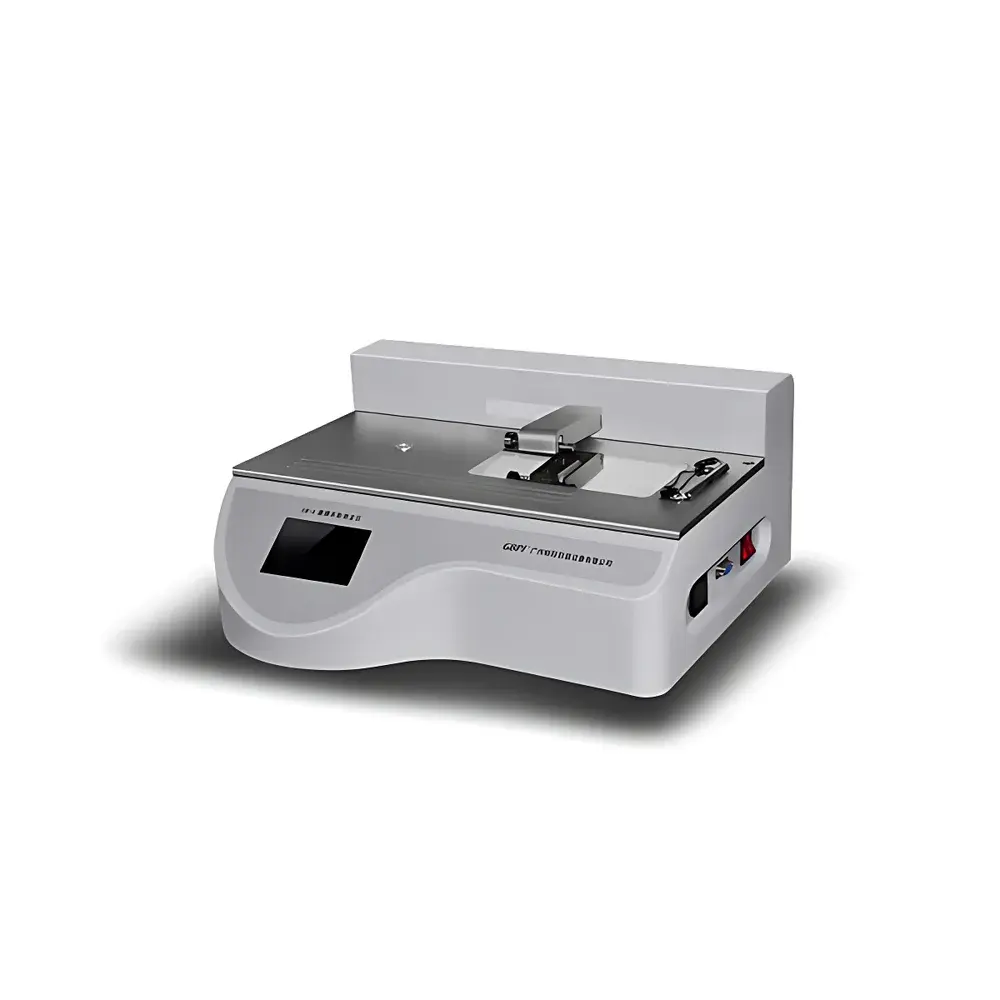
GBPI GM-4RR Coefficient of Friction Tester for Packaging Materials
| Brand | GBPI |
|---|---|
| Model | GM-4RR |
| Origin | Guangdong, China |
| Manufacturer Type | Direct Manufacturer |
| Country of Origin | China |
| Price Range | USD 1,400 – 7,000 (FOB) |
| Compliance Standards | GB/T 10006–1988, ASTM D1894–2014, ISO 8295–2004, TAPPI T816 |
| COF Measurement Range | 0.01–0.999 |
| Force Measurement Accuracy | ±2% |
| Load Cell Range | 0–10 N |
| Slider Dimensions | 63 mm × 63 mm |
| Slider Mass | 200 ± 2 g |
| Test Speed | Adjustable from 100 mm/min (stepless variable speed) |
| Temperature Control Range (optional) | Ambient to 75 °C |
| Specimen Thickness Limit | ≤2 mm |
| Test Platform Size | 200 mm × 470 mm |
| Overall Dimensions | 470 mm × 330 mm × 210 mm |
| Weight | 37 kg |
| Power Supply | AC 220 V ±10%, 50 Hz, 100 W |
Overview
The GBPI GM-4RR Coefficient of Friction Tester is an engineered precision instrument designed specifically for static and kinetic coefficient of friction (COF) measurement in flexible packaging materials—including plastic films, laminates, coated papers, foils, and nonwovens. It operates on the fundamental principle of horizontal sliding resistance measurement: a standardized slider (200 g, 63 mm × 63 mm) is pulled at controlled velocity across a stationary test specimen mounted on a rigid horizontal platform. The force required to initiate motion (static friction) and sustain uniform sliding (kinetic friction) is captured via a calibrated high-stability load cell (0–10 N range), then normalized against the normal force to compute dimensionless COF values (μs and μk). This methodology aligns rigorously with internationally recognized test protocols—namely GB/T 10006–1988, ASTM D1894–2014, ISO 8295–2004, and TAPPI T816—ensuring data comparability across global R&D labs, quality control departments, and regulatory submission dossiers.
Key Features
- High-reproducibility mechanical architecture: Precision-machined aluminum frame with vibration-damped base and linear-motion guide rails ensures consistent slider trajectory and minimal lateral deviation.
- Dual-mode operation: Standalone testing via integrated 4.3-inch LCD interface—displaying real-time velocity, μs, and μk—or PC-connected mode for advanced data capture and reporting.
- Stepless speed control: Motor-driven transmission enables continuous adjustment of sliding velocity (default 100 mm/min), critical for evaluating velocity-dependent friction behavior per ASTM D1894 Annex A1.
- Modular sensor protection system: Automatic over-load cutoff prevents damage to the primary load cell during misalignment or specimen jamming—enhancing long-term calibration stability.
- Tool-free calibration: Uses certified reference weights (200 g slider + auxiliary mass) and geometrically traceable calibration blocks; no external calibration lab required for routine verification.
- Optional temperature-controlled test chamber (ambient to 75 °C): Enables evaluation of thermal effects on interfacial adhesion and slip performance—essential for hot-fill packaging validation and shelf-life modeling.
Sample Compatibility & Compliance
The GM-4RR accommodates flat, non-porous specimens up to 2 mm in thickness and 470 mm × 200 mm in planar dimension. Compatible substrates include BOPP, PET, PE, CPP, aluminum foil, metallized films, kraft paper, wax-coated board, and barrier-laminated structures. All test configurations adhere strictly to the specimen preparation, conditioning (23 °C / 50% RH per ISO 291), and mounting requirements specified in ASTM D1894 and ISO 8295. Data outputs meet GLP documentation standards, supporting audit readiness for pharmaceutical secondary packaging (USP , ICH Q5C), food contact material compliance (FDA 21 CFR Part 177), and ISO 9001:2015 clause 7.1.5 traceability requirements.
Software & Data Management
The optional GBPI COF Control Suite (v3.2+) runs on Windows 7/10/11 and communicates via RS-232 (DB9). It provides real-time force vs. time curve visualization with zoom/pan functionality, automatic peak detection for μs, and plateau averaging for μk. Raw data exports to CSV or Excel; reports include operator ID, timestamp, environmental conditions, calibration status, and pass/fail flags against user-defined specification limits. Audit trail logging complies with FDA 21 CFR Part 11 requirements when configured with electronic signatures and role-based access controls.
Applications
- Optimizing anti-block additive levels in polyolefin films to balance machinability and seal integrity.
- Validating surface treatment efficacy (e.g., corona, plasma) on low-surface-energy substrates prior to printing or lamination.
- Assessing coefficient mismatch between inner and outer layers in multi-layer pouches to prevent delamination during form-fill-seal operations.
- Supporting regulatory submissions for medical device packaging per ISO 11607–1, where consistent slip performance ensures reliable opening force and sterility maintenance.
- Quantifying humidity-induced COF shifts in hygroscopic papers and bioplastics under accelerated aging protocols.
FAQ
What standards does the GM-4RR fully support for COF testing?
It implements test procedures and acceptance criteria defined in GB/T 10006–1988, ASTM D1894–2014, ISO 8295–2004, and TAPPI T816—including specimen conditioning, slider specifications, and calculation methodology.
Can the instrument measure both static and kinetic COF in a single run?
Yes—each test automatically captures the maximum breakaway force (for μs) and the average sustained drag force over a 50 mm displacement window (for μk), per ASTM D1894 Section 8.3.
Is temperature control mandatory for routine testing?
No—it is an optional module. Standard testing is conducted at ambient laboratory conditions (23 ±2 °C), but elevated temperature capability is recommended for applications involving heat-seal layers or tropical climate distribution validation.
How often must the load cell be recalibrated?
Annual calibration is advised per ISO/IEC 17025; however, daily verification using the supplied 200 g standard mass satisfies intermediate performance checks as outlined in ASTM E2586.
Does the system support LIMS integration?
Yes—CSV export format and configurable metadata fields (batch ID, operator, instrument ID) enable seamless ingestion into common Laboratory Information Management Systems (LIMS) without proprietary middleware.





