
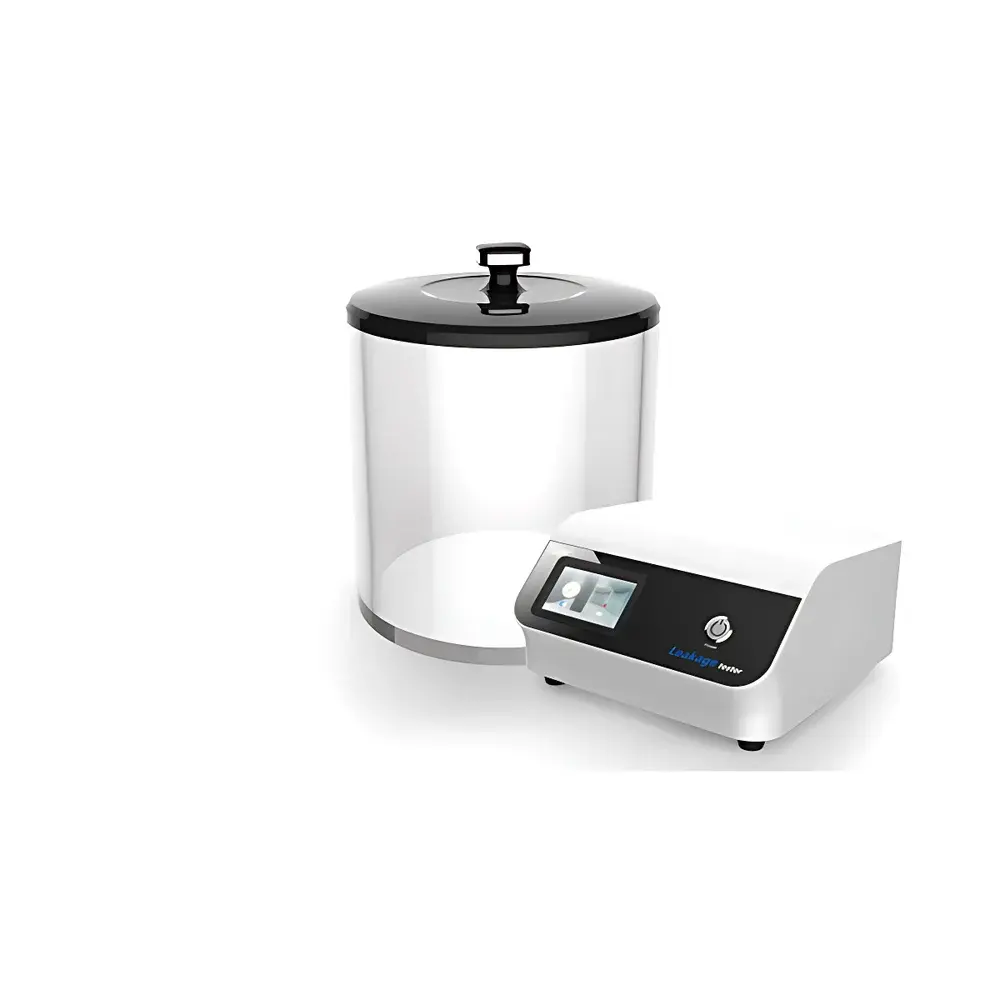
GBPI GB-M2 Seal Integrity Tester
| Brand | GBPI (Guangzhou Biaoji) |
|---|---|
| Origin | Guangdong, China |
| Manufacturer Type | OEM/ODM Manufacturer |
| Country of Origin | China |
| Model | GB-M2-aa |
| Price Range | USD 4,200 – 7,000 |
| Vacuum Range | 0 to −90 kPa |
| Vacuum Accuracy | ±1% FS (Full Scale) |
| Vacuum Hold Time | 0.1 s – 9999.9 s |
| Compressed Air Pressure | 0.6–0.8 MPa |
| Air Consumption | ≥180 L/min (dependent on hold time & vacuum level) |
| Power Supply | 220 V, 50 Hz |
| Vacuum Chamber Dimensions | Ø300 × 300 mm (standard small chamber |
| Instrument Dimensions | 320 × 300 × 160 mm |
| Net Weight | 5.1 kg (main unit) + 8.3 kg (chamber) |
Overview
The GBPI GB-M2 Seal Integrity Tester is an automated, pneumatic-driven instrument engineered for quantitative evaluation of seal integrity in flexible and rigid packaging systems. It operates on the principle of vacuum decay testing—applying a controlled negative pressure to a sealed package immersed in water or placed within a vacuum chamber, then monitoring for bubble emission or pressure loss over a defined dwell period. This method aligns with standardized leak detection protocols used in quality assurance laboratories across regulated industries. Designed in strict compliance with GB/T 15171–1994 *Test Methods for Seal Integrity of Flexible Packages* and ASTM D3078–2002 (reapproved 2013) *Standard Test Method for Determination of Leaks in Flexible Packaging by Bubble Emission*, the GB-M2 delivers repeatable, operator-independent results essential for process validation, packaging development, and routine QC release testing.
Key Features
- Pneumatically actuated vacuum generation system ensures stable, low-noise operation without oil contamination or thermal drift.
- Microprocessor-controlled test sequence: automatic vacuum draw, precise hold-time regulation (0.1 s resolution), timed pressure release, and chamber re-pressurization.
- Backlit LCD interface displays real-time vacuum level, elapsed hold time, system status, and error codes—enabling immediate operational verification.
- Two-mode operation: fully automated cycle execution or manual intervention via pause/resume/abort functions for troubleshooting or protocol optimization.
- Modular vacuum chamber design (standard Ø300 × 300 mm) supports rapid interchangeability; optional custom chambers accommodate irregularly shaped containers or high-throughput tray-based testing.
- Integrated safety logic prevents over-pressurization and monitors air supply stability; audible and visual alerts trigger upon parameter deviation or system fault.
Sample Compatibility & Compliance
The GB-M2 accommodates a broad range of packaging formats including pouches, sachets, blister cards, trays, bottles, and tubs made from laminated films, aluminum foils, coextrusions, and thermoformed plastics. It is routinely deployed in pharmaceutical primary packaging (e.g., Alu-Alu blisters, peelable lids), sterile medical device pouches, food-grade retort and vacuum-sealed bags, and cosmetic sachets. All test procedures conform to regulatory expectations for seal validation under Good Manufacturing Practice (GMP) frameworks. The instrument’s documented performance characteristics—including traceable vacuum accuracy (±1% FS), calibrated timing resolution, and mechanical repeatability—support audit readiness for FDA inspections, EU Annex 11 assessments, and ISO 13485-certified environments. CNAS-accredited calibration services are available through GBPI’s in-house GBPI Testing Center.
Software & Data Management
While the GB-M2 operates as a standalone benchtop unit with embedded firmware, its test parameters and pass/fail outcomes are fully recordable via external USB data logging (optional). GBPI provides compliant reporting templates aligned with 21 CFR Part 11 requirements—including electronic signatures, audit trails, and user-access controls—when integrated with GBPI’s LabSuite QC software suite (sold separately). Raw vacuum decay curves and timestamped event logs can be exported in CSV format for statistical process control (SPC) analysis using Minitab, JMP, or internal LIMS platforms. Firmware updates maintain alignment with evolving test standards and support future protocol expansions such as dual-chamber comparative testing or multi-step pressure ramp profiles.
Applications
- Validation of heat-seal parameters (temperature, dwell time, pressure) during packaging line qualification.
- Comparative assessment of seal strength across different film structures or adhesive formulations.
- Post-distribution simulation testing: evaluating seal integrity after mechanical stress (drop, compression, vibration) per ISTA or ASTM D4169 protocols.
- Root cause analysis of seal failures in complaint investigations or CAPA workflows.
- Supporting packaging component selection—e.g., evaluating compatibility between closure systems and container materials under accelerated aging conditions.
- Facilitating regulatory submissions requiring objective evidence of container-closure integrity (CCI), particularly for non-sterile and semi-permeable dosage forms.
FAQ
What vacuum level range does the GB-M2 support, and how is accuracy verified?
The instrument achieves a maximum vacuum of −90 kPa with full-scale accuracy of ±1%, validated against NIST-traceable pressure standards during factory calibration.
Can the GB-M2 test rigid containers like glass vials or HDPE bottles?
Yes—when used with appropriately sized vacuum chambers and immersion fixtures, it supports both flexible and semi-rigid packaging per ASTM D3078 Annex A1 (dry chamber method) and Annex A2 (submersion method).
Is compressed air supply included with the instrument?
No—users must provide a clean, dry, oil-free compressed air source meeting 0.6–0.8 MPa pressure and ≥180 L/min flow capacity; GBPI recommends ISO 8573-1 Class 2.2.2 filtration.
Does the GB-M2 meet international regulatory requirements for pharmaceutical packaging testing?
It complies with core physical test standards referenced in USP , ISO 11607-2, and EU GMP Annex 1, and its documented measurement uncertainty supports IQ/OQ/PQ protocol execution.
How frequently should calibration be performed?
Annual calibration is recommended; GBPI offers certified recalibration services with full traceability documentation and CNAS-endorsed certificates.





