
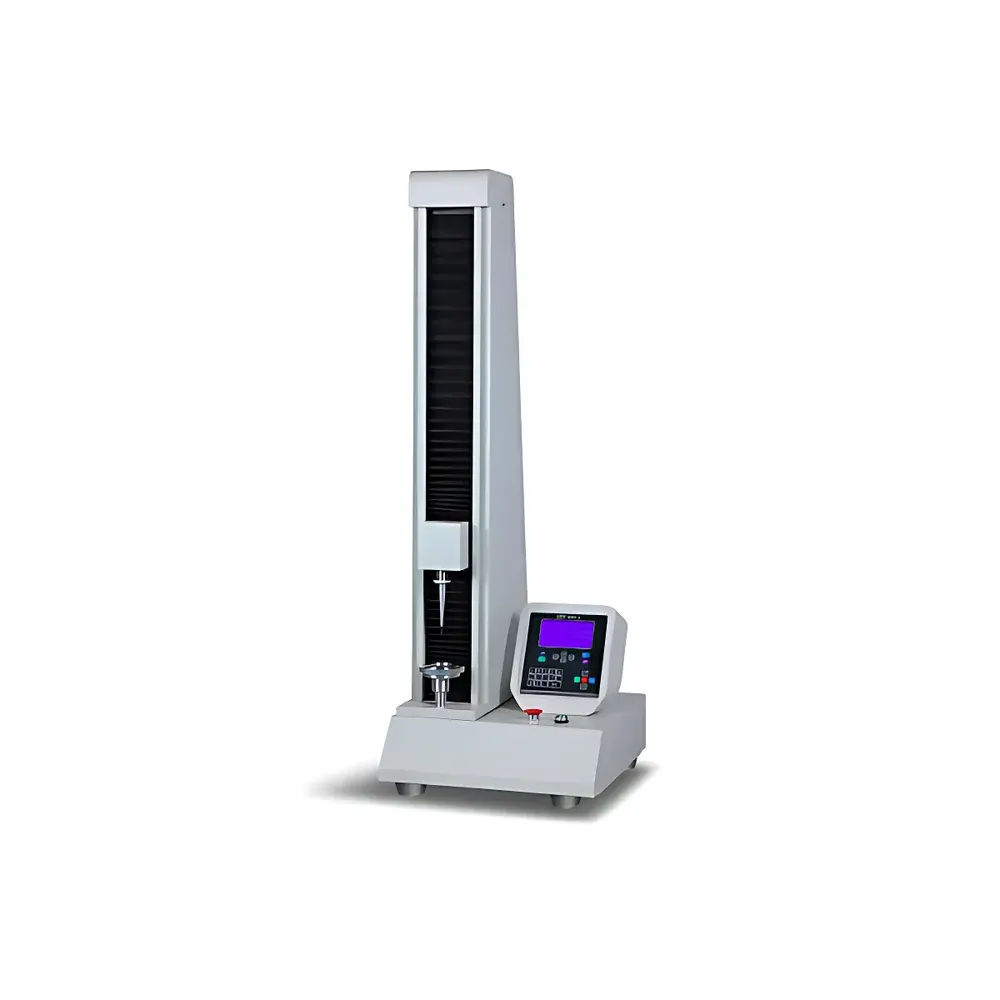
GBPI GBH-1W Universal Electronic Tensile Testing Machine for Film Peel, Puncture, Tear and Tensile Analysis
| Brand | GBPI |
|---|---|
| Model | GBH-1W |
| Type | Single-Column Electromechanical Tensile Tester |
| Max Load Capacity | 1.5 kN |
| Force Range | 0–500 N (optional 0–1500 N) |
| Force Accuracy | ±0.5% of reading (Class 0.5) |
| Extension Range | up to 1400% strain |
| Crosshead Travel | 750 mm |
| Displacement Resolution | ±0.5% of reading |
| Test Speed | 0–500 mm/min (infinitely variable) |
| Effective Specimen Width | 30 mm (customizable to 50 mm) |
| Sampling Rate | 100 Hz |
| Power Supply | AC 220 V, 50 Hz, 1000 W |
| Dimensions (W×D×H) | 600 × 600 × 1300 mm |
| Weight | 70 kg |
Overview
The GBPI GBH-1W is a precision-engineered single-column universal electromechanical tensile testing machine designed specifically for the mechanical characterization of thin, flexible packaging materials—including plastic films, laminated pouches (e.g., PET/AL/PE), aluminum-plastic composites, medical blister foils, adhesive tapes, nonwovens, rubber sheets, and coated papers. It operates on the fundamental principle of controlled uniaxial force application via a high-stiffness ball-screw-driven crosshead, coupled with real-time load and displacement transduction using calibrated load cells and digital encoders. The system conforms to standardized test geometries and kinematic constraints defined in ISO, ASTM, and Chinese national standards (e.g., GB/T 8808 for peel strength, GB/T 2790 for adhesion, ASTM D882 for tensile properties of thin plastics), enabling traceable, reproducible mechanical data acquisition under GLP-compliant laboratory conditions.
Key Features
- Modular multi-function capability: supports tensile, 90°/180° peel, puncture, trouser tear, Elmendorf tear, heat seal strength, compression, bending, and shear tests—configurable via software-defined test protocols.
- Class 0.5 force measurement accuracy (±0.5% of reading) across full scale, validated per ISO 7500-1 and ASTM E4, with dual-range load cell support (standard 0–500 N; optional 0–1500 N).
- High-resolution motion control: imported AC servo motor + preloaded ball screw actuation ensures minimal backlash, zero drift, and long-term positional stability over 750 mm travel.
- Dual configuration options: integrated controller (compact desktop footprint) or external control unit (enabling standalone operation and future hardware upgrades without PC dependency).
- Real-time data acquisition at 100 Hz sampling rate, capturing transient events such as yield onset, necking propagation, and failure initiation with high fidelity.
- Comprehensive safety architecture: hardware-based upper/lower limit switches, overload cut-off, emergency stop circuitry, and software-enforced parameter bounds prevent mechanical overtravel or sensor saturation.
- Open data structure compliant with ASTM E1434 and ISO 10360-5: all raw channel data (load, displacement, time, extensometer if fitted) are stored in ASCII-compatible format for third-party analysis (e.g., MATLAB, Python Pandas, Excel).
Sample Compatibility & Compliance
The GBH-1W accommodates specimens up to 30 mm wide (expandable to 50 mm) and thicknesses ranging from 12 µm polymer films to 3 mm elastomeric sheets. Its standardized fixture interface supports interchangeable grips—including pneumatic clamps (optional), pneumatic peel fixtures, puncture probes (Φ1.0 mm stainless steel), and right-angle tear blades—ensuring consistent edge alignment and stress distribution per ISO 37, ASTM D1938, and GB/T 2791. All test methods implemented align with regulatory requirements for packaging validation in pharmaceutical (YBB series), food (GB 4850, GB/T 10004), and medical device (ISO 11607-2) applications. Instrument qualification documentation—including as-delivered calibration certificates traceable to NIM (National Institute of Metrology, China)—is provided, supporting IQ/OQ protocols under FDA 21 CFR Part 11 and EU Annex 11 environments.
Software & Data Management
The embedded Windows-based control software features intuitive wizard-guided test setup, real-time curve overlay (up to 8 concurrent tests), automatic peak detection, modulus calculation (secant/tangent), and elongation-at-break reporting. Audit-trail functionality logs user actions, parameter changes, and calibration events with timestamps—meeting ALCOA+ principles for data integrity. Export modules generate CSV, XLSX, and PDF reports with customizable templates; raw data files include metadata headers specifying test standard, specimen ID, environmental conditions (optional hygrometer integration), and operator signature. Software supports automated batch processing for QC labs performing routine release testing on incoming film rolls or finished pouches.
Applications
- Quality assurance of thermoformed blisters and cold-form foil laminates in pharmaceutical packaging lines.
- Evaluation of delamination resistance in multilayer barrier films (e.g., EVOH-containing structures) subjected to thermal cycling or humidity stress.
- Validation of heat seal integrity across varying dwell times, temperatures, and pressures per ASTM F88 and ISO 11607-2.
- Characterization of puncture resistance in sterile barrier systems used for surgical instrument trays.
- Comparative tear propagation analysis of biodegradable films (PLA, PHA) versus conventional PE/LDPE under controlled humidity.
- Academic research on strain-rate-dependent viscoelastic behavior of hydrogel-coated wound dressings.
FAQ
What standards does the GBH-1W natively support?
It includes built-in test templates for GB/T 8808 (peel), GB/T 1040 (tensile), ASTM D882 (thin plastics), ASTM F88 (seal strength), ISO 37 (rubber tear), and YBB 00112003 (pharmaceutical foil), with editable parameters to accommodate lab-specific SOPs.
Can the system be integrated into an existing LIMS or MES platform?
Yes—via RS232 serial interface or optional Ethernet module, the GBH-1W supports ASTM E1434-compliant data streaming and SCADA-level command-response protocols for automated result ingestion.
Is third-party calibration certification available?
GBPI provides factory calibration certificates traceable to NIM; accredited ISO/IEC 17025 calibration services can be arranged through authorized regional metrology labs upon request.
What maintenance intervals are recommended for long-term reliability?
Ball screw lubrication every 6 months, load cell verification annually, and encoder alignment check after any impact event or relocation—detailed in the included maintenance logbook and digital manual.
Does the software meet FDA 21 CFR Part 11 requirements for electronic records?
Full compliance requires enabling audit trail, electronic signatures, and role-based access control—features activated during installation and validated during IQ/OQ by qualified personnel.



