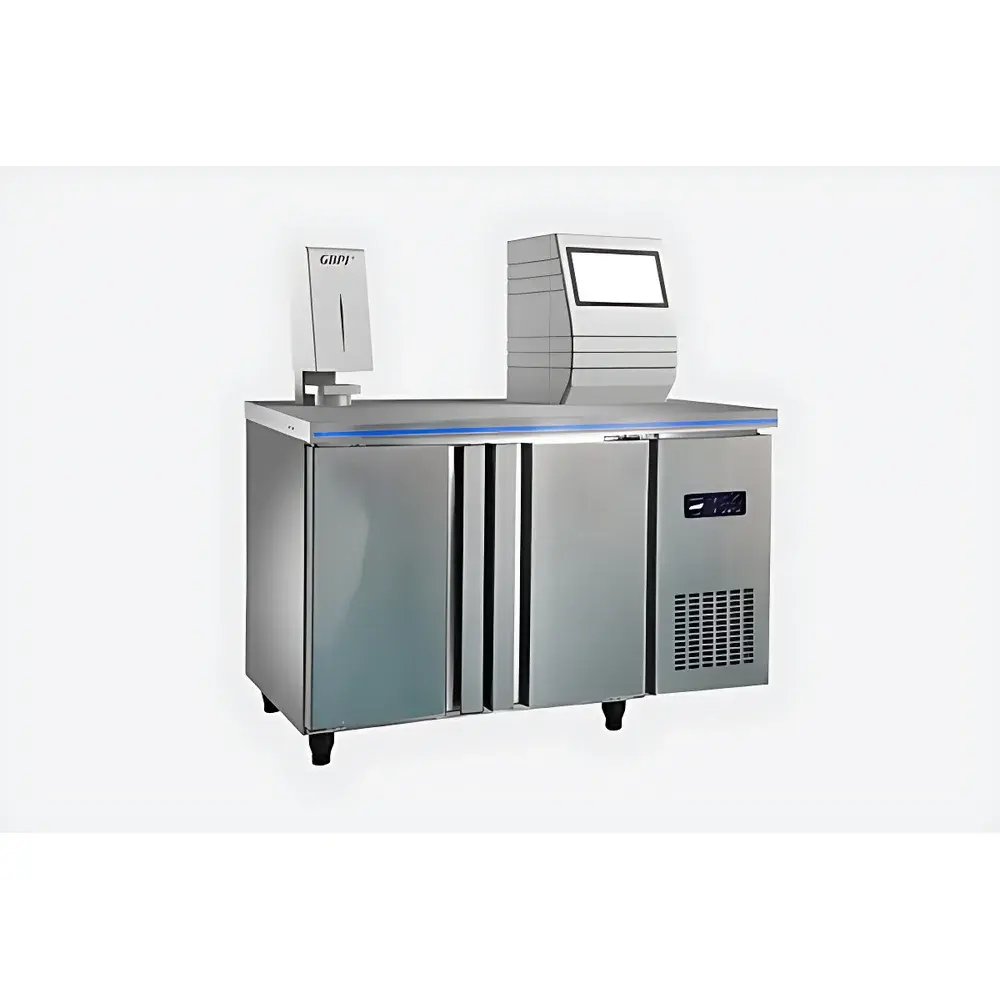
GBPI GB-KF30010CV ASTM-Compliant Particulate Filtration Efficiency Tester for Respiratory Protective Devices and Woven Fabrics
| Brand | GBPI |
|---|---|
| Origin | Guangdong, China |
| Manufacturer Type | Direct Manufacturer |
| Country of Origin | China |
| Model | GB-KF30010CV |
| Price Range | USD 42,000–70,000 |
| Filtration Efficiency Range | 0–99.999% |
| Flow Rate Control Range | 20–100 L/min |
| Pressure Drop Measurement Range | 0–1000 Pa |
| Test Particle Sizes | 0.3 µm, 0.5 µm, 5.0 µm |
| Aerosol Sources | DEHS (oil-based) and 2% NaCl (salt-based) |
| Standard Test Area | 100 cm² (customizable per mask geometry) |
| Dimensions | 130 × 75 × 157 cm |
| Weight | 250 kg |
| Power Consumption | <1500 W |
| Power Supply | AC 220 V, 50 Hz |
Overview
The GBPI GB-KF30010CV is a fully integrated, ASTM-aligned particulate filtration efficiency (PFE) testing system engineered for precise evaluation of respiratory protective devices—including surgical masks, N95-equivalent respirators, and medical gowns—as well as woven and nonwoven textile filter media. It operates on the principle of controlled aerosol challenge under constant volumetric flow, measuring both upstream and downstream particle concentrations via laser particle counting to calculate fractional filtration efficiency across discrete aerodynamic diameters (0.3 µm, 0.5 µm, and 5.0 µm). The system complies with core regulatory frameworks governing personal protective equipment (PPE) performance verification in North America, Europe, and Asia, including ASTM F2299 (for surgical mask PFE), ASTM F2100 (medical face mask standards), and ISO 16890 (air filter classification), while maintaining full traceability to U.S. FDA-recommended test methodologies for respiratory protection validation.
Key Features
- Cold-generation aerosol system capable of stable, reproducible output of both oil-based (DEHS) and salt-based (2% NaCl) challenge aerosols—enabling dual-mode compliance testing per ASTM F2299 and EN 1822-3.
- Integrated electrostatic neutralizer (bipolar ionizer) upstream of the test sample to eliminate charge-dependent filtration artifacts, ensuring measurement fidelity aligned with ISO 16890 Annex B and USP <788> aerosol characterization guidance.
- Hermetically sealed aerosol pathway with negative-pressure containment and HEPA-filtered exhaust—designed to meet OSHA 29 CFR 1910.1200 and ANSI Z88.2-2015 requirements for operator safety during high-concentration aerosol exposure.
- Pneumatically actuated, force-calibrated sample holder with over-travel limiters and mechanical interlocks—ensuring consistent clamping pressure (±2 kPa) and eliminating edge leakage per ISO/IEC 17025:2017 clause 7.2.2.
- Dual-channel, real-time laser particle counter (0.3–10 µm detection range, 0.1 fL sample volume resolution) synchronized with mass flow controllers (±0.5% reading accuracy) for dynamic efficiency calculation at defined flow rates (20–100 L/min).
- Embedded industrial-grade touch interface with local data logging, plus optional Ethernet-linked PC control software supporting audit trail, electronic signatures, and 21 CFR Part 11-compliant user access management.
Sample Compatibility & Compliance
The GB-KF30010CV accommodates flat-sheet filter media (e.g., melt-blown polypropylene, glass fiber, PTFE membranes) and three-dimensional respirator samples—including cup-style, fold-flat, and duckbill configurations—via adjustable mounting fixtures and programmable sample area definition (standard 100 cm², scalable up to 150 cm²). It satisfies mandatory testing protocols referenced in GB/T 32610–2016 (daily-use masks), GB 2626–2019 (KN-class respirators), YY 0469–2011 (surgical masks), and YY/T 0969–2013 (disposable medical masks). Its architecture supports GLP-compliant operation through calibrated transducers (NIST-traceable pressure and flow sensors), automated zero-drift compensation, and built-in system verification routines (e.g., blank filter baseline, aerosol stability check every 15 minutes).
Software & Data Management
The proprietary GBPI FilterTest Suite v4.2 provides ISO/IEC 17025-aligned test sequencing, real-time visualization of differential pressure, particle count histograms, and cumulative filtration efficiency curves. All raw sensor outputs—including voltage signals from photodetectors, thermistor readings, and solenoid valve states—are timestamped and stored in encrypted SQLite databases with SHA-256 hashing. Export options include CSV (for LIMS integration), PDF test reports with digital signatures, and XML files compliant with ASTM E2500-13 metadata schema. Audit trails record user login/logout events, parameter modifications, calibration actions, and report generation—fully supporting FDA 21 CFR Part 11 Subpart C requirements for electronic records and signatures.
Applications
This instrument serves laboratories engaged in regulatory submission support (e.g., FDA 510(k), CE Marking under PPE Regulation EU 2016/425), internal QC/QA for mask and filter material manufacturers, third-party certification bodies accredited to ISO/IEC 17025, and national reference labs conducting inter-laboratory comparison studies. Typical use cases include: comparative analysis of electret decay under humidity stress; validation of reprocessing efficacy for reusable respirators; assessment of filtration degradation after mechanical abrasion or laundering cycles; and determination of pressure drop–efficiency trade-offs for next-generation nanofiber composites.
FAQ
Does the GB-KF30010CV support both salt and oil aerosol testing per ASTM F2299 and F1862?
Yes—it includes dual aerosol generators and a neutralizer module configured to meet the aerosol generation and conditioning requirements of both standards.
Can test results be exported to LIMS or ERP systems?
Yes—CSV and XML exports are natively supported, with configurable field mapping and scheduled automated transfers via FTP/SFTP.
Is the system validated for ISO/IEC 17025 accreditation?
Yes—the hardware architecture, sensor calibration intervals, and software audit trail functionality are designed to satisfy Clause 6.4 (Equipment) and Clause 7.7 (Results Reporting) of ISO/IEC 17025:2017.
What maintenance is required for long-term operational reliability?
Scheduled quarterly verification of aerosol generator output stability, annual recalibration of pressure and flow sensors by GBPI-certified engineers, and biannual replacement of desiccant in the air dryer unit.
Is remote diagnostics and software update capability available?
Yes—optional GBPI RemoteCare subscription enables secure TLS-encrypted remote access for firmware updates, log file retrieval, and troubleshooting assistance from GBPI Application Engineers.