
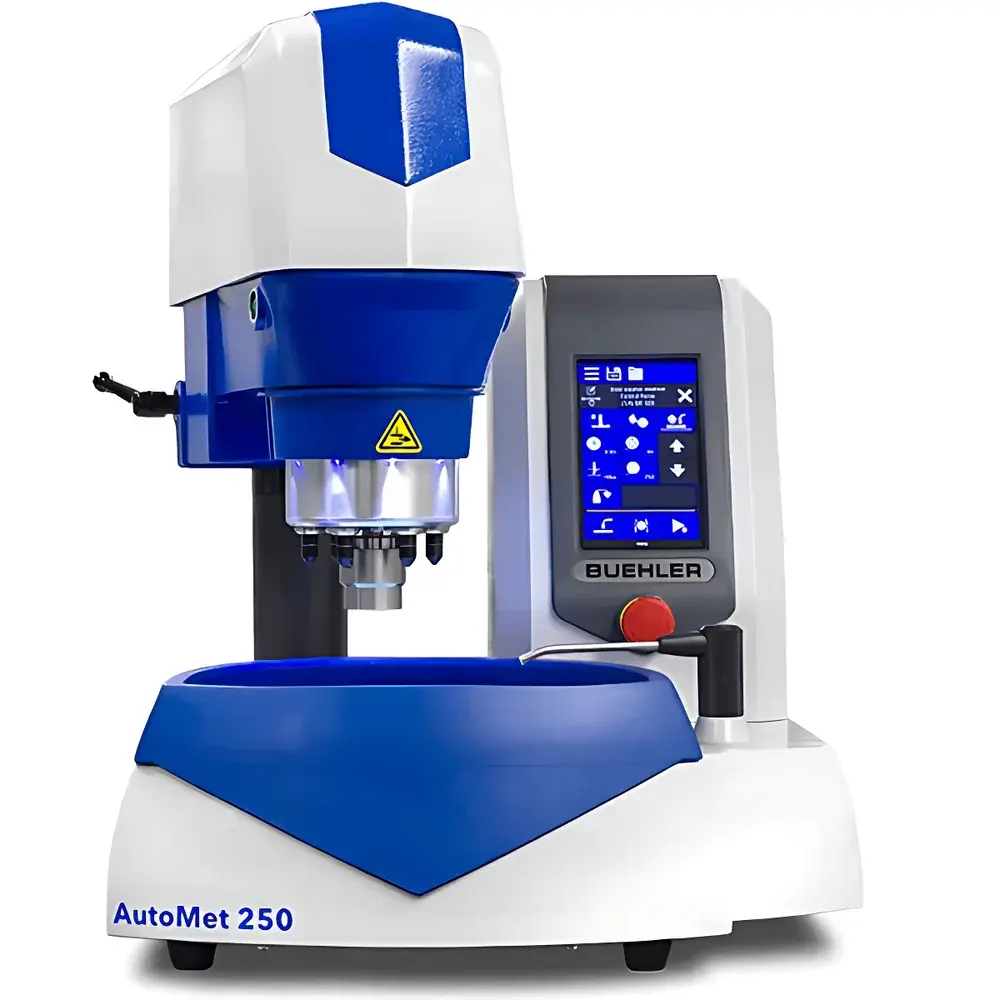
Buehler AutoMet 250 Pro Semi-Automatic Grinding and Polishing System
| Brand | Buehler |
|---|---|
| Origin | USA |
| Model | AutoMet 250 Pro |
| Motor Power | 1 hp (0.75 kW) |
| Maximum Sample Diameter | 40 mm (1.5 in) |
| Control Interface | Full-color LCD touchscreen |
| Sample Mounting | Apex S and magnetic disc system |
| Diamond Suspension Delivery | Up to 5 programmable Burst dispensers |
| Automation Capability | Multi-step method programming, Z-axis material removal mode |
| Cleaning | One-touch auto-clean function |
| Fixture Compatibility | Medium- and large-size sample holders |
| Compliance | Designed for GLP/GMP-aligned metallurgical lab workflows |
Overview
The Buehler AutoMet 250 Pro is a semi-automatic grinding and polishing system engineered for precision, repeatability, and operational efficiency in metallurgical, materials science, and failure analysis laboratories. Built upon Buehler’s decades of expertise in metallographic sample preparation, the AutoMet 250 Pro employs a robust mechanical architecture combined with programmable motion control to deliver consistent surface conditioning across diverse material classes—including ferrous and non-ferrous alloys, ceramics, composites, and geological specimens. Its core operation follows standardized metallographic principles: sequential abrasive grinding (SiC paper or diamond-impregnated discs), fine grinding, and final polishing—each stage governed by controlled rotational speed, applied load, dwell time, and coolant flow. The system integrates Z-axis material removal mode, enabling precise depth-controlled grinding to target specific microstructural regions without over-removal—a critical capability for cross-sectional analysis of coatings, interfaces, or heat-affected zones.
Key Features
- Full-color LCD touchscreen interface: Intuitive graphical user interface supports both manual operation and fully programmable multi-step methods; all parameters—including speed, time, pressure, and suspension delivery—are adjustable and stored with timestamped method IDs.
- Apex S and magnetic disc mounting system: Enables rapid, tool-free exchange of grinding wheels, polishing cloths, and consumables; eliminates alignment drift and ensures repeatable disc concentricity across hundreds of cycles.
- Programmable Burst diamond suspension dispensers (up to 5 units): Delivers metered, timed pulses of diamond suspensions (e.g., 9 µm, 3 µm, 1 µm, 0.25 µm) directly onto the polishing surface; reduces reagent waste and minimizes operator variability in slurry application.
- Z-axis material removal mode: Uses real-time motor current feedback and positional encoding to maintain constant material removal rate independent of specimen hardness or topography—ideal for preparing planar cross-sections of layered structures or embedded components.
- One-touch auto-clean cycle: Activates synchronized rotation, coolant flush, and disc agitation to evacuate debris from the platen, spindle, and fixture interface—reducing maintenance downtime and preventing cross-contamination between samples.
- High-torque 0.75 kW motor and reinforced chassis: Supports continuous operation under high-load conditions typical of large-diameter (up to 40 mm) or high-hardness samples; structural rigidity minimizes vibration-induced artifacts during fine polishing stages.
Sample Compatibility & Compliance
The AutoMet 250 Pro accommodates specimens ranging from standard 25 mm mounts to oversized 40 mm diameter samples using optional medium- and large-format holders. It is compatible with all major consumable formats—including rigid and flexible grinding papers, diamond-impregnated discs, woven and non-woven polishing cloths, and colloidal silica or alumina suspensions. The system supports ASTM E3, ISO 13082, and EN 10365-compliant preparation protocols. Its method storage, audit trail logging (including user ID, timestamp, and parameter set), and password-protected configuration align with GLP and GMP requirements. While not FDA 21 CFR Part 11–certified out-of-the-box, its data export functionality (CSV, PDF reports) facilitates integration into validated LIMS or electronic lab notebook environments.
Software & Data Management
All methods are defined, saved, and recalled via the onboard touchscreen controller. Each method includes up to 10 sequential steps, with independent settings for rotational speed (50–600 rpm), dwell time (0.1–999.9 s), applied force (0–50 N), suspension burst count/duration, and coolant activation logic. The system logs execution history per run—including actual torque, temperature, and suspension volume dispensed—and exports logs via USB to support root-cause analysis of preparation anomalies. No proprietary software installation is required for routine operation; however, optional Buehler MetaMorph™ Lab Suite enables remote monitoring, fleet-wide method synchronization, and statistical process control (SPC) charting of surface roughness or etch uniformity metrics derived from downstream imaging systems.
Applications
The AutoMet 250 Pro serves as a primary preparation platform in quality control labs for automotive castings, aerospace turbine blades, additive-manufactured parts, and semiconductor packaging substrates. It is routinely deployed for failure analysis of solder joints, thermal barrier coatings, and brazed assemblies where interfacial integrity must be preserved. In academic and R&D settings, it supports serial sectioning for 3D microstructure reconstruction, grain boundary mapping via EBSD, and TEM lamella preparation via precision low-angle grinding. Its reproducibility makes it suitable for ISO/IEC 17025-accredited testing laboratories performing hardness calibration block preparation or reference material certification.
FAQ
What sample sizes does the AutoMet 250 Pro support?
It accepts specimens up to 40 mm in diameter using standard or optional large-format holders; thickness is limited only by fixture clearance (typically ≤ 30 mm).
Can the system be integrated into an automated lab workflow?
Yes—via digital I/O signals and Modbus TCP protocol, it can synchronize with robotic sample handlers, barcode scanners, and central LIMS systems for unattended batch processing.
Is method validation documentation available?
Buehler provides IQ/OQ templates and performance qualification protocols aligned with ASTM E3 Annex A1; full PQ support requires site-specific testing under user-defined acceptance criteria.
How is suspension consumption tracked and optimized?
Each Burst dispenser records actuation count and duration per run; cumulative usage data is exported and correlates strongly with observed surface finish metrics in inter-laboratory studies.
Does the system require compressed air or external vacuum?
No—coolant delivery and cleaning functions operate solely via integrated pump and gravity drainage; optional exhaust hood integration is supported for volatile suspension handling.



