
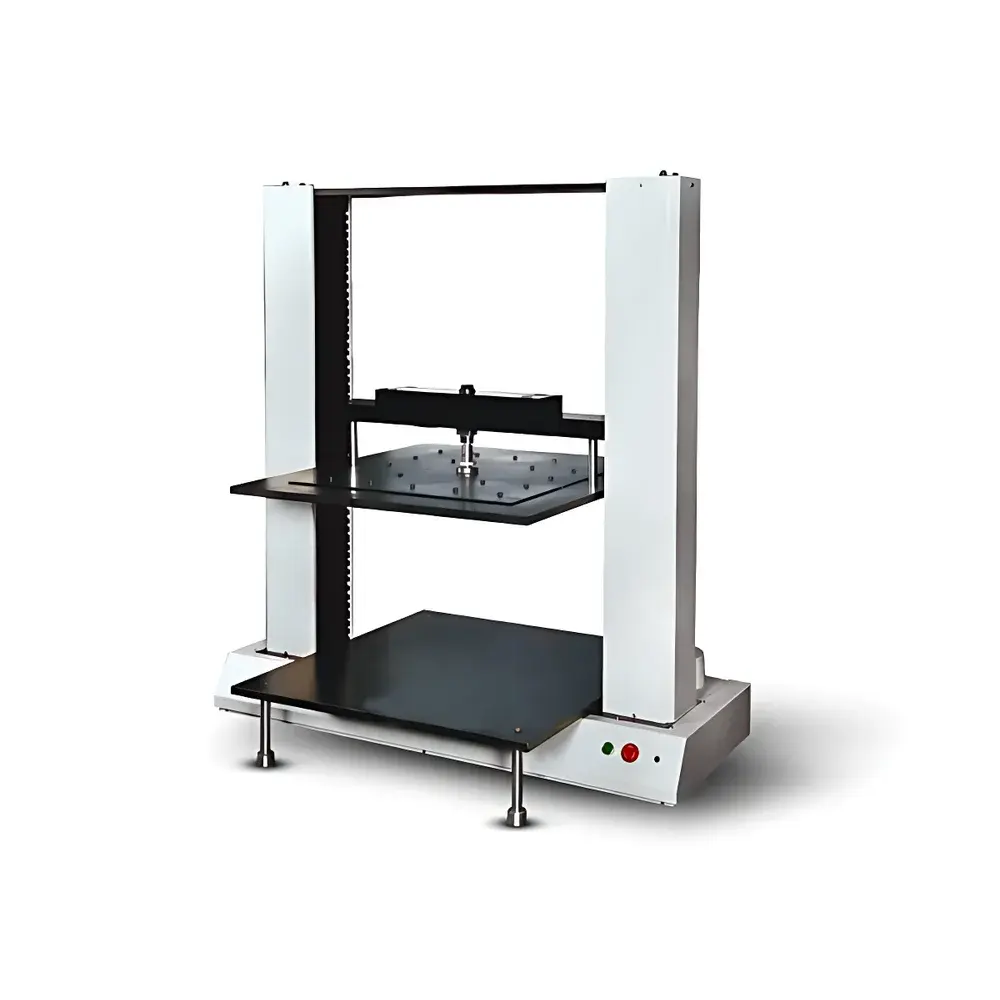
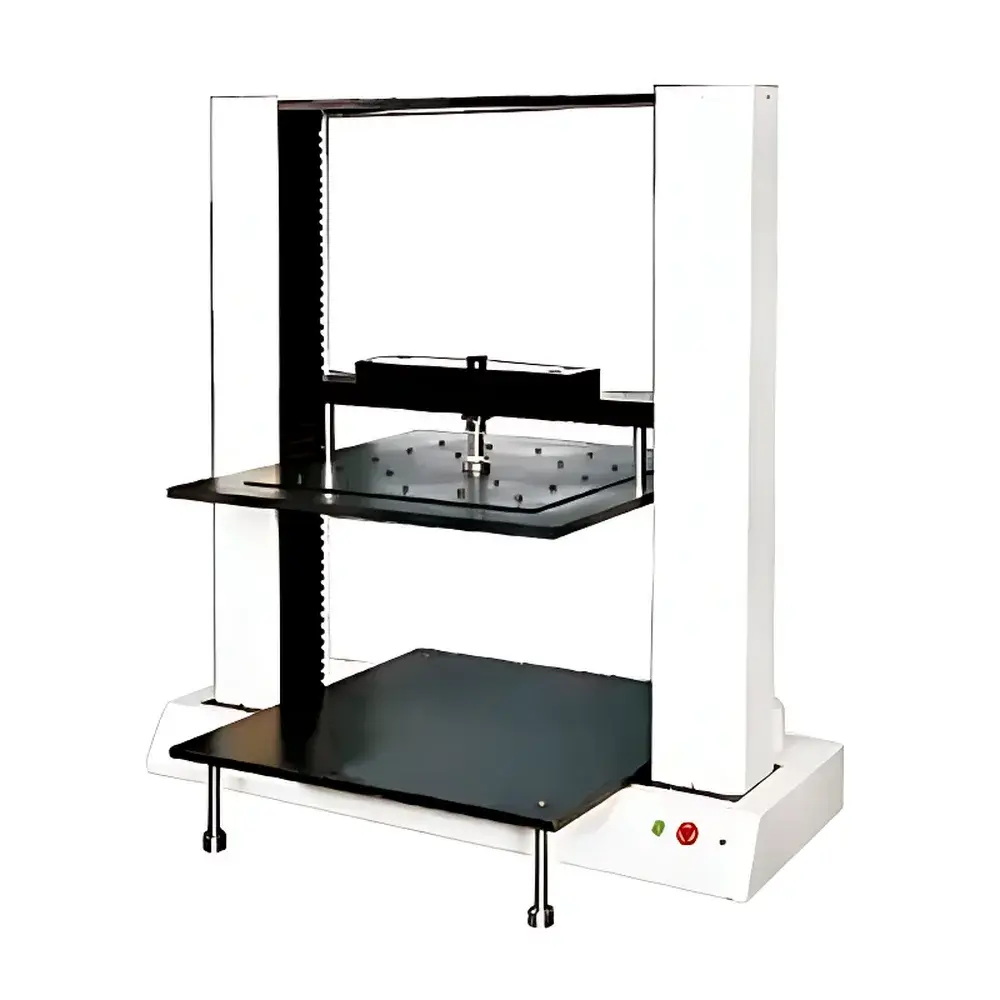
GBPI GBN 2000Z Compression Testing Machine for Corrugated Boxes
| Brand | GBPI |
|---|---|
| Origin | Guangdong, China |
| Manufacturer | GBPI Packaging Instruments Co., Ltd. |
| Model | GBN 2000Z |
| Max Load Capacity | 20 kN |
| Effective Force Range | 0.4–100% of full scale |
| Force Accuracy | ±1% of reading (Class 1) |
| Force Resolution | 0.001 N |
| Effective Test Space | 800 mm × 800 mm × 800 mm (W × D × H) |
| Test Speed Range | 0.01–200 mm/min (infinitely variable) |
| Speed Accuracy | ±1% of set value |
| Displacement Accuracy | ±1% of reading |
| Crosshead Adjustment | Dual-speed motorized lift — rapid (200 mm/min) and fine-adjustment (10 mm/min), with jog control |
| Compliance Standards | GB/T 16491, GB/T 4857.16, ISO 2872, ASTM D642 |
Overview
The GBPI GBN 2000Z Compression Testing Machine is an electromechanical universal testing system engineered for high-reliability static compression evaluation of corrugated fiberboard packaging—specifically designed to quantify compressive strength, deformation behavior, and stacking resistance under controlled loading conditions. Based on the principle of axial force application via a servo-controlled crosshead and precision load cell measurement, the instrument delivers repeatable, traceable mechanical data essential for packaging integrity validation in logistics, distribution, and warehouse storage environments. Its architecture adheres to fundamental metrological requirements for Class 1 mechanical testing systems per ISO 7500-1 and aligns with structural test methodologies defined in ASTM E4 and GB/T 228.1 for force transduction and displacement registration.
Key Features
- 20 kN high-capacity dual-range load cell with resolution down to 0.001 N, enabling precise quantification across low-force creep and high-load collapse regimes.
- Infinitely variable speed control from 0.01 to 200 mm/min, supporting both quasi-static compression (e.g., long-term stack simulation) and rapid crush assessment (e.g., impact-like loading).
- Motorized dual-speed crosshead lift: rapid positioning at 200 mm/min for setup efficiency; fine-tuned 10 mm/min mode for precise specimen alignment and contact initiation—both with momentary jog capability.
- Uniform test chamber dimensions of 800 mm × 800 mm × 800 mm (W × D × H), accommodating standard RSC, HSC, and custom large-format corrugated containers without dimensional compromise.
- Force accuracy certified to ±1% of reading over 0.4–100% of full scale, validated per GB/T 16491 and traceable to national metrological standards.
- Rigid four-column frame with preloaded linear guides ensures minimal deflection (<0.05 mm under max load), preserving axial alignment and minimizing parasitic bending moments during testing.
Sample Compatibility & Compliance
The GBN 2000Z is optimized for rigid and semi-rigid fiber-based packaging structures including single-wall and multi-wall corrugated boxes, honeycomb board containers, solid fiberboard trays, and edge-protected shipping units. It supports standardized test configurations for compression-to-failure, constant-rate compression, and time-dependent creep under sustained load—critical for evaluating real-world palletized stacking performance. The system fully complies with internationally recognized test protocols: GB/T 16491 (General Requirements for Electronic Universal Testing Machines), GB/T 4857.16 (Packaging – Compression Testing of Transport Packages), ISO 2872 (Packaging – Complete, Filled Transport Packages – Compression Test), and ASTM D642 (Standard Test Method for Determining Compressive Resistance of Shipping Containers, Components, and Unit Loads). All test sequences are structured to support GLP-compliant documentation when paired with validated software.
Software & Data Management
Operation is managed via GBPI’s proprietary Windows-based control and analysis software, requiring a user-supplied Windows PC (Windows 10/11, 64-bit, minimum 8 GB RAM). The software provides real-time force-displacement curve visualization, automatic peak detection (maximum compressive load), yield point identification, and deformation modulus calculation. Raw data export is supported in CSV and Excel formats for downstream statistical analysis (e.g., Weibull distribution modeling of box failure thresholds). Audit trails—including operator ID, timestamp, calibration status, and test parameter logs—are retained per session. While native software does not implement FDA 21 CFR Part 11 electronic signature functionality, the platform supports external integration with LIMS or ELN systems via standardized API endpoints for enterprise-level data governance.
Applications
- Quantitative assessment of compression strength for cartons used in e-commerce fulfillment centers.
- Evaluation of edge crush test (ECT)-correlated performance in double-wall and triple-wall corrugated designs.
- Stack load simulation for warehouse racking compliance verification per ANSI MH1 and ISO 8611.
- Comparative durability testing of recycled-content vs. virgin-fiber board under identical environmental conditioning (e.g., 50% RH / 23°C per ISO 187).
- Validation of closure integrity and corner reinforcement efficacy under vertical load.
- Support for ISTA 3A, 3E, and 3H test protocols where compression is a defined sub-sequence.
FAQ
What standards does the GBN 2000Z directly support out-of-the-box?
It is factory-configured to execute GB/T 16491, GB/T 4857.16, ISO 2872, and ASTM D642 test methods—including preset speed profiles, load limits, and reporting templates.
Is the system suitable for testing non-corrugated materials such as molded pulp or plastic crates?
Yes—provided specimens fit within the 800 mm test envelope and generate forces within the 20 kN range; however, specialized platens or fixtures may be required for non-planar or compliant surfaces.
Does the machine include calibration certification?
A factory-issued calibration certificate (traceable to CNAS-accredited reference standards) is provided with initial delivery; annual recalibration is recommended per ISO/IEC 17025 guidelines.
Can test data be exported to third-party statistical packages?
Yes—CSV and XLSX exports include raw time-stamped force/displacement arrays, metadata headers, and calculated metrics (peak load, deformation at 10% strain, energy absorption).
What maintenance is required for long-term repeatability?
Monthly visual inspection of load cell mounting, quarterly lubrication of lead screws, and biannual verification of encoder linearity using calibrated gauge blocks are advised per GBPI Maintenance Schedule M-GBN2000Z Rev. 3.



