
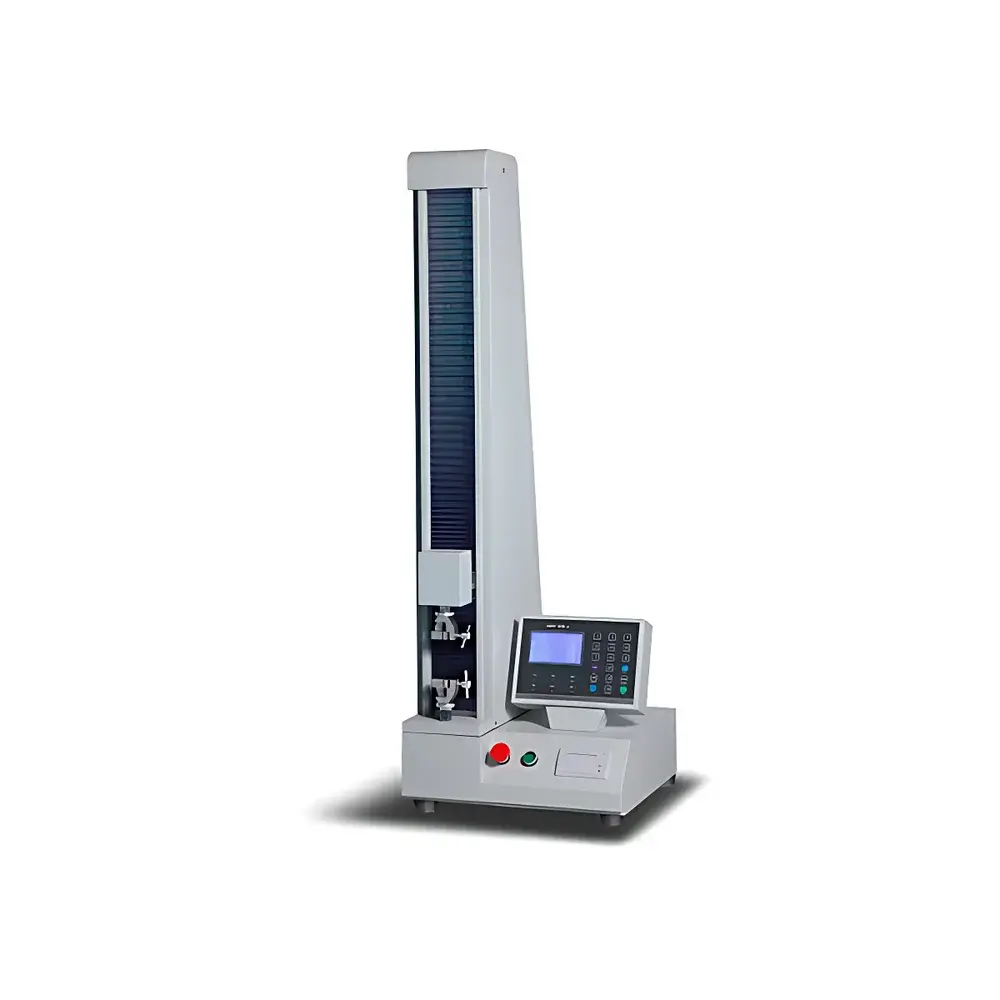
GBPI GBL-H1 Desktop Tensile Testing Machine for Pharmaceutical and Food Packaging Materials
| Brand | GBPI |
|---|---|
| Origin | Guangdong, China |
| Manufacturer | GBPI Packaging Instruments Co., Ltd. |
| Model | GBL-H1 |
| Instrument Type | Electronic Tensile Tester |
| Max Test Load | 0.5 kN |
| Force Range | 0–300 N (optional 0–500 N) |
| Elongation Capacity | up to 1400% |
| Force Accuracy | ±1% of reading (Class 1) |
| Crosshead Travel | 700 mm |
| Displacement Resolution | ±1% of reading |
| Effective Sample Width | 30 mm (customizable to 50 mm) |
| Test Speed | 0–500 mm/min, continuously variable |
| Sampling Rate | 50 Hz |
| Safety | Triple-level protection with emergency stop |
| Display | LCD screen with real-time data and status |
| Output | Integrated thermal printer |
| Power Supply | AC 220 V, 50 Hz |
| Power Consumption | 300 W |
| Dimensions (W×D×H) | 600 × 500 × 1300 mm |
| Weight | 65 kg |
Overview
The GBPI GBL-H1 is a precision-engineered desktop tensile testing machine specifically designed for mechanical property evaluation of flexible packaging materials used in pharmaceutical, food, and consumer healthcare applications. It operates on the fundamental principle of uniaxial force application under controlled displacement, measuring tensile strength, elongation at break, peel adhesion, heat seal strength, tear resistance, and puncture force according to standardized test protocols. Its single-column, benchtop architecture ensures stability and ergonomic operation while maintaining compliance with international mechanical testing standards—including ASTM E4 (load verification), ASTM D882 (tensile properties of thin plastic sheeting), ASTM F88 (heat seal strength), and ISO 11843 (detection capability)—as well as Chinese national pharmacopoeial standards such as YBB00112003 (for pharmaceutical plastic packaging), YBB00102003 (aluminum-plastic composite films), and YBB00132002 (blister packaging). The system is calibrated to Class 1 accuracy per ISO 7500-1 and meets metrological traceability requirements for GLP-compliant laboratories.
Key Features
- Multi-functional mechanical testing platform supporting tensile, peel, heat seal, tear, and puncture modes—each configurable via intuitive parameter input on the integrated LCD interface.
- High-fidelity force measurement using imported load cells with ±1% full-scale accuracy (Class 1), validated against certified reference standards.
- Real-time data acquisition at 50 Hz sampling rate, ensuring high temporal resolution for dynamic failure event capture—critical for brittle film fracture analysis or viscoelastic seal delamination studies.
- Adjustable crosshead speed (0–500 mm/min, infinitely variable) and programmable dwell time, enabling precise replication of regulatory test conditions defined in USP <1207> and ISO 11607-2.
- Triple-tier safety architecture: hardware-based emergency stop button, software-driven overload cutoff, and mechanical limit switches—fully compliant with IEC 61000-6-2 electromagnetic compatibility and EN 61000-6-4 emission standards.
- Thermal printer integration for immediate hard-copy reporting, supporting audit-ready documentation with date/time stamp, sample ID, test mode, peak load, elongation, and modulus values.
- Benchtop footprint (600 × 500 × 1300 mm) optimized for QC labs with space constraints; no external air supply or cooling required.
Sample Compatibility & Compliance
The GBL-H1 accommodates a broad spectrum of soft, anisotropic, and multi-layered packaging substrates—including BOPP, PET, PE, aluminum foil laminates, paperboard composites, medical-grade Tyvek®, and hydrocolloid wound dressings. Its 30 mm standard clamp width (expandable to 50 mm) supports both narrow-strip and wide-web specimens per ASTM D3330 (peel adhesion) and GB/T 2792 (180° peel). All test routines align with mandatory quality control frameworks: FDA 21 CFR Part 11 (via optional password-protected user access logs), Chinese GMP Annex for Pharmaceutical Packaging, and EU Annex 15 (Qualification and Validation). Calibration certificates are traceable to CNAS-accredited national metrology institutes, and the instrument satisfies JJG 139 (Chinese verification regulation for universal testing machines).
Software & Data Management
While the base GBL-H1 operates via embedded firmware with local LCD control, optional PC-based software (GBPI TestSuite v3.2) enables advanced data management. This Windows-compatible application provides customizable test method templates, statistical process control (SPC) charts, batch report generation, and export to CSV, PDF, or XML formats. Audit trail functionality records operator ID, timestamp, parameter changes, and calibration events—meeting ALCOA+ principles (Attributable, Legible, Contemporaneous, Original, Accurate, Complete, Consistent, Enduring, Available) for regulatory submissions. Data integrity safeguards include electronic signatures, role-based permissions, and automatic backup to network drives or NAS systems.
Applications
- Pharmaceutical primary packaging: Quantifying peel strength of blister lidding foils (YBB00202004), seal integrity of sachets (YBB00102003), and puncture resistance of IV bags (GB/T 10004).
- Food packaging R&D: Evaluating tensile modulus of compostable films (ASTM D882), hot-tack performance of CPP sealants (ASTM F1921), and delamination onset in retort pouches (GB/T 17590).
- Regulatory QA/QC: Routine verification of incoming raw material specifications per GB/T 16578.1 (plastic film tear resistance) and GB/T 453 (paper bursting strength).
- Adhesive development: Measuring lap-shear strength of pressure-sensitive tapes (ASTM D3330) and cohesive failure analysis in medical transdermal patches.
- Package validation: Supporting ISTA 3A and ASTM D4169 distribution simulation protocols through baseline mechanical property trending.
FAQ
Does the GBL-H1 comply with FDA 21 CFR Part 11 requirements?
Yes—when configured with optional TestSuite software and user access controls, it supports electronic signatures, audit trails, and data integrity features aligned with Part 11 expectations for regulated environments.
Can the instrument perform simultaneous multi-point strain measurement?
No—the GBL-H1 relies on crosshead displacement for strain calculation and does not integrate extensometry or digital image correlation (DIC); for true strain mapping, contact GBPI for the GBL-H2 series with optional video extensometer.
Is calibration documentation included with shipment?
Yes—a factory calibration certificate traceable to CNAS-certified standards is provided; annual recalibration is recommended and supported by GBPI’s ISO/IEC 17025-accredited service centers in Guangzhou and Shanghai.
What maintenance is required for long-term accuracy?
Biannual verification of load cell linearity and crosshead alignment is advised; routine cleaning of guide rails and periodic lubrication (per GBPI Maintenance Manual Rev. 4.1) ensure sustained ±1% force accuracy over 10,000+ test cycles.
Are custom grips available for specialized specimen geometries?
Yes—GBPI offers pneumatic, serrated, rubber-coated, and micro-grip fixtures (e.g., for 2 mm diameter filaments or 0.1 mm thick electrospun membranes), all documented in the Accessories Catalog v2024.



