
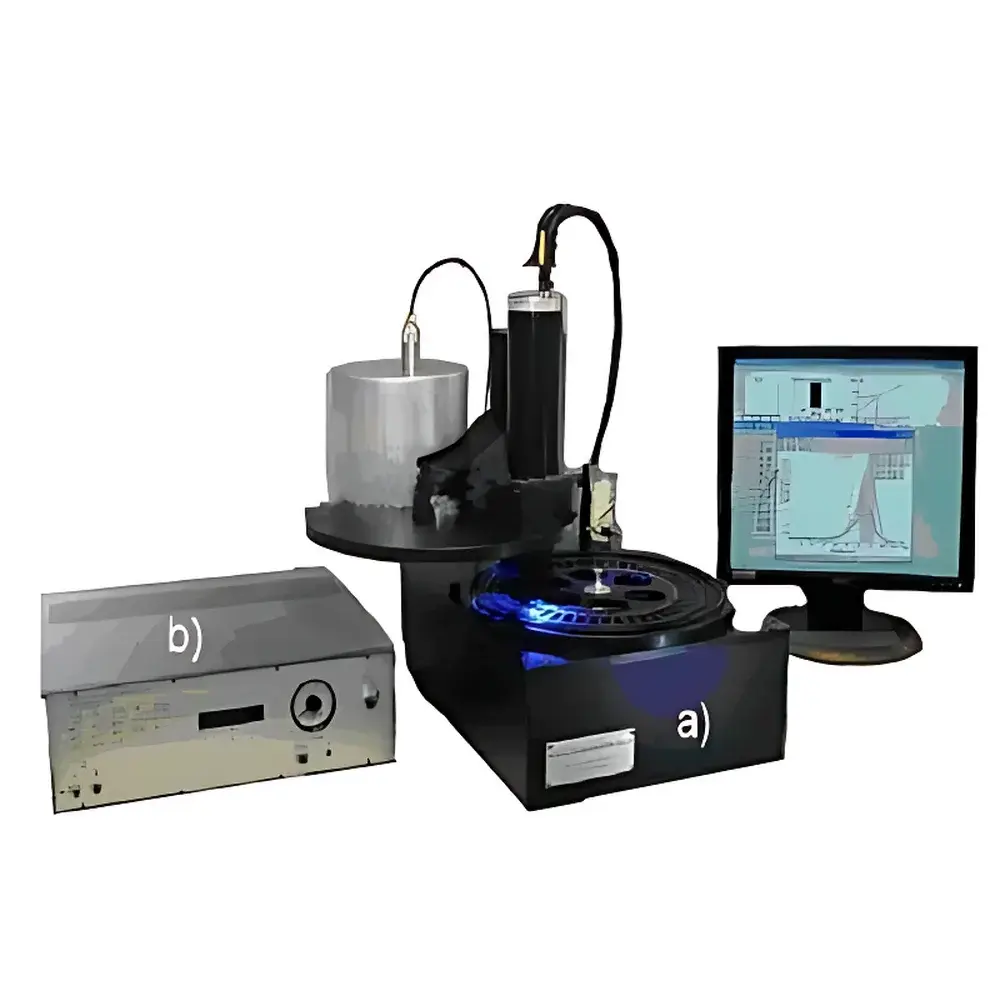
Risø DA20 C/D Thermoluminescence and Optically Stimulated Luminescence (TL/OSL) Dating System
| Origin | Denmark |
|---|---|
| Manufacturer | Risø National Laboratory (Technical University of Denmark) |
| Type | TL/OSL Reader System |
| Model | DA20 C/D |
| Power Supply | 100–240 V, 50/60 Hz, 120 W |
| Heating Range | Room temperature to 700 °C |
| Heating Rate | 0.1–10 K/s |
| TL Detection | PMT with U-340, BG-39, and Corning 7-59 filters |
| OSL Excitation | Blue LED (470 nm, ≥50 mW/cm²), IR LED (870 nm, ≥140 mW/cm²), optional green laser (532 nm, 50 W/cm²) |
| Irradiation Sources | ⁹⁰Sr/⁹⁰Y β-source (1.48 GBq, ~0.1 Gy/s on quartz), ²⁴¹Am α-source (10.7 MBq, ~45 mGy/s on quartz), X-ray tube (Varian VF-50J, 50 kV/1 mA, dose rate 10 mGy/s–2 Gy/s with 50 mm Al filtration) |
| Sample Capacity | Up to 48 positions |
| Vacuum & N₂ Cooling | Integrated for TL measurement |
| Compliance | Designed for GLP/GMP-aligned laboratory workflows |
Overview
The Risø DA20 C/D is a fully integrated, research-grade thermoluminescence (TL) and optically stimulated luminescence (OSL) reader system developed by the Risø National Laboratory at the Technical University of Denmark. It implements solid-state luminescence physics to determine the time elapsed since crystalline minerals—such as quartz and feldspar—were last exposed to sufficient thermal or optical energy to reset their trapped charge population. In archaeological and geological contexts, this corresponds to the last firing event of ceramics or the last exposure to sunlight of sediments. The DA20 C/D employs a high-sensitivity photomultiplier tube (PMT) coupled with selectable optical filters and precisely controlled thermal/optical stimulation to quantify luminescence signals proportional to natural radiation dose accumulation. Its design reflects decades of methodological refinement in luminescence dating, supporting both routine dating applications and advanced protocol development—including single-grain OSL, linearly modulated OSL (LM-OSL), and isothermal TL.
Key Features
- Simultaneous processing of up to 48 samples via programmable carousel, enabling high-throughput dating workflows.
- Programmable heating module with precise control from ambient to 700 °C and ramp rates adjustable between 0.1 and 10 K/s; includes vacuum capability and nitrogen-cooled sample chamber for rapid post-heating thermal quenching.
- Dual-mode OSL excitation: continuous-wave (CW) and linearly modulated (LM) stimulation using calibrated blue (470 nm) and infrared (870 nm) LED arrays, each with real-time optical feedback for power stability.
- Multi-source irradiation system supporting β (⁹⁰Sr/⁹⁰Y), α (²⁴¹Am), and X-ray (50 kV Varian VF-50J) dosing, all software-selectable and independently controllable for regenerative-dose protocol execution.
- Modular optical detection path featuring interchangeable interference filters (Hoya U-340, Schott BG-39, Corning 7-59) optimized for UV, violet, and visible emission bands typical of quartz and feldspar TL/OSL spectra.
- Optional single-grain attachment with focused 532 nm green laser (50 W/cm²) or 830 nm IR laser (~500 W/cm²), enabling grain-specific signal analysis critical for heterogeneous sediment samples.
Sample Compatibility & Compliance
The DA20 C/D accommodates standard 9.7 mm diameter aluminum planchets, custom ceramic discs, and loose sediment aliquots mounted on stainless-steel stubs. It is routinely deployed for dating fired clay artifacts (e.g., pottery, bricks, kiln fragments), loess and fluvial sediments, volcanic tephra, and heated lithics. All hardware and firmware are engineered to support traceable, auditable measurement practices aligned with ISO/IEC 17025 requirements for testing laboratories. Data acquisition logs include timestamps, operator ID, instrument configuration, environmental parameters (if interfaced), and raw photon counts—enabling full reconstruction of measurement sequences. While not certified for FDA 21 CFR Part 11 compliance out-of-the-box, the system architecture permits integration with validated LIMS platforms that implement electronic signature and audit-trail functionality required under GLP and GMP frameworks.
Software & Data Management
The DA20 C/D operates under the proprietary Analyst software suite, which provides full experimental scripting, real-time signal visualization, automated background subtraction, and built-in dose-response curve fitting (e.g., saturating exponential, general-order kinetic models). Raw data are stored in vendor-neutral ASCII formats compatible with third-party analysis tools such as Analyst, SAR Analysis, and R-based luminescence packages (e.g., ‘Luminescence’). Software supports batch processing of regeneration, test-dose, and recovery measurements essential for equivalent dose (De) estimation. All parameter settings, irradiation histories, and measurement metadata are embedded in exported files, ensuring reproducibility across laboratories and longitudinal studies.
Applications
- Archaeological chronology: direct dating of ceramics, burnt flint, and mudbrick without reliance on typological or stratigraphic correlation.
- Quaternary geochronology: age determination of aeolian, fluvial, and glacial deposits where radiocarbon dating is inapplicable (e.g., beyond 50 ka or in carbonate-poor environments).
- Nuclear accident dosimetry: retrospective assessment of gamma/beta exposure in building materials (e.g., bricks, tiles) near incident sites.
- Radiation-treated food authentication: verification of ionizing radiation processing via induced TL signal in silicate contaminants (e.g., salt, spices).
- Fundamental luminescence research: trap-depth analysis, thermal stability studies, and stimulation cross-section characterization of natural and synthetic dosimeters.
FAQ
What distinguishes TL from OSL in practice?
TL relies on thermal energy to release trapped electrons, producing light upon heating; OSL uses specific wavelengths of light (e.g., blue or infrared) to stimulate emission at ambient or controlled temperatures—enabling repeated measurements on the same aliquot.
Can the DA20 C/D perform single-grain analysis?
Yes, when equipped with the optional laser attachment, it supports automated single-grain OSL measurement using 532 nm or 830 nm lasers, facilitating detection of mixing or partial bleaching in sediment samples.
Is calibration traceable to international standards?
The system accepts NIST-traceable beta and alpha sources; dose-rate calibrations are performed using reference quartz samples with known laboratory doses, following protocols described in IEEE Std 1487 and ISO/ASTM 51276.
Does the system support automated regenerative-dose protocols?
Yes—Analyst software enables full automation of SAR (Single-Aliquot Regenerative-dose) and MAAD (Multiple-Aliquot Additive-Dose) sequences, including preheat optimization, dose recovery tests, and recycling ratio evaluation.
What maintenance is required for long-term operational stability?
Annual PM includes PMT gain verification, LED output calibration, source activity verification, vacuum pump oil replacement, and thermal sensor validation—procedures documented in the manufacturer’s service manual and supported by DTU Risø technical assistance.



