
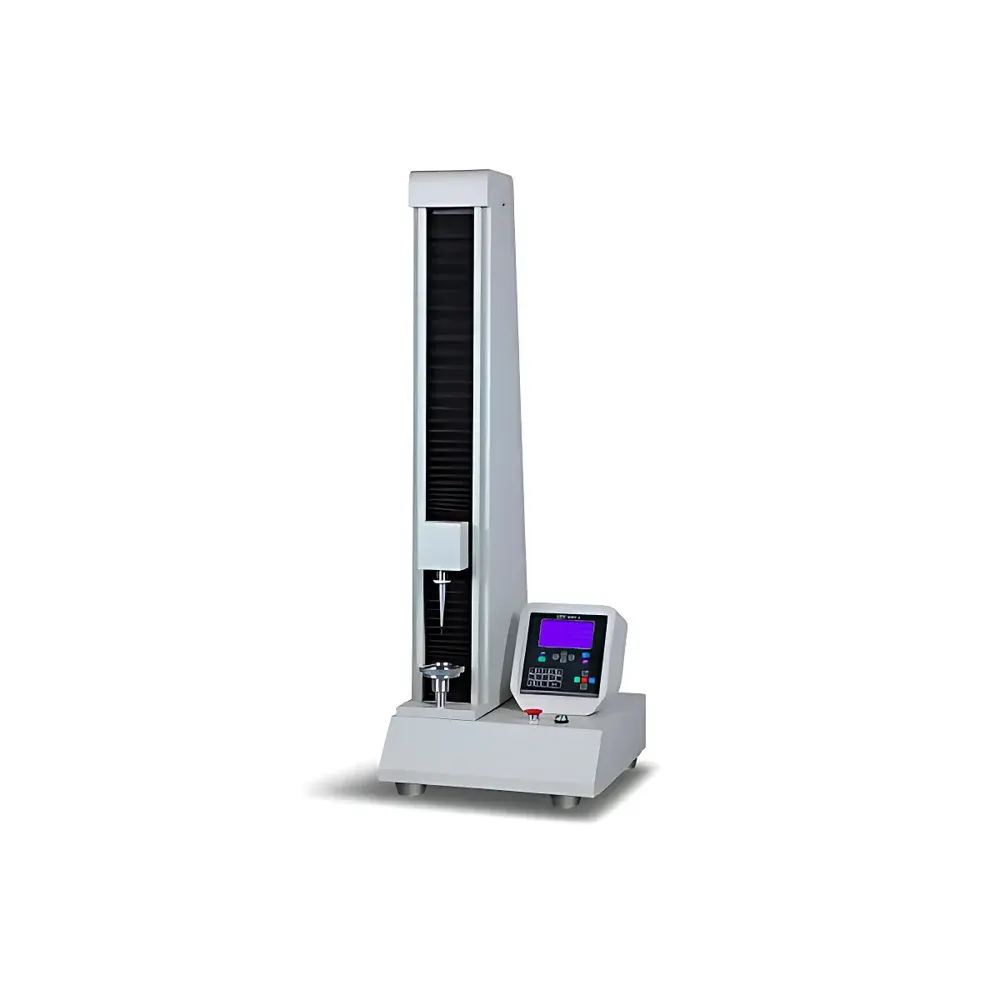
GBPI GBH-1L2 Single-Column Electronic Tensile Testing Machine for Film Tensile and Puncture Performance Evaluation
| Brand | GBPI |
|---|---|
| Origin | Guangdong, China |
| Manufacturer Type | Direct Manufacturer |
| Country of Origin | China |
| Model | GBH-1L2 |
| Instrument Type | Electronic Tensile Testing Machine |
| Maximum Test Load | 1.5 kN |
| Force Range | 0–500 N (optional 0–1500 N) |
| Elongation Capacity | up to 1400% |
| Force Accuracy | ±0.5% of reading (Class 0.5) |
| Travel Distance | 750 mm |
| Displacement Resolution | ±0.5% of reading |
| Effective Specimen Width | 30 mm (customizable to 50 mm) |
| Speed Range | 0–500 mm/min, infinitely variable |
| Power Supply | AC 220 V, 50 Hz |
| Power Consumption | 1000 W |
| Dimensions (W×D×H) | 600 × 600 × 1300 mm |
| Weight | 70 kg |
Overview
The GBPI GBH-1L2 is a single-column, microprocessor-controlled electronic tensile testing machine engineered for high-precision mechanical characterization of thin, flexible materials used in packaging, medical device, and polymer research applications. It operates on the fundamental principle of uniaxial force application under controlled displacement or speed, measuring load response and dimensional change to determine tensile strength, elongation at break, puncture resistance, peel adhesion, tear propagation, seal integrity, and compressive stiffness. Designed specifically for low-to-medium force regimes (up to 1.5 kN), the system complies with standardized test protocols across ISO, ASTM, GB, and YBB regulatory frameworks—making it suitable for quality control laboratories operating under GLP, GMP, or ISO/IEC 17025 accreditation requirements.
Key Features
- Modular dual-mode control architecture: supports both built-in embedded controller operation (space-efficient, standalone use) and PC-based real-time control via RS232 interface.
- High-fidelity force measurement system calibrated to Class 0.5 accuracy per JJG 139 and ASTM E4, ensuring traceable compliance with national metrological standards.
- Precision ball-screw actuation driven by imported AC servo motor, delivering smooth loading profiles, minimal thermal drift, and long-term repeatability over >100,000 test cycles.
- Real-time data acquisition at 100 Hz sampling rate, capturing transient mechanical responses during rapid events such as film puncture or seal failure.
- Multi-channel sensor support enabling simultaneous measurement of load, displacement, and optional auxiliary parameters (e.g., temperature, thickness).
- Comprehensive safety suite including mechanical limit switches, overload cut-off, emergency stop circuitry, and software-enforced operational boundaries.
- Configurable test fixtures—including standard 30 mm tensile grips, puncture probe assemblies, right-angle tear blades, and hot-tack clamps—facilitating rapid method switching without recalibration.
- Optional pneumatic clamping system available for consistent gripping pressure across variable specimen thicknesses (e.g., laminated pouches, foamed elastomers).
Sample Compatibility & Compliance
The GBH-1L2 accommodates specimens ranging from ultra-thin polymer films (≥12 µm) to multi-layer composite structures (≤5 mm thick), including but not limited to BOPP, PET, PE, CPP, aluminum foil laminates, paperboard, nonwovens, hydrogels, and biomedical membranes. Its validated test methods align with over 30 international and domestic standards—including ISO 37 (rubber tensile), ASTM D882 (thin plastic sheeting), ASTM F88 (seal strength), GB/T 1040 (plastics tensile), YBB00112003 (pharmaceutical packaging), and GB/T 2792 (peel adhesion). All firmware and calibration routines are documented per ISO/IEC 17025 clause 6.5 and support audit-ready traceability for FDA 21 CFR Part 11–compliant environments when paired with validated software configurations.
Software & Data Management
The included Windows-based test software provides full IEC 62304–aligned functionality: parameterized test method templates, real-time curve overlay (load vs. extension, stress vs. strain), automatic peak detection, statistical reporting (mean, SD, CV%), and export to CSV, PDF, or native Excel formats. Raw data files retain full metadata—including operator ID, timestamp, environmental conditions (if external sensors connected), and instrument calibration status—enabling retrospective analysis and trend monitoring. The open data structure permits third-party integration via COM/ActiveX interfaces, supporting LIMS connectivity and automated report generation workflows compliant with laboratory digital transformation initiatives.
Applications
- Quantitative evaluation of seal strength and hot-tack performance in thermoformed trays and blister packs.
- Determination of puncture resistance for IV bag films and sterile barrier packaging per ISO 11607-2.
- Tensile modulus and yield point analysis of biodegradable mulch films per ASTM D5210.
- Peel adhesion testing of pressure-sensitive labels and medical transdermal patches.
- Tear propagation resistance assessment of woven and nonwoven surgical drapes (ASTM D1938).
- Compression testing of foam cushioning layers in pharmaceutical secondary packaging.
- Educational use in polymer science curricula for stress-strain curve derivation and Hooke’s law validation.
FAQ
What standards does the GBH-1L2 support out-of-the-box?
Preconfigured test methods cover ASTM D882, ASTM F88, GB/T 1040.1, GB/T 2792, ISO 37, and YBB00112003; additional standards can be implemented via user-defined protocol scripting.
Can the system perform simultaneous multi-axis measurements?
No—it is a uniaxial testing platform. However, its multi-channel analog input supports synchronized acquisition from external sensors (e.g., extensometer, environmental chamber output).
Is calibration certificate included with shipment?
A factory calibration report is supplied; optional accredited metrology certification (CNAS or ILAC-MRA traceable) is available upon request.
What maintenance intervals are recommended?
Ball-screw lubrication every 6 months; annual verification of load cell linearity and displacement encoder accuracy using certified reference standards.
Does the software meet 21 CFR Part 11 requirements?
Yes—when deployed with role-based access control, electronic signatures, and audit trail logging enabled (requires validated installation package and procedural SOPs).



