
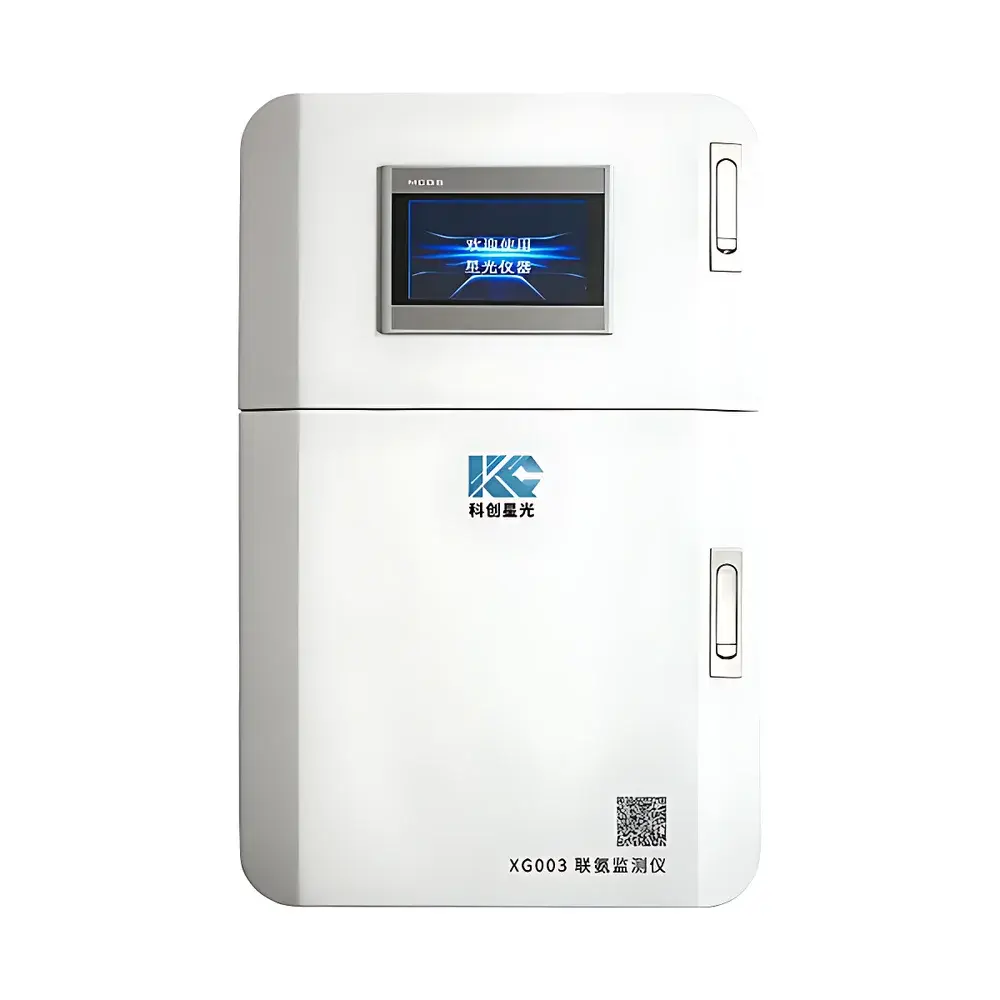
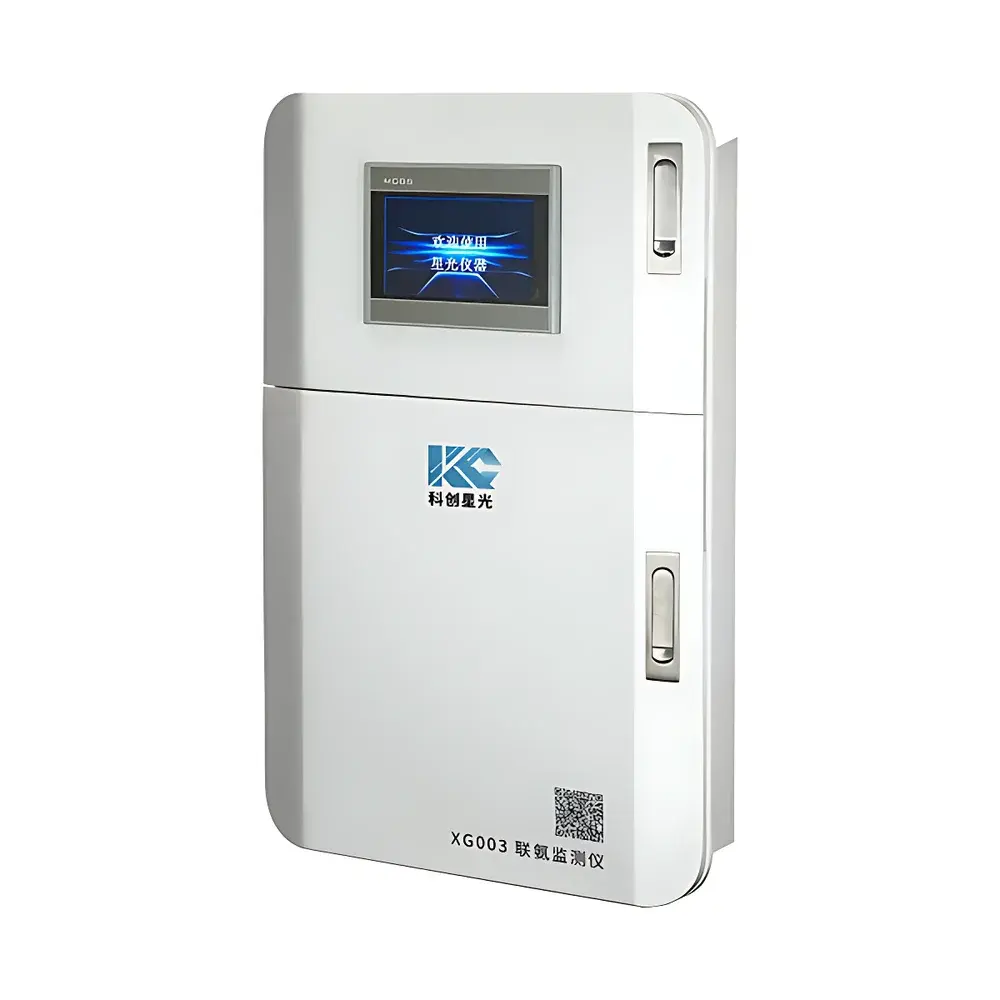
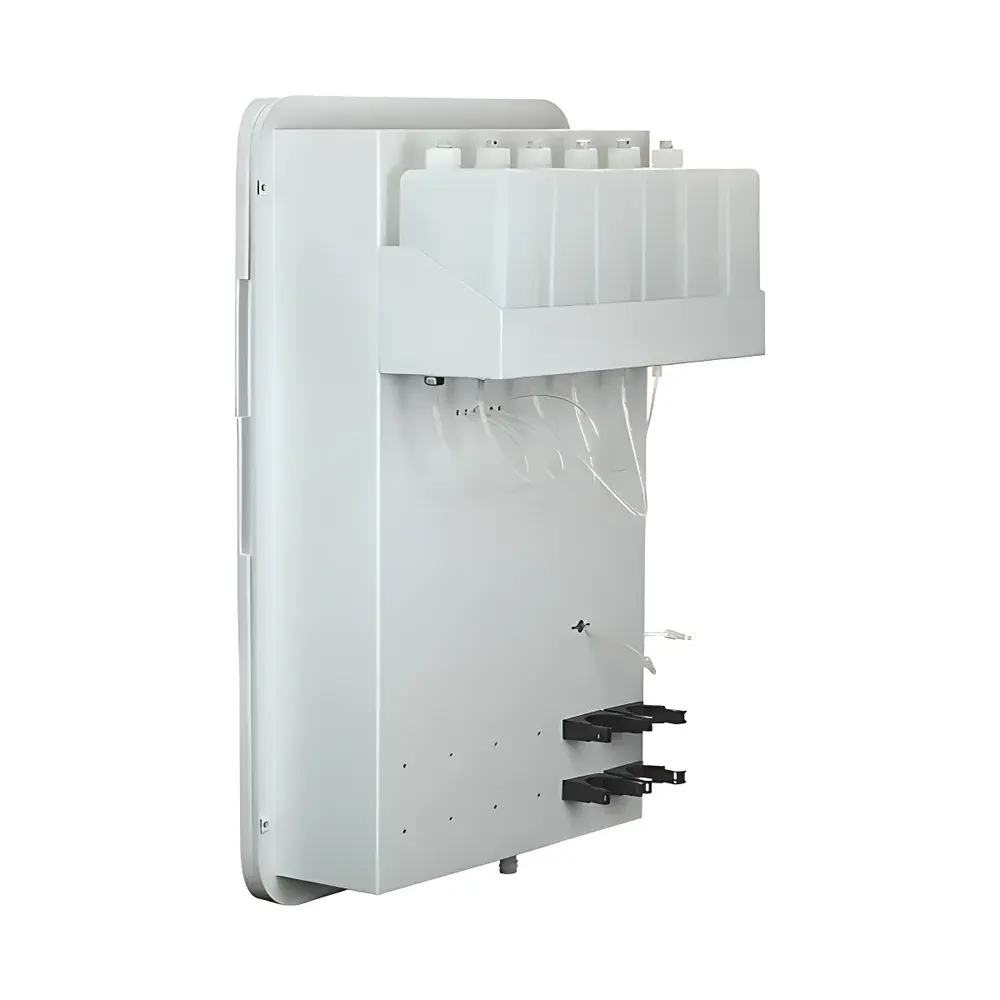
KC XG03 Online Hydrazine Analyzer
| Brand | KC |
|---|---|
| Origin | Beijing, China |
| Manufacturer Type | Manufacturer |
| Origin Category | Domestic |
| Model | XG03 |
| Instrument Type | Online Analyzer |
| Measurement Principle | Colorimetric Method |
| Measurement Range | 0.0–100.0 µg/L |
| Accuracy | ±2% F.S. |
| Detection Limit | 0.01 µg/L |
| Measurement Time | <4 min |
| Batch Capacity | 6 channels |
Overview
The KC XG03 Online Hydrazine Analyzer is an industrial-grade, continuous-monitoring instrument engineered for precise, real-time quantification of hydrazine (N₂H₄) in ultrapure water streams—primarily within power plant boiler feedwater, nuclear primary coolant systems, and high-purity process water loops. It operates on the principle of colorimetric analysis: hydrazine reacts with p-dimethylaminobenzaldehyde (DMAB) under controlled acidic conditions to form a yellow azine complex, the absorbance of which is measured photometrically at 455 nm. The analyzer integrates optical detection, reagent dosing, thermal stabilization, and fluidic control into a single compact photometer module, minimizing interferences from temperature drift, particulate scattering, or reagent variability. Designed for 24/7 unattended operation in demanding utility environments, it meets the functional reliability expectations of ISO 9001-certified manufacturing and aligns with technical requirements referenced in ASTM D129-19 (Standard Test Method for Sulfur in Petroleum Products) and EP 2.2.45 (European Pharmacopoeia monograph for hydrazine in water for injection), where trace hydrazine monitoring supports corrosion inhibition validation and steam cycle integrity assurance.
Key Features
- Modular three-zone architecture separates water pathways, electrical components, and waste disposal into physically isolated compartments—enhancing safety, reducing cross-contamination risk, and simplifying field maintenance.
- Integrated photometric core unit houses all critical functions: reagent metering, sample mixing, reaction incubation, temperature-controlled color development, photometric quantification, and waste discharge—ensuring measurement repeatability and minimizing calibration drift.
- Constant-pressure peristaltic dosing system delivers reagents with ≤±0.5% volumetric accuracy over 12 months without recalibration or mechanical wear compensation.
- Surface-mount solenoid valves eliminate O-ring degradation and tubing pinch points—reducing downtime and enabling rapid valve replacement without system depressurization.
- Programmable measurement modes: continuous monitoring (fixed 3-min cycle per channel) or user-defined interval sampling (1–240 min intervals); each channel operates independently with dedicated timing logic.
- Thermostatically regulated measurement cell maintains sample at 35 °C ±0.3 °C, eliminating thermal coefficient errors common in low-concentration (<100 µg/L) hydrazine assays.
- Standard analog outputs include 4–20 mA (HART-enabled), 0–20 mA, and 0–10 mA current loops—fully configurable per channel for integration with DCS, PLC, or SCADA systems.
- Non-volatile flash memory retains >12 months of timestamped measurement logs (including raw absorbance, calculated concentration, alarm flags, and system diagnostics); data persistence exceeds 10 years after power loss.
- 7-inch Windows-based HMI touchscreen with localized Chinese UI supports multi-level access control (operator, engineer, administrator), embedded calibration logging, and on-screen diagnostic flowcharts.
- Scalable channel configuration: 1–6 independent analytical channels share a common reagent manifold and waste reservoir—optimizing footprint and operational cost in multi-point monitoring deployments.
Sample Compatibility & Compliance
The XG03 accepts aqueous samples with temperature between 5–50 °C and suspended solids <5 µm (non-agglomerating, non-colloidal). It is incompatible with oxidizing agents (e.g., chlorine, ozone), strong acids/bases (pH <3 or >11), or organic solvents that degrade DMAB reactivity. All wetted materials comply with USP Class VI biocompatibility standards and meet ASTM F2129 corrosion resistance requirements for stainless steel 316L and PTFE fluid paths. The analyzer supports audit-ready operation under GLP and GMP frameworks: electronic records include immutable timestamps, operator IDs, calibration verification entries, and alarm event histories—fully traceable per FDA 21 CFR Part 11 Annex 11 requirements when paired with validated network logging servers.
Software & Data Management
Firmware v3.2+ provides embedded data handling via SD card export (CSV format), Modbus TCP/IP (port 502), and optional OPC UA server interface. Internal database stores up to 100,000 records per channel with automatic overwrite policy. Calibration curves are stored as polynomial coefficients with reference wavelength metadata; manual zero/span adjustments require dual-password authorization. Remote firmware updates are supported via secure HTTPS upload with SHA-256 signature verification. Audit trail reports include full parameter change history—including output range modifications, alarm threshold edits, and channel enable/disable events—with no ability to delete or backdate entries.
Applications
- Boiler feedwater monitoring in fossil and nuclear power plants to verify hydrazine residual levels for oxygen scavenging efficiency and copper alloy corrosion mitigation.
- Monitoring of condensate polishing system effluent to ensure compliance with EP 2.2.45 and pharmacopeial limits for injectable water production.
- Continuous surveillance of deaerator outlet water in combined-cycle gas turbine (CCGT) facilities.
- Quality control of hydrazine dosing pumps during commissioning and routine performance verification.
- Environmental compliance tracking in industrial wastewater pretreatment units discharging hydrazine-containing process effluents (per EPA Method 351.2 equivalents).
FAQ
What is the minimum detectable hydrazine concentration?
The detection limit is 0.01 µg/L (10 ng/L) under standard operating conditions with fresh reagent and clean optics.
Can the analyzer operate in hazardous area Zone 2 environments?
No—the XG03 is rated IP54 and designed for indoor control room or sheltered outdoor cabinet installation only; explosion-proof enclosures are not available.
Is third-party calibration certification included?
Factory calibration uses NIST-traceable hydrazine standards; ISO/IEC 17025-certified calibration certificates are available upon request at additional cost.
How often must reagents be replaced?
At nominal 10 L/h sample flow and 3-min cycle time, reagent consumption averages 3 L/month per active channel.
Does the system support remote diagnostics via Ethernet?
Yes—Modbus TCP/IP enables real-time register polling of status bits, analog outputs, error codes, and internal temperatures; web-based HMI access requires optional firewall-configured VPN tunneling.







