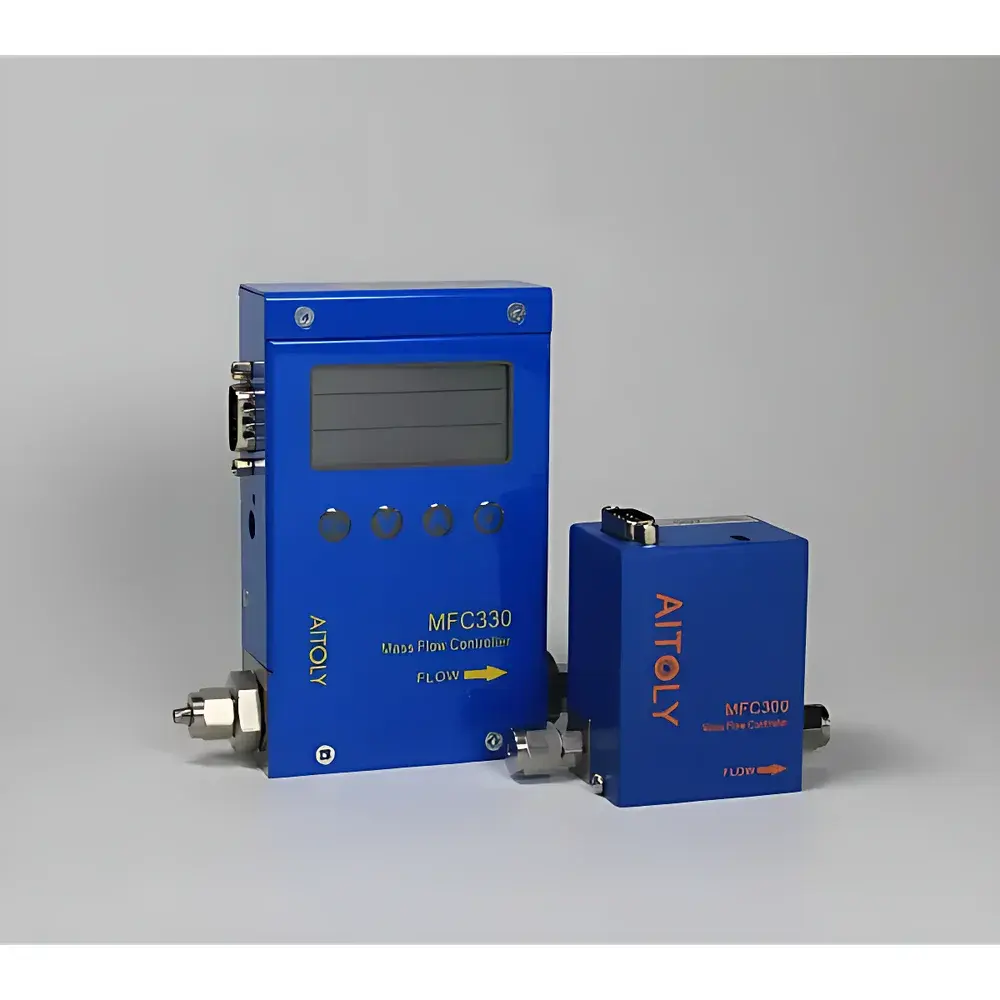
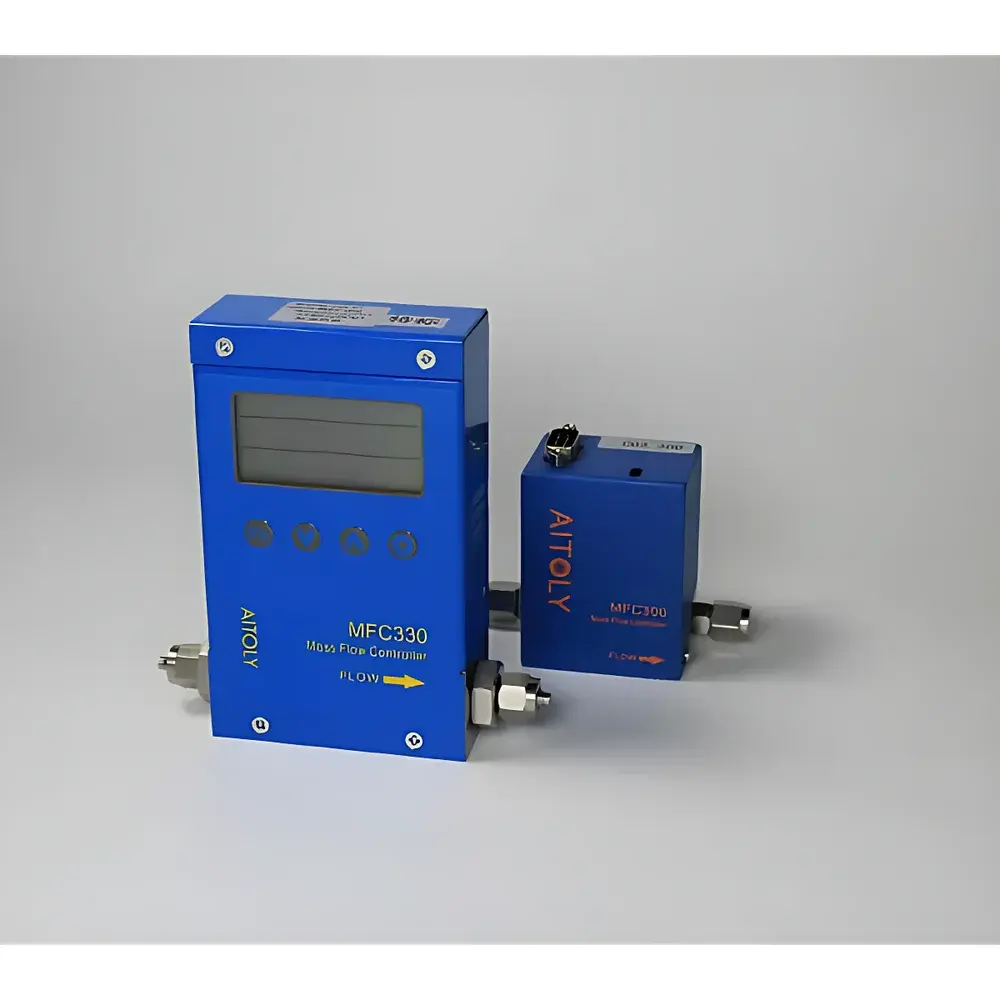
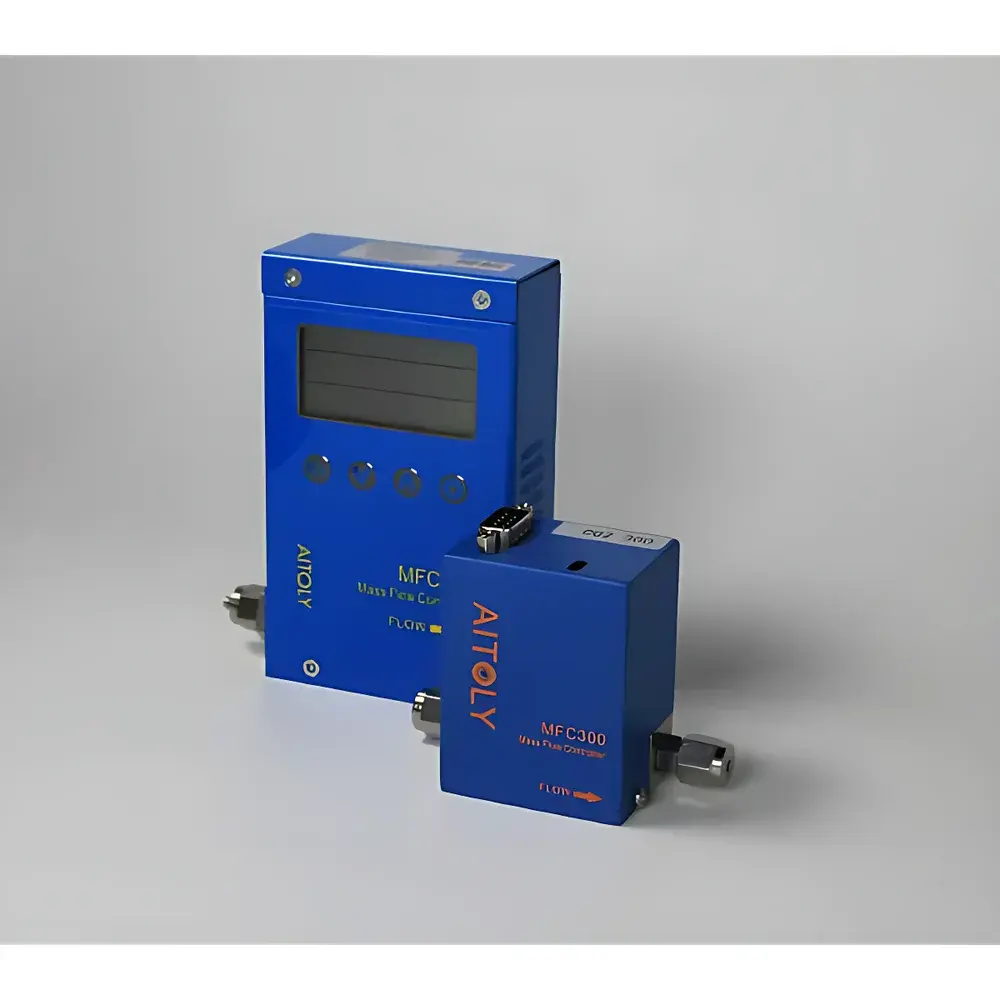
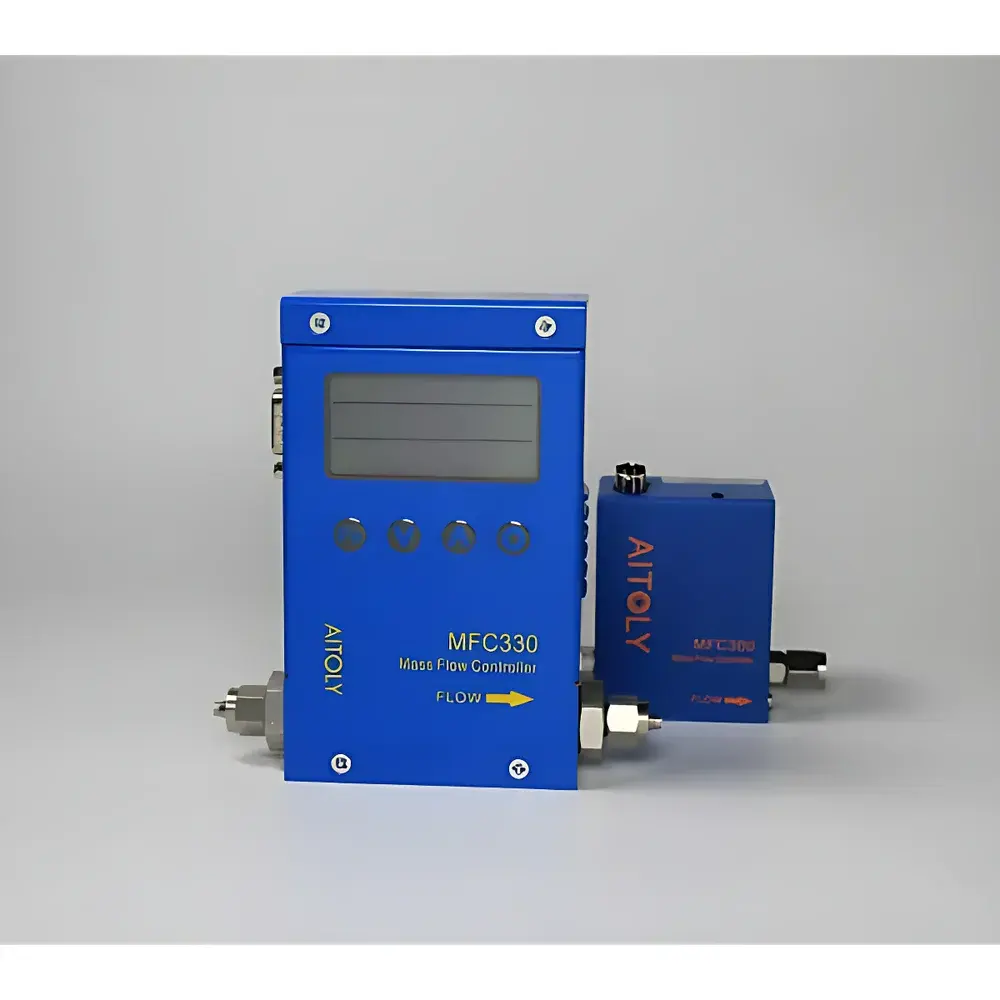
Aitoly MFC300_CAN Thermal Mass Flow Controller
| Brand | Aitoly |
|---|---|
| Origin | Jiangsu, China |
| Type | Thermal Mass Flow Controller |
| Model | MFC300_CAN |
| Power Supply | 15–40 VDC |
| Flow Ranges | 0–5, 10, 50, 100, 200, 300, 500 sccm |
| Accuracy | ±0.5 % FS |
| Linearity | ±1 % FS |
| Repeatability | ±0.5 % FS |
| Response Time | <1 s |
| Pressure Drop Range | 0–1 MPa |
| Burst Pressure | 1.1 MPa |
| Operating Temperature | 0–65 °C |
| Gas Compatibility | Air, He, Ar, N₂, O₂, H₂, NO, CO, CH₄, NH₃, N₂O, NO₂, CO₂ |
| Electrical Interface | DB9 connector |
| Output Signals | Analog (0–5 V / 0–10 V / 4–20 mA), RS232, RS422, RS485, CAN (galvanically isolated) |
| Gas Connection Options | M8×1 thread, 4 mm push-to-connect, 6 mm push-to-connect |
| Tubing ID | 3–3.2 mm, 4 mm, 6 mm |
| Zero Drift | Extremely low |
| Moving Parts | None |
| Compliance | Designed for industrial process control environments requiring stable, repeatable gas flow regulation in continuous operation |
Overview
The Aitoly MFC300_CAN is a thermally-based mass flow controller engineered for high-reproducibility gas flow regulation in industrial and laboratory process systems. Utilizing constant-temperature anemometry (CTA), the device measures mass flow rate by detecting heat transfer between a heated sensor element and the flowing gas stream—enabling direct, pressure- and temperature-compensated mass flow measurement without moving parts. Unlike volumetric flowmeters, the MFC300_CAN delivers true mass flow output (standard cubic centimeters per minute or liters per minute, referenced to STP: 0 °C, 101.325 kPa), eliminating dependency on upstream pressure or ambient thermal fluctuations. Its architecture supports bidirectional flow control with fast dynamic response (<1 s), making it suitable for closed-loop feedback applications in gas blending, reactor feed control, leak testing, and semiconductor process tooling.
Key Features
- No moving parts — eliminates mechanical wear, maintenance downtime, and calibration drift associated with turbine or piston-based designs
- Multi-gas capability — factory-calibrated for 13 common industrial and specialty gases (Air, He, Ar, N₂, O₂, H₂, NO, CO, CH₄, NH₃, N₂O, NO₂, CO₂); gas selection configurable via digital interface
- Dual-mode operation — supports both analog (0–5 V, 0–10 V, 4–20 mA) and digital communication (CAN bus with galvanic isolation, RS232, RS422, RS485) for integration into PLC, DCS, or PC-based SCADA systems
- Low zero drift design — optimized thermal compensation circuitry ensures long-term baseline stability under varying ambient conditions (0–65 °C)
- Wide operating pressure range — functional across 0–1 MPa differential pressure, with 1.1 MPa burst rating for safety margin in high-pressure gas delivery lines
- Flexible mechanical integration — standard M8×1 male thread, 4 mm and 6 mm push-to-connect fittings accommodate common tubing sizes (ID: 3–3.2 mm, 4 mm, 6 mm)
- Single-supply operation — 15–40 VDC input simplifies field wiring and enables compatibility with standard industrial power rails
Sample Compatibility & Compliance
The MFC300_CAN is designed for clean, dry, non-corrosive, and non-particulate gas streams. It is not rated for use with aggressive halogenated compounds, vapors, or condensing gases. While not certified to specific international safety standards (e.g., ATEX, IECEx), its electrical isolation (CAN/RS485/RS422), robust enclosure, and intrinsic design align with general-purpose industrial equipment requirements per IEC 61000-6-2 (immunity) and IEC 61000-6-4 (emissions). For regulated environments (e.g., pharmaceutical gas distribution, analytical instrument carrier gas control), users must validate installation against site-specific GLP/GMP, ISO 17025, or FDA 21 CFR Part 11 data integrity requirements—particularly when paired with the MCL300 controller for audit-trail-enabled setpoint logging.
Software & Data Management
Digital communication protocols support full remote configuration—including gas type selection, flow range scaling, PID tuning parameters, and alarm thresholds—via ASCII command sets or proprietary host software. When integrated with the Aitoly MCL300 master controller (supporting up to 16 MFC300 units), the system enables synchronized real-time monitoring of instantaneous and cumulative flow across multiple channels, with timestamped data export (CSV/Excel-compatible) and manual/auto cycling of setpoints. All digital transactions retain immutable timestamps and user identifiers—facilitating traceability in quality-critical workflows. The CAN interface complies with ISO 11898-2 physical layer specifications and supports bus termination and node addressing for deterministic multi-drop network deployment.
Applications
- Precise gas dosing in catalytic reactors, CVD/PVD chambers, and fuel cell test benches
- Calibration and verification of gas analyzers (e.g., FTIR, GC, NDIR) using certified reference flows
- Leak detection systems requiring rapid, repeatable flow step responses
- Environmental chamber purge control and inert gas blanketing in metallurgical and chemical processing
- Research-grade gas mixing systems where stoichiometric ratio stability is critical (e.g., synthetic air generation, combustion simulation)
- Automated gas chromatography carrier gas control with pressure-independent flow stability
FAQ
Does the MFC300_CAN require external temperature or pressure compensation?
No—the built-in thermal mass flow sensor inherently compensates for variations in gas temperature and line pressure within its specified operating range, delivering true mass flow output without auxiliary transducers.
Can the device be calibrated for custom gas mixtures?
Factory calibration covers 13 standard gases. Custom gas calibrations are available upon request but require gas composition certification and may incur additional lead time and cost.
What is the maximum number of MFC300 units controllable by one MCL300?
The MCL300 supports up to 16 MFC300 controllers on a single CAN or RS485 bus, with independent setpoint assignment and real-time data polling per unit.
Is firmware upgrade supported in-field?
Yes—firmware updates can be deployed remotely via CAN or RS232 using Aitoly-provided utility software, preserving all user-configured parameters during update.
Does the analog output support both voltage and current modes simultaneously?
No—output mode (0–5 V, 0–10 V, or 4–20 mA) must be selected at commissioning via digital command; hardware switching is not supported.