
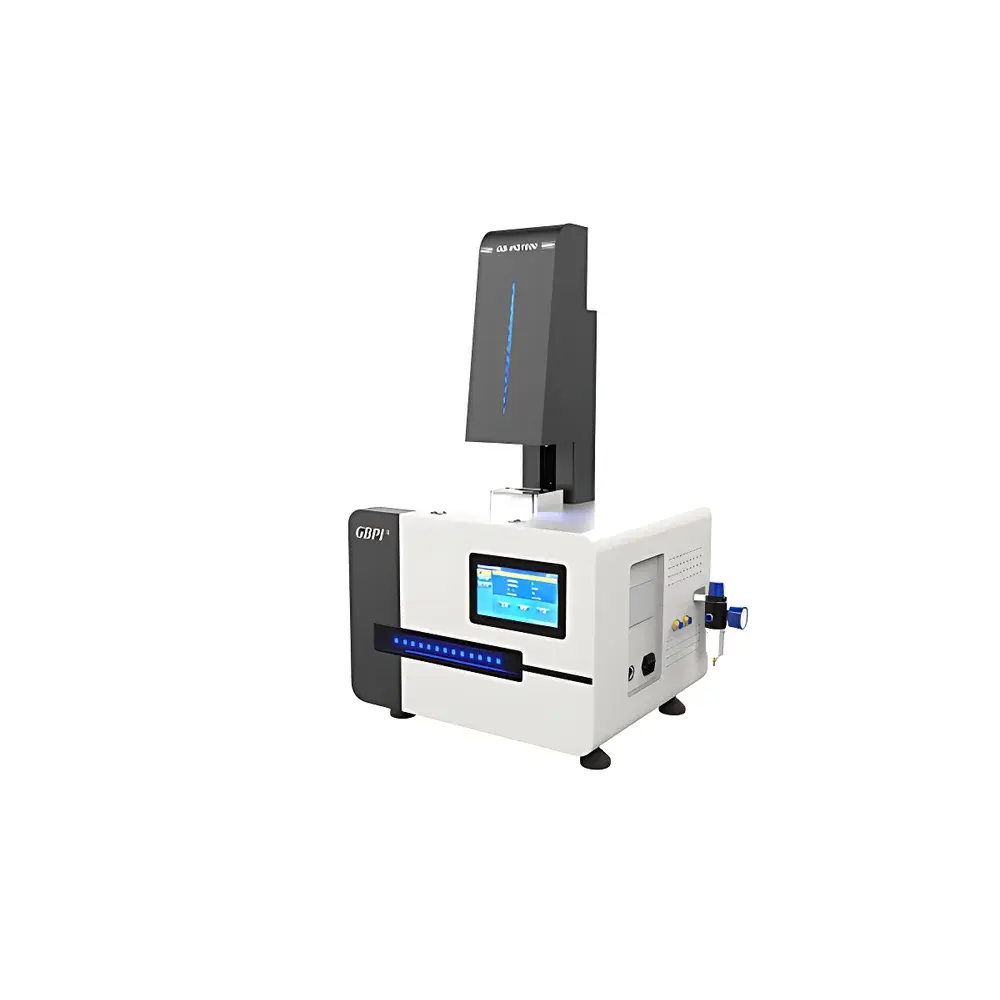
GBPI GB-HQ1000C Medical Mask Exhalation Valve Airtightness Tester
| Brand | GBPI |
|---|---|
| Origin | Guangdong, China |
| Manufacturer Type | Direct Manufacturer |
| Country of Origin | China |
| Model | GB-HQ1000C |
| Price Range | USD 14,000 – 42,000 |
| Air Source | Compressed Air |
| Vacuum Pump Flow Rate | 2 L/min |
| Buffer Chamber Volume | 5 L |
| Pressure Sensor Range | −1000 Pa to 0 Pa |
| Pressure Sensor Accuracy | ±1% FS |
| Pressure Resolution | 1 Pa |
| Flow Meter Range | 0–100 mL/min |
| Flow Meter Accuracy | ±1% FS |
| Flow Resolution | 0.1 mL/min |
| Display | Integrated HD Touchscreen Interface |
| Power Supply | 220 V AC, 50 Hz |
Overview
The GBPI GB-HQ1000C Medical Mask Exhalation Valve Airtightness Tester is a precision-engineered instrument designed specifically for quantitative evaluation of exhalation valve integrity in disposable and reusable respiratory protective devices. It operates on the principle of controlled negative pressure differential testing: a calibrated vacuum is applied across the valve assembly while simultaneously measuring real-time leakage flow rate and pressure decay characteristics. This method aligns with the physical validation requirements defined in GB 2626–2019, the Chinese national standard governing particulate-filtering half-mask respirators, and serves as a technically compatible surrogate for internationally referenced protocols such as ISO 16900-3 (Respiratory protective devices — Methods of test — Part 3: Determination of inward leakage) and ASTM F2299 (Standard Test Method for Determining the Initial Efficiency of Materials Used in Medical Face Masks to Penetration by Particulates Using Latex Spheres). The system integrates pneumatic control, high-stability pressure regulation, and trace-level flow quantification into a single compact platform suitable for quality control laboratories, regulatory compliance testing centers, and R&D facilities engaged in PPE development.
Key Features
- Integrated dual-sensor architecture: high-accuracy differential pressure transducer (−1000 Pa to 0 Pa, ±1% full-scale accuracy, 1 Pa resolution) and laminar-flow calibrated mass flow meter (0–100 mL/min, ±1% FS, 0.1 mL/min resolution) enable simultaneous, synchronized acquisition of pressure decay and volumetric leakage.
- Dedicated sample holder with ergonomic clamping mechanism ensures repeatable positioning of respirator valves—regardless of geometry or mounting configuration—minimizing operator-induced variability.
- Onboard 5-liter buffer chamber stabilizes vacuum dynamics during transient testing phases, reducing pulsation artifacts and improving measurement reproducibility across sequential trials.
- Embedded HD capacitive touchscreen interface provides intuitive navigation through test setup, real-time parameter monitoring, result visualization, and post-test data review—no external PC required for basic operation.
- Built-in thermal line printer generates immediate hard-copy reports compliant with GLP documentation practices, including timestamp, operator ID, test parameters, and pass/fail status per GB 2626–2019 Clause 6.4.2.
- Microprocessor-controlled vacuum regulation via a low-noise, oil-free diaphragm pump (2 L/min free-air displacement) enables precise ramp-and-hold pressure profiles, supporting both static leak verification and dynamic response characterization.
Sample Compatibility & Compliance
The GB-HQ1000C accommodates all standard exhalation valve configurations used in KN95, N95-equivalent, and surgical-type respirators—including duckbill, disc, and membrane-based designs—without requiring custom fixtures. Sample mounting conforms to the dimensional constraints specified in GB 2626–2019 Annex B. The instrument’s metrological traceability supports internal calibration verification against NIST-traceable pressure and flow standards. While not certified to IEC 61326-1 (EMC) or ISO/IEC 17025 out-of-the-box, its measurement subsystems are architected to meet the performance thresholds required for inclusion in accredited laboratory scope assessments under CNAS or equivalent bodies. Data outputs comply with minimum audit-trail requirements for regulated environments, including immutable timestamps and user-access logging.
Software & Data Management
The embedded firmware implements deterministic real-time control logic with fixed-loop sampling at 10 Hz, ensuring temporal fidelity in pressure/flow correlation analysis. Test records are stored locally in CSV format with ISO 8601 timestamps and include raw sensor readings, calculated leakage rates, and pass/fail flags based on user-defined threshold limits (e.g., ≤30 mL/min at −250 Pa per GB 2626–2019). USB export enables integration with LIMS platforms or statistical process control (SPC) software. Optional firmware upgrade paths support future alignment with FDA 21 CFR Part 11 electronic record requirements—including digital signature capture and role-based access controls—upon customer request and site-specific validation.
Applications
- Final product release testing of medical masks and industrial respirators prior to distribution.
- Supplier qualification audits for exhalation valve component manufacturers.
- Design validation studies assessing valve durability under cyclic pressure loading.
- Root cause analysis of field-reported seal failures via comparative leakage profiling.
- Supporting technical documentation packages for CE marking (under PPE Regulation EU 2016/425) and FDA 510(k) submissions.
- Educational use in biomedical engineering labs for teaching principles of fluid sealing mechanics and regulatory metrology.
FAQ
Does the GB-HQ1000C meet international regulatory requirements beyond GB 2626–2019?
Yes—its measurement methodology and uncertainty budget are consistent with ISO 16900-3 and ASTM F2299, enabling cross-referenced reporting for global market access.
Can test parameters be customized for non-standard valve geometries?
Yes—pressure setpoints, hold durations, and pass/fail thresholds are fully programmable via the touchscreen interface.
Is external calibration certification included with delivery?
A factory calibration report with as-found/as-left data is provided; third-party ISO/IEC 17025 calibration services are available upon request.
What maintenance intervals are recommended for sustained accuracy?
Vacuum pump diaphragms and flow sensor filters require inspection every 500 operating hours; pressure sensor zero-checks are advised before each daily shift.
Is remote diagnostics or firmware update capability supported?
Firmware updates are performed via USB drive; remote diagnostic access requires optional Ethernet module installation and network configuration.




