
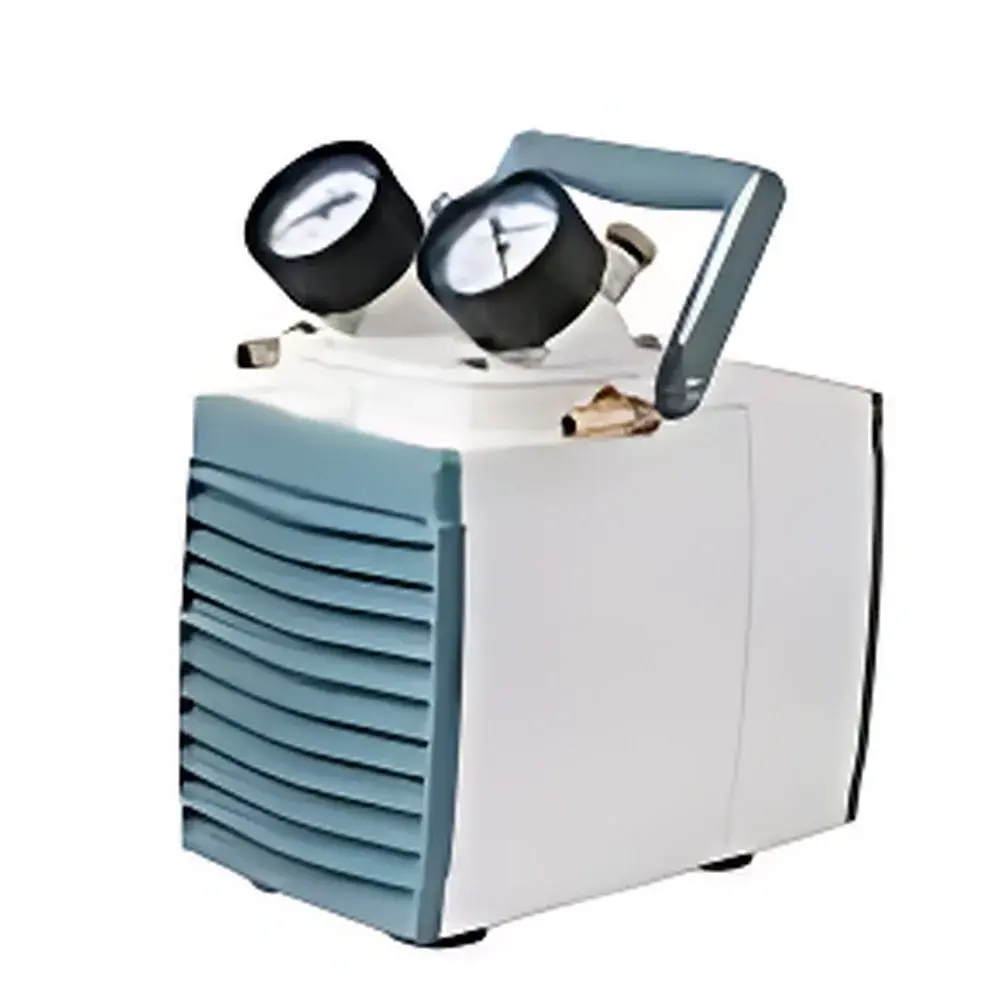
JINTENG GM-0.5A Dual-Mode Diaphragm Vacuum/Pressure Pump with Trap Bottle
| Brand | JINTENG |
|---|---|
| Origin | Tianjin, China |
| Model | GM-0.5A Dual-Mode |
| Pump Type | Diaphragm |
| Oil-Free Design | Yes |
| Air Displacement Rate | 30 L/min |
| Ultimate Vacuum | 200 mbar (abs) |
| Positive Pressure Output | ≥0.08 MPa (≥11.6 psi) |
| External Dimensions | 230 × 180 × 265 mm |
| Weight | 7.5 kg |
| Motor Power | 160 W |
| Operating Temperature Range | 5–40 °C |
| Noise Level | <60 dB(A) |
| Inlet/Outlet Port Diameter | Ø6 mm |
| Motor Certification | CE-compliant (EN 60335-1, EN 61000-6-3) |
| Diaphragm Material | Imported FKM/FPM fluoroelastomer |
| Wetted Parts Surface Treatment | PTFE-coated |
| Cooling | Integrated passive airflow system |
| Thermal Protection | Bimetallic overheat cutoff at 130 °C |
| Standard Accessories | Analog vacuum/pressure gauge (−0.1 MPa range), silicone-reinforced PVC tubing (Ø7×12 mm, 80 cm) |
Overview
The JINTENG GM-0.5A Dual-Mode Diaphragm Vacuum/Pressure Pump is an oil-free, maintenance-optimized laboratory pump engineered for precise, contamination-free gas handling across vacuum and positive pressure applications. Unlike rotary vane or piston-based systems, this pump operates on a reciprocating diaphragm principle—where a fluoropolymer-reinforced elastomeric membrane oscillates within a sealed chamber to alternately expand (generating suction) and compress (delivering pressure). This mechanism eliminates lubricant dependency, ensures zero hydrocarbon carryover, and delivers stable performance in analytical workflows requiring clean gas streams—such as solvent evaporation, filtration under reduced pressure, inert gas purging, vacuum drying, and controlled-pressure sample transfer. Its dual-mode capability allows seamless switching between vacuum generation (down to 200 mbar absolute) and positive pressure delivery (up to 0.08 MPa), eliminating the need for separate dedicated units in space-constrained labs.
Key Features
- Oil-free operation with FKM/FPM diaphragm material—resistant to organic solvents, acids, and bases; certified for extended service life under cyclic loading.
- PTFE-coated wetted surfaces—including valve plates, chamber walls, and gas pathways—ensuring full chemical compatibility per ASTM D471 and ISO 1817 standards.
- CE-certified brushless AC motor (ODM-sourced) with integrated thermal cutoff (130 °C activation) and electromagnetic interference suppression compliant with EN 61000-6-3.
- Passive convection cooling architecture enabling continuous 24/7 operation without fan-induced vibration or acoustic interference.
- Adjustable pressure regulation via precision needle valve—enabling fine-tuned control of both vacuum level and positive output pressure across defined operational ranges.
- Compact footprint (230 × 180 × 265 mm) and lightweight design (7.5 kg) optimized for benchtop integration, mobile lab carts, and shared instrumentation suites.
- Low-noise operation (<60 dB[A] at 1 m distance) suitable for open-plan laboratories and GLP-compliant environments where ambient acoustic conditions affect sensitive measurements.
Sample Compatibility & Compliance
The GM-0.5A is compatible with aqueous, polar, and moderately aggressive organic media when used with appropriate trap configurations (e.g., cold traps for volatile solvents or chemical scrubbers for acidic vapors). It meets ISO 8573-1 Class 0 air purity requirements for non-lubricated compression stages and conforms to IEC 61000-4-2/4-3/4-4 immunity standards. While not intrinsically rated for hazardous area use (ATEX/IECEx), its spark-free diaphragm actuation and grounded metal chassis support safe deployment in standard laboratory zones per NFPA 45 and ANSI Z9.5 ventilation guidelines. All electrical components comply with RoHS 2011/65/EU and REACH SVHC screening protocols.
Software & Data Management
This model operates as a standalone analog-controlled device without embedded firmware or digital interfaces. For traceability in regulated environments (e.g., pharmaceutical QC labs adhering to FDA 21 CFR Part 11), users may integrate it with external pressure/vacuum transducers and data loggers (e.g., Omega OM-DAQPRO-5300 or LabVIEW-compatible DAQ systems) to record real-time operational parameters. The included analog gauge (−0.1 MPa range) provides visual verification of setpoints, supporting manual SOP execution and audit-ready documentation workflows under GLP/GMP frameworks.
Applications
- Routine vacuum filtration of biological suspensions, particulate slurries, and HPLC mobile phase degassing.
- Rotary evaporation support—paired with condensers and chillers for efficient solvent recovery at controlled vacuum levels.
- Inert gas blanketing during sample preparation (e.g., oxygen-sensitive electrochemical cell assembly or catalyst handling).
- Positive-pressure purging of GC autosampler vials, FTIR sample compartments, or glovebox antechambers.
- Driving fluidic circuits in microfluidic chip testing rigs requiring stable, pulsation-damped flow profiles.
- Supporting vacuum-assisted resin infiltration in materials science specimen preparation (e.g., TEM grid embedding).
FAQ
Can the GM-0.5A be used for vacuum distillation?
Yes—provided the target boiling point depression aligns with its 200 mbar ultimate vacuum and compatible trap configuration is employed to prevent solvent backstreaming.
Is the pump suitable for corrosive gas applications?
When fully equipped with PTFE-coated internals and appropriate inlet filtration (e.g., sodium hydroxide scrubber for Cl₂), it handles low-concentration acidic or halogenated vapors per ISO 15858 corrosion classification Group 2.
Does it require periodic oil changes or lubrication?
No—this is a true oil-free diaphragm pump; only routine inspection of diaphragm integrity and valve seating is recommended every 6 months under continuous use.
What is the expected service life of the diaphragm under typical lab usage?
Based on accelerated lifecycle testing (IEC 60068-2-64), the FKM diaphragm maintains functional integrity for ≥15,000 hours at rated load, assuming ambient temperature ≤35 °C and absence of mechanical shock.
Can it be mounted vertically or inverted?
Mounting orientation must remain upright (base-down) to ensure proper condensate drainage and thermal management; side-mounting voids thermal protection calibration and accelerates diaphragm fatigue.



