
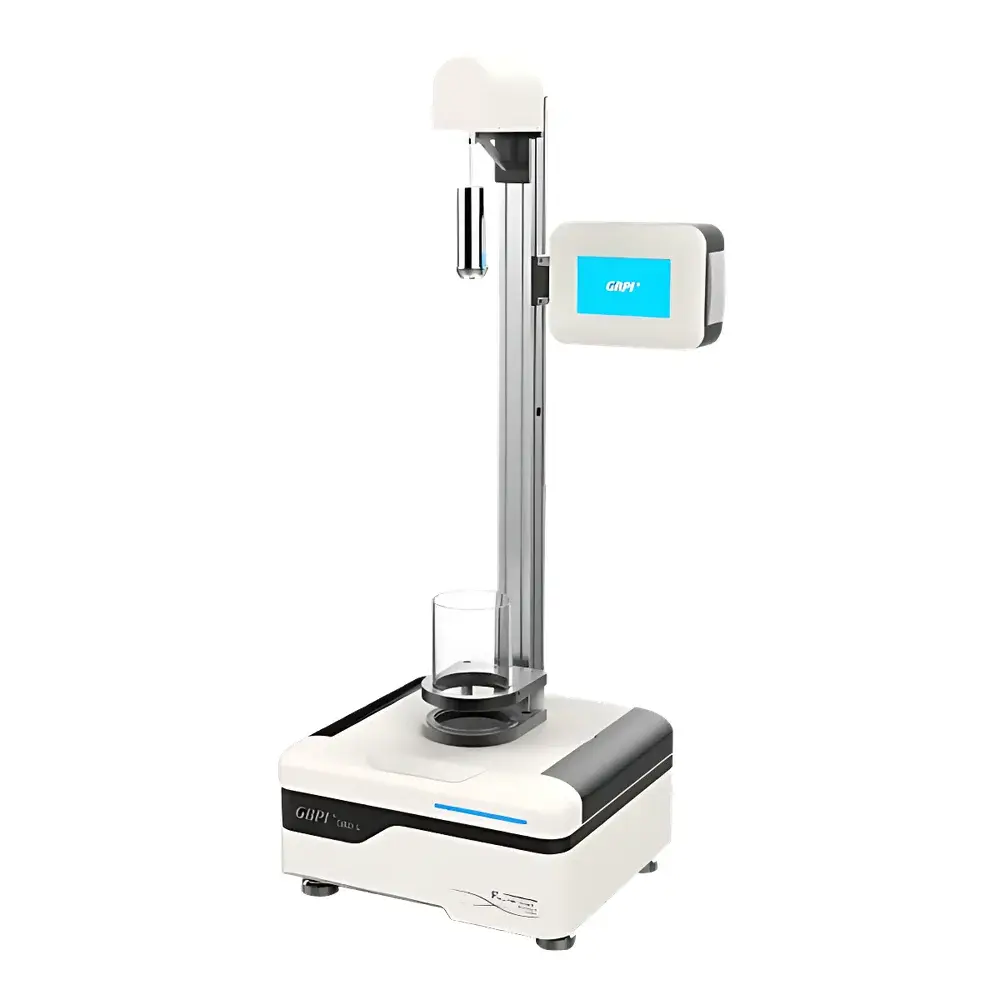
GBPI GBD-L2 Dart Impact Tester
| Brand | GBPI |
|---|---|
| Origin | Guangdong, China |
| Manufacturer Type | Direct Manufacturer |
| Country of Origin | China |
| Model | GBD-L2 |
| Pricing | Available Upon Request |
| Measurement Methods | Method A, Method B, Single-Specimen Test |
| Test Range (Method A) | 50–2000 g |
| Test Range (Method B) | 300–2000 g |
| Single-Specimen Test Mass Options | 20 g, 25 g, 40 g, 60 g, 80 g |
| Resolution | 0.1 g |
| Dart Tip Diameter (Method A) | Φ38 mm ±1 mm |
| Dart Tip Diameter (Method B) | Φ50 mm ±1 mm |
| Weight Disc Diameter (Method A) | Φ30 mm |
| Weight Disc Diameter (Method B) | Φ45 mm |
| Method A Weights | 5 g, 15 g, 30 g, 80 g (8 pcs each), 120 g (16 pcs) |
| Method B Weights | 15 g, 45 g, 90 g (8 pcs each), 180 g (9 pcs) |
| Impact Height Options | 1500 mm / 660 mm |
| Clamp Outer Diameter | 150 mm |
| Clamp Inner Diameter | 125 mm |
| Pneumatic Supply | Compressed Air, 0.6–0.8 MPa |
| Air Hose Connector | Φ6 mm |
| Dimensions (W×D×H) | 510 mm × 440 mm × 1300 mm |
| Net Weight | 50 kg |
| Power Supply | AC 220 V, 50 Hz |
| Power Consumption | 75 W |
Overview
The GBPI GBD-L2 Dart Impact Tester is a precision-engineered instrument designed to quantify the impact resistance of thin, flexible sheet materials—primarily plastic films, laminates, coated foils, and lightweight paperboard—under controlled free-fall conditions. It operates on the fundamental principle of gravitational energy conversion: a standardized dart assembly is released from a fixed height onto a horizontally clamped specimen; the mass required to produce 50% failure probability across a statistically valid sample set is determined via incremental mass adjustment per ASTM D1709, ISO 7765-1, GB/T 9639, GB/T 15267, and JIS K7124 protocols. Unlike pendulum-based impact testers, the GBD-L2 employs a vertically aligned, pneumatically actuated clamping system and electromagnetic release mechanism—eliminating operator-induced variability in drop initiation and ensuring high reproducibility across laboratories and production QA environments.
Key Features
- Triple-mode testing capability: fully compliant Method A (small-diameter dart, lower mass range), Method B (larger-diameter dart, higher mass range), and single-specimen test mode for rapid screening or validation.
- Electromagnetic dart release system ensures precise, jitter-free drop initiation with zero manual intervention—critical for minimizing systematic bias in threshold determination.
- Pneumatic clamping (0.6–0.8 MPa supply) delivers uniform, repeatable specimen fixation across the 125 mm inner clamp diameter, preventing edge slippage or localized stress concentration during impact.
- Integrated 7-inch color touchscreen interface enables intuitive navigation through test setup, real-time parameter monitoring, and on-device result visualization without external software dependency.
- Onboard thermal printer produces traceable, timestamped test reports—including sample ID, method selected, individual pass/fail outcomes, cumulative N-value, and final calculated impact energy (g).
- Automated data logic engine implements the staircase-up-down protocol per ISO 7765-1: dynamically adjusts mass incrementally (±Δm) based on prior specimen outcome until exactly 10 failures (or 10 non-failures) are recorded among ≥20 specimens.
- Internal data storage supports retrieval of up to 30 complete test sessions with full parameter history—facilitating internal audit trails and GLP-aligned record retention.
Sample Compatibility & Compliance
The GBD-L2 is validated for specimens ≤1.0 mm thickness, including monolayer and multilayer polymer films (e.g., PE, PP, PET, PA, metallized CPP), coextruded structures, aluminum-laminated packaging, pharmaceutical blister lidding, and coated paperboard substrates such as those used in tobacco packaging or aseptic cartons. Its mechanical design conforms to dimensional tolerances specified in ASTM D1709 Annex A1 (dart geometry) and ISO 7765-1 Clause 6 (clamp configuration). All pneumatic components meet ISO 8573-1 Class 4 purity requirements when supplied with filtered compressed air. The instrument’s operational logic and reporting structure support alignment with ISO/IEC 17025 clause 7.7 (result reporting) and provides raw data export capability for integration into LIMS or FDA 21 CFR Part 11-compliant systems when paired with validated third-party software.
Software & Data Management
No external PC or proprietary software is required for basic operation—the embedded firmware handles all test sequencing, pass/fail classification, statistical convergence evaluation (N = 10 criterion), and final energy calculation per standard equations. Test parameters (initial mass, Δm, height, method) are stored with each session ID. Data export is supported via USB flash drive in CSV format, containing per-specimen mass, outcome (0/1), cumulative failure count, and final reported value. Audit log entries include operator ID (if configured), start/end timestamps, and firmware version—enabling traceability in regulated environments where ALCOA+ principles apply. Firmware updates are delivered via secure USB load, with version rollback capability retained for validation continuity.
Applications
This tester serves critical roles across packaging R&D, supplier qualification, in-process QC, and regulatory submission support. In food and pharma packaging development, it validates seal integrity under simulated pallet-drop or conveyor impact conditions. For flexible packaging converters, it benchmarks comparative toughness across resin grades, additive packages, or coating formulations. Quality assurance labs use it for lot-release testing against internal specifications derived from ASTM D1709 pass/fail thresholds. Academic institutions employ the GBD-L2 in polymer physics courses to correlate impact energy with crystallinity, chain branching, or plasticizer content. Its dual-height configuration (660 mm and 1500 mm) allows differentiation between low-energy handling damage and high-energy distribution hazards.
FAQ
What standards does the GBD-L2 comply with?
It fully implements test procedures defined in ISO 7765-1, ASTM D1709 (Methods A and B), GB/T 9639, GB/T 15267, and JIS K7124.
Is compressed air supply included with the instrument?
No—users must provide a clean, dry, oil-free compressed air source meeting 0.6–0.8 MPa pressure and ISO 8573-1 Class 4 purity.
Can test data be exported for statistical process control (SPC)?
Yes—CSV files generated via USB export contain all raw pass/fail events and final mass values, compatible with Minitab, JMP, or custom SPC dashboards.
How is calibration verified?
Mass calibration is performed using NIST-traceable weights; height verification uses certified tape measures or laser distance meters per ISO/IEC 17025 Section 6.5. Calibration certificates are issued by accredited third-party labs upon request.
Does the system support user-defined test protocols beyond A/B methods?
No—the firmware implements only the standardized staircase protocols defined in referenced international standards; custom algorithms are not supported to maintain compliance integrity.





