
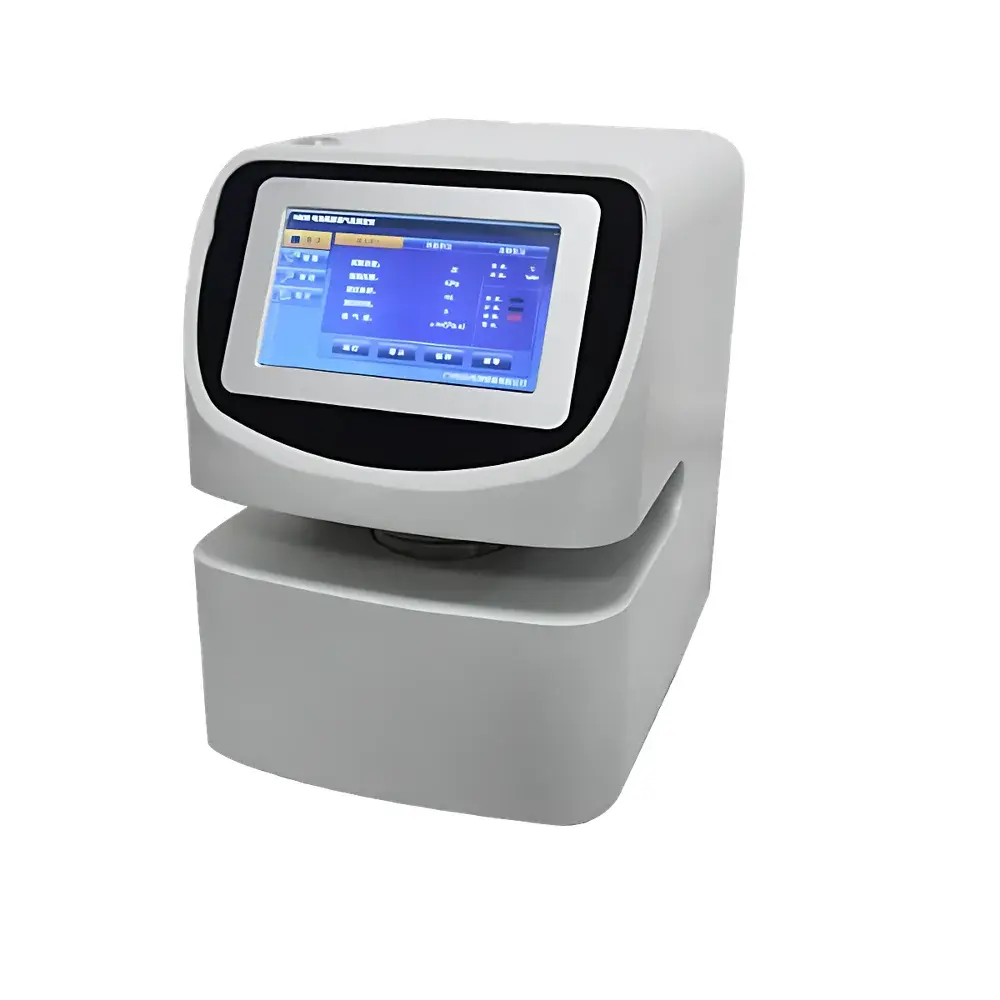
GBPI N600M Battery Separator Air Permeability Tester
| Brand | GBPI |
|---|---|
| Origin | Guangdong, China |
| Manufacturer | GBPI Packaging Instruments Co., Ltd. |
| Model | N600M |
| Testing Methods | Gurley (1.23 kPa ± 0.01 kPa), Schopper (1.00 kPa ± 0.01 kPa or 2.50 kPa ± 0.01 kPa), Bentzen (1.47 kPa ± 0.02 kPa) |
| Test Area Options | 6.42 cm² or 10.0 ± 0.2 cm² |
| Pressure Range | 0–3 kPa (adjustable, resolution 0.001 kPa) |
| Air Flow Range | 0.01–120 mL/min |
| Permeability Range | 0.01–2.5 µm/(Pa·s) |
| Resolution | 0.001 µm/(Pa·s) |
| Test Duration | 10–6000.0 s |
| Sample Dimensions | 50 mm × 50 mm (Gurley/Bentzen) or 60 mm × 100 mm (Schopper) |
| Environmental Monitoring | Integrated temperature & humidity sensor |
| Seal Integrity | ≤1.0 mL/h leakage rate |
| Power | 100 W, 220 V, 50 Hz |
| Dimensions (L×W×H) | 500 mm × 400 mm × 300 mm |
| Compliance | SJ/T 10171–2016, GB/T 458–2008, GB/T 36363–2018 |
Overview
The GBPI N600M Battery Separator Air Permeability Tester is an engineered solution for precise, repeatable quantification of gas permeability in microporous polyolefin separators used in lithium-ion and alkaline battery manufacturing. It operates on three standardized pneumatic resistance principles—Gurley, Schopper, and Bentzen—each defined by controlled differential pressure across a fixed sample area, with measurement of either time-to-volume (Gurley), volumetric flow rate (Schopper), or instantaneous flow after clamping (Bentzen). The instrument’s core architecture is designed to meet the stringent metrological requirements of battery material qualification, where separator porosity, tortuosity, and pore interconnectivity directly influence ionic conductivity, dendrite suppression, and thermal shutdown performance. Unlike generic textile or packaging permeability testers, the N600M integrates method-specific pressure calibration, dual-area sample fixtures, and real-time environmental monitoring to ensure data traceability under ISO/IEC 17025-aligned laboratory conditions.
Key Features
- Triple-method compliance: Simultaneous support for Gurley (ASTM D726-03 equivalent), Schopper (DIN 53122-1), and Bentzen (DIN 53122-2) protocols—each with independent pressure setpoints, tolerance bands, and timing logic.
- High-fidelity pressure control: Digital servo-regulated pneumatic system with 0–3 kPa range, ±0.01 kPa accuracy, and 0.001 kPa resolution—validated per ISO 9001 calibration procedures.
- Modular test area configuration: Interchangeable masks enabling rapid switching between 6.42 cm² (Gurley/Bentzen) and 10.0 ± 0.2 cm² (Schopper) effective areas without recalibration.
- Integrated environmental monitoring: Onboard temperature and relative humidity sensors (±0.5 °C, ±3 %RH) continuously log chamber conditions during test cycles, supporting GLP-compliant reporting.
- Leak-tight test chamber: Hermetic sealing verified to ≤1.0 mL/h air leakage at 3 kPa—critical for low-flow measurements (<0.1 mL/min) common in high-density separators.
- Dual-mode operation: Standalone touchscreen interface with embedded firmware (including pass/fail thresholds and statistical summary) + USB/RS232 connectivity for full PC-based control via GBPI PermeaSoft™ v3.2.
Sample Compatibility & Compliance
The N600M accommodates standard battery separator formats—including mono- and biaxially oriented PP/PE films, ceramic-coated membranes, and nonwoven composites—within defined dimensional tolerances (50 mm × 50 mm or 60 mm × 100 mm). Sample conditioning follows SJ/T 10171–2016 Clause 5.2: equilibration at ≤40 °C and 10–35 %RH for ≥24 h, with mass stability confirmed by ≤0.25 % variation over 1-h intervals. All measurement outputs comply with uncertainty budgets defined in GUM (JCGM 100:2008) and are traceable to national standards via GBPI’s internal metrology lab (CNAS-accredited). Regulatory alignment includes GB/T 458–2008 (paper/board), GB/T 36363–2018 (Li-ion separator specifications), and technical equivalency to ASTM F2457 (lithium battery separator testing).
Software & Data Management
PermeaSoft™ v3.2 provides audit-ready data handling compliant with FDA 21 CFR Part 11 requirements: electronic signatures, role-based access control, immutable raw data logs, and automatic generation of IQ/OQ documentation templates. Each test record includes timestamped pressure profiles, environmental metadata, operator ID, and calculated permeability values (µm/(Pa·s)), airflow rates (mL/min), and Gurley seconds. Export options include CSV, PDF reports with embedded calibration certificates, and direct integration into LIMS platforms via HL7 or ASTM E1384 interfaces. Software validation packages (IQ/OQ/PQ) are available upon request for GMP environments.
Applications
- Quality control of roll-to-roll separator production lines—monitoring batch-to-batch consistency in pore structure uniformity.
- R&D screening of novel coating formulations (e.g., Al₂O₃, SiO₂) for impact on gas diffusion resistance.
- Failure analysis of thermal shrinkage-induced pore closure after abuse testing (e.g., 130 °C oven exposure).
- Supplier qualification against OEM technical specifications (e.g., CATL, BYD, Panasonic separator datasheets).
- Correlation studies between air permeability and electrochemical impedance spectroscopy (EIS) results for Li⁺ transference number estimation.
FAQ
What pressure tolerances does the N600M maintain for each test method?
Gurley: 1.23 kPa ± 0.01 kPa; Schopper: 1.00 kPa ± 0.01 kPa or 2.50 kPa ± 0.01 kPa; Bentzen: 1.47 kPa ± 0.02 kPa—verified daily using NIST-traceable digital manometers.
Can the instrument be used for non-battery porous materials?
Yes—validated for filtration membranes, fuel cell GDLs, and medical packaging films—but method selection and calibration must align with relevant standards (e.g., ISO 5636-3 for paper, ASTM D737 for textiles).
Is environmental compensation applied automatically during calculation?
No—temperature and RH are logged as metadata only; permeability calculations assume standard reference conditions (23 °C, 50 %RH) per GB/T 458–2008. Users may apply empirical correction factors if required.
What maintenance is required for long-term pressure accuracy?
Annual recalibration of the pressure transducer and leak integrity verification using helium mass spectrometry are recommended; GBPI provides certified service contracts with ISO/IEC 17025 documentation.
Does the system support automated sample loading?
Not natively—the N600M is manually loaded to preserve sample integrity and avoid compression artifacts; however, third-party robotic integrators have developed compatible auto-loaders for high-throughput labs.
Related Products






