
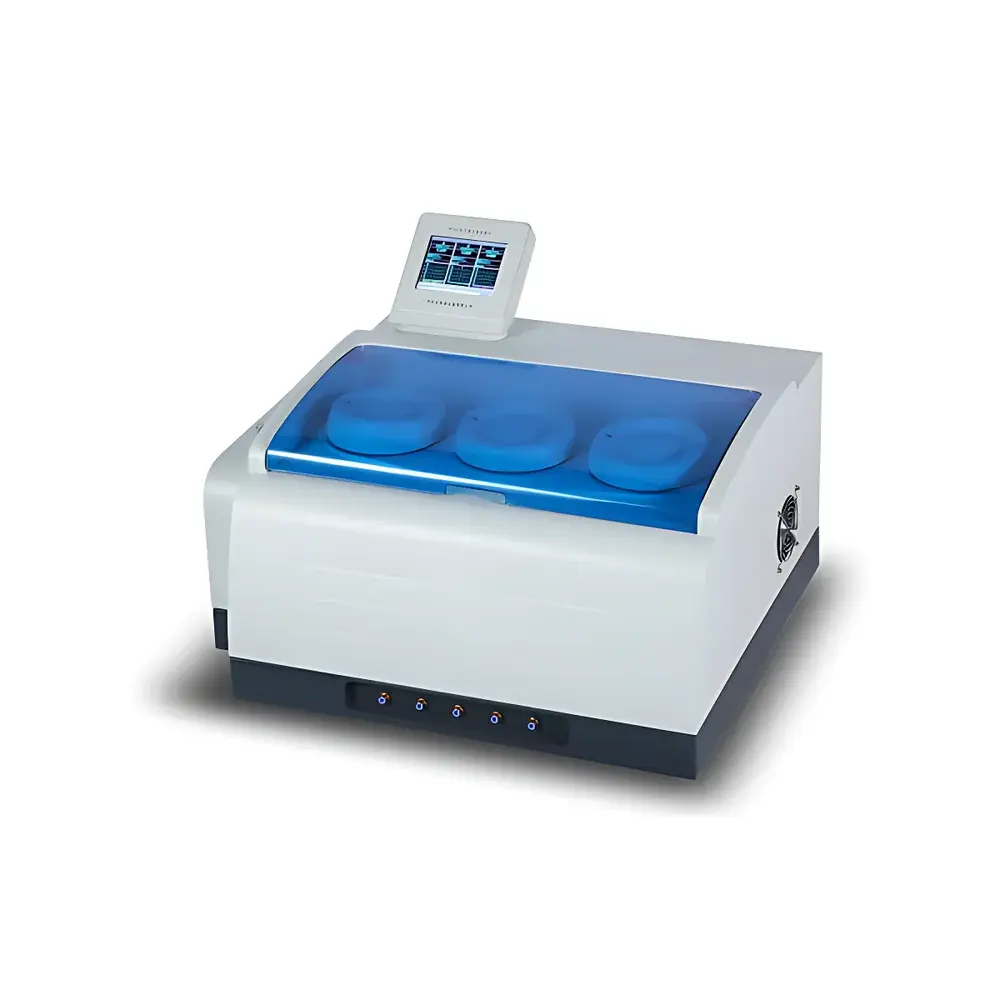
GBPI W203Y Water Vapor Transmission Rate (WVTR) Tester
| Brand | GBPI |
|---|---|
| Origin | Guangdong, China |
| Manufacturer Type | Direct Manufacturer |
| Model | W203Y |
| Test Range | 0.001–50 g/(m²·24h) (film & sheet) |
| Accuracy | 0.001 g/(m²·24h) |
| Temperature Control Range | 15–45 °C |
| Temp. Stability | ±0.1 °C |
| Humidity Control Range | 30–90 %RH |
| RH Stability | ±1 %RH |
| Test Area | 50.24 cm² |
| Specimen Diameter | Φ100 mm |
| Max. Thickness | ≤3 mm |
| Sample Capacity | 3 independent test chambers |
| Carrier Gas | ≥99.999% N₂, pressure ≥0.1 MPa, flow 0–100 mL/min |
| Gas Inlet | 1/8″ metal tube |
| Dimensions | 700 × 560 × 370 mm |
| Weight | 100 kg |
| Power | 750 W, AC 220 V / 50 Hz (110 V optional) |
Overview
The GBPI W203Y Water Vapor Transmission Rate (WVTR) Tester is a gravimetric-coulometric hybrid instrument engineered for precise, traceable, and compliant measurement of water vapor permeation through packaging materials and functional barriers. It operates on the principle of dynamic carrier gas coulometric detection: dry nitrogen sweeps the downstream side of a conditioned specimen mounted in a sealed test cell; water vapor permeating through the sample is carried into a high-precision dual-electrode coulometric moisture sensor, where quantitative electrolysis yields a direct current proportional to mass flux. This method—fully aligned with ISO 15106-3 (infrared detection variant) and ASTM E398 (desiccant-based gravimetric reference)—ensures metrological rigor across low-to-high barrier regimes, including ultra-low-permeability aluminum foil, metallized PET, and multilayer pharmaceutical blister laminates.
Key Features
- Triple independent test chambers with dedicated temperature/humidity sensors, enabling concurrent testing of three distinct specimens under identical or divergent environmental conditions—each generating a fully traceable, standalone report.
- High-stability climate control: electromagnetic step-programmed heating/cooling system maintains chamber temperature within ±0.1 °C; dual-stream humidity generation (dry + saturated wet gas mixing) delivers ±1 %RH accuracy across 30–90 %RH range.
- ARM-based embedded control architecture—fully operational without external PC; integrated 7-inch color touchscreen displays real-time curves for temperature, RH, sensor signal, and calculated WVTR, with configurable curve visibility and historical database query.
- GMP-aligned software compliant with Annex 11 (EU GMP) and FDA 21 CFR Part 11: role-based user authentication (Administrator, Operator, Reviewer), hierarchical permission assignment, and comprehensive audit trails covering system events, method changes, and data modifications.
- Modular hardware design with protected coulometric sensor—auto-range limiting prevents overexposure damage; field-replaceable functional units minimize downtime during preventive maintenance or calibration.
Sample Compatibility & Compliance
The W203Y accommodates flat specimens up to 3 mm thick and 100 mm in diameter—including monolayer polymers (LDPE, PP), coextruded films, vacuum-metallized substrates, ceramic-coated foils, and rigid sheets (PVC, PS). With optional container adapters, it extends to 3D packaging formats: pouches, trays, bottles, and blister cavities per ASTM F1249 (for flexible containers) and YBB00092003-2015 (Chinese pharmaceutical packaging standard). All measurements adhere to internationally recognized protocols: GB/T 21529-2008 (China), ISO 15106-3 (coulometric mode), DIN 53122-2 (German standard for barrier testing), and ASTM E398-2013 (standard test method for water vapor transmission of sheet materials using desiccant).
Software & Data Management
The instrument’s native software provides full lifecycle data governance—from method creation and parameter validation to automated report generation in PDF, Excel, and Word formats. Calibration workflows integrate certified reference standards (GBW(E)130543/4, accredited by China’s State Administration for Market Regulation), allowing users to perform in-house verification without third-party intervention. All raw sensor outputs, environmental logs, and calculation intermediates are stored in an encrypted local SQLite database with immutable timestamps. Exported reports include metadata: operator ID, instrument serial number, calibration certificate IDs, environmental setpoints, and uncertainty estimates derived from repeatability studies per ISO/IEC 17025 guidelines.
Applications
This system serves quality control laboratories in regulated industries requiring documented barrier integrity: pharmaceutical packaging (blister foil, cold-forming foil, sachets), medical device sterile barrier systems (Tyvek® pouches, peelable lids), food packaging (retort pouches, coffee laminates), electronics encapsulation (solar backsheet, OLED encapsulation films), and transdermal drug delivery patches. Its sub-milligram sensitivity enables validation of high-barrier coatings used in flexible OLED displays and perovskite photovoltaics—where WVTR thresholds fall below 10⁻⁶ g/(m²·day).
FAQ
What carrier gas is required, and why must it be ≥99.999% pure nitrogen?
Ultra-high-purity nitrogen eliminates interfering moisture and hydrocarbons that would saturate the coulometric sensor or distort baseline stability. Impurities >10 ppm H₂O introduce systematic bias exceeding ±5% at sub-0.01 g/(m²·24h) levels.
Can the W203Y validate compliance with FDA 21 CFR Part 11?
Yes—the software implements electronic signatures, audit trail logging, and role-based access controls meeting all substantive requirements for computerized system validation in regulated environments.
Is calibration traceable to national standards?
Yes. GBPI holds CNAS-accredited manufacturing licenses for GBW(E)130543/4 certified reference materials. Users perform routine calibration verification using these NMI-traceable films, with results automatically logged and linked to test records.
What maintenance intervals are recommended for the coulometric sensor?
Under continuous operation at 35 °C/70 %RH, sensor recalibration is advised every 6 months; full replacement recommended after 24 months or 10,000 test hours—whichever occurs first—to maintain stated accuracy specifications.
Does the system support IQ/OQ/PQ documentation packages?
Yes. Factory-supplied qualification protocols—including installation checklist, operational boundary mapping, and performance verification using certified low- and high-permeability standards—are provided in editable Word format for client-specific execution and archiving.





