
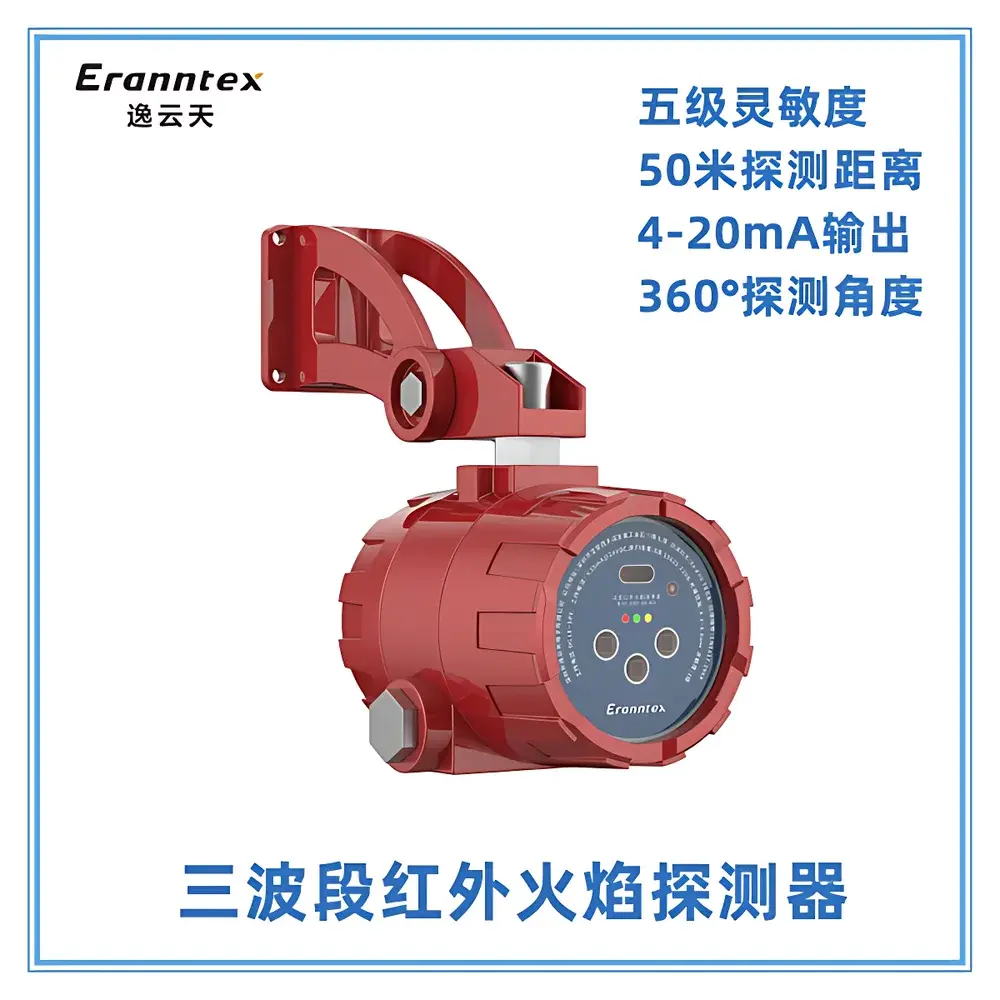
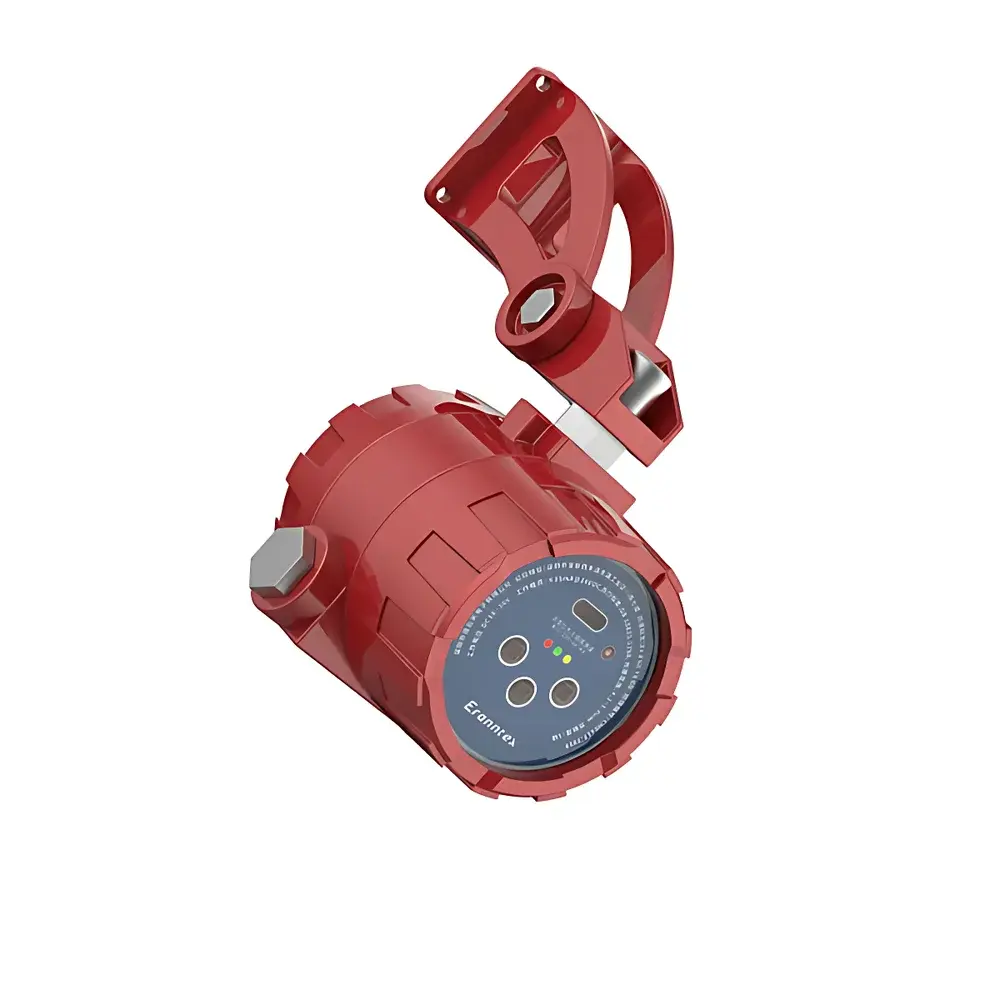
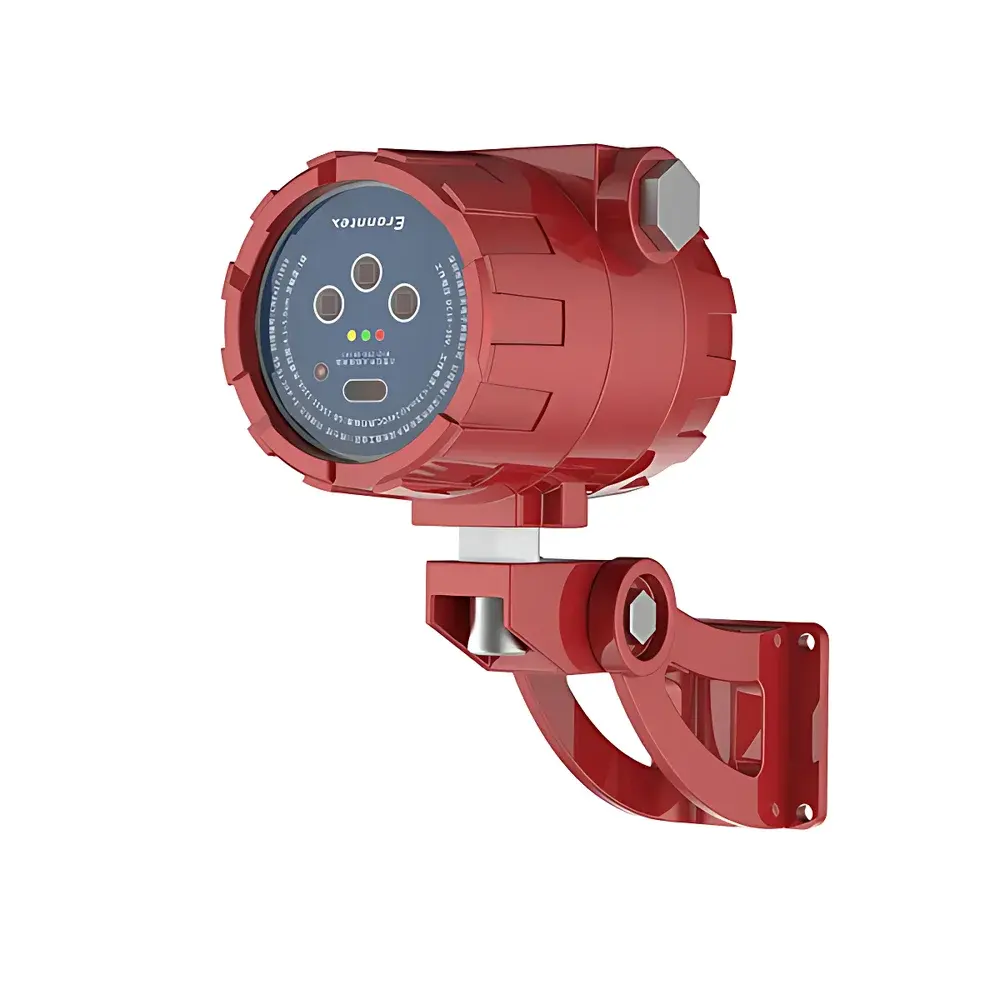
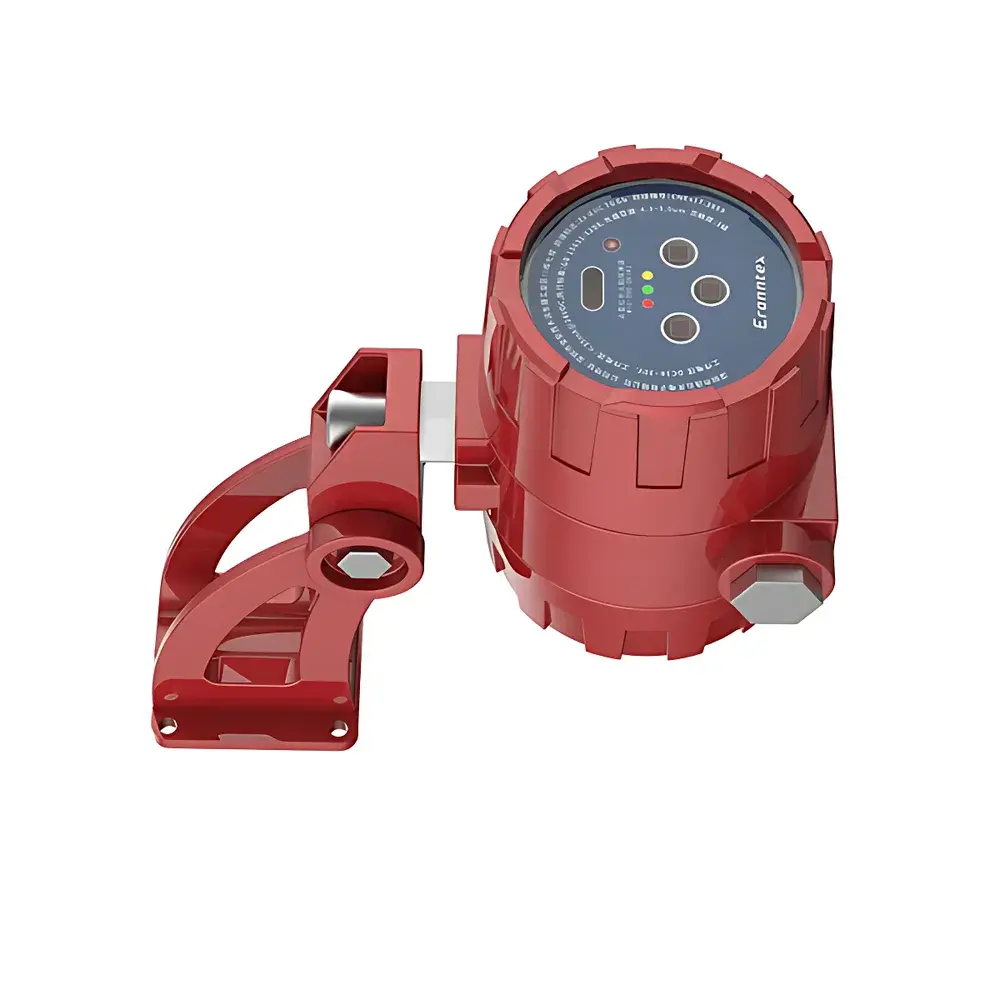
Eranntex MIC-200-IR3 Triple-Band Infrared Flame Detector
| Brand | Eranntex |
|---|---|
| Origin | Guangdong, China |
| Manufacturer Type | Manufacturer |
| Country of Origin | Domestic (China) |
| Model | MIC-200-IR3 |
| Price | Upon Request |
| Operating Voltage | DC 18–30 V |
| Operating Current | ≤30 mA (standby), ≤45 mA (alarm) |
| Spectral Range | 4–5 µm (three narrowband IR sensors) |
| Field of View | 90° |
| Detection Distance | up to 50 m (n-heptane/gasoline, 0.3 m × 0.3 m fire source), 45 m (diesel/kerosene/ethanol), 30 m (methane 0.5 m × 0.2 m, paper 0.3 m × 0.3 m) |
| Response Time | 5–10 s (medium-dependent) |
| Sensitivity Levels | 5 adjustable levels (via IR remote) |
| Output Signal | 4–20 mA (3-wire) |
| Relay Outputs | 2 SPST relays (fire alarm & fault), NO contacts, 30 VDC/AC, 3 A |
| Operating Temperature | −40 °C to +70 °C |
| Operating Humidity | ≤95 % RH (non-condensing) |
| EMC & Environmental Compliance | GB 16838 |
| Explosion Protection | Ex d IIC T6 Gb / DIP A20 TA, T6 |
| Ingress Protection | IP66 |
| Housing Material | Anodized aluminum alloy with anti-corrosion powder coating |
| Electrical Interface | M20 × 1.5 mm |
| Standards Compliance | GB 15631–2008, GB 3836–2000 series |
| Weight | 1.7 kg |
Overview
The Eranntex MIC-200-IR3 Triple-Band Infrared Flame Detector is an industrial-grade optical flame sensing device engineered for high-reliability fire detection in hazardous and demanding environments. Unlike single-band or UV/IR hybrid detectors, the MIC-200-IR3 employs a tri-spectral infrared architecture—three precisely tuned narrowband photodetectors centered within the 4–5 µm range—to selectively monitor the characteristic CO2 emission peak at 4.4 µm generated during hydrocarbon combustion. This spectral selectivity enables robust discrimination between genuine flame signatures and common false alarm sources such as blackbody radiation from hot surfaces, welding arcs, sunlight reflection, or incandescent lighting. The detector operates on the principle of ratio-based spectral analysis: by comparing signal amplitudes across three adjacent IR bands, it calculates dynamic intensity ratios that remain stable under varying background conditions while exhibiting sharp deviation upon flame onset. Its design targets continuous monitoring applications in oil & gas facilities, chemical storage areas, turbine enclosures, paint spray booths, and power generation substations where rapid, unambiguous flame confirmation is critical to initiating suppression systems or emergency shutdown protocols.
Key Features
- Triple-band IR sensing architecture with three independent 4–5 µm narrowband detectors and matched optical filters optimized for CO2 emission band detection at 4.4 µm
- Adjustable 5-level sensitivity via infrared remote control—enabling fine-tuned calibration without physical access to the unit
- Wide operating temperature range (−40 °C to +70 °C) and IP66-rated enclosure with corrosion-resistant anodized aluminum housing and powder-coated finish
- Dual relay outputs (fire alarm and fault) with SPST NO contacts rated at 30 V, 3 A—compatible with standard fire alarm control panels (FACP) and PLC safety interlocks
- 4–20 mA analog output with diagnostic current states: ≤3 mA (fault), 5 mA (normal operation), 15 mA (alarm)—supporting loop-powered configuration and HART-compatible monitoring
- Comprehensive electromagnetic immunity per GB 16838, including resistance to fast transient bursts, surge voltages (±2 kV line-to-earth), and electrostatic discharge (±8 kV contact, ±15 kV air)
- ATEX and IECEx-certified explosion protection: Ex d IIC T6 Gb for gas atmospheres and DIP A20 TA, T6 for combustible dust environments
Sample Compatibility & Compliance
The MIC-200-IR3 is validated for detection of open-flame hydrocarbon fires—including n-heptane, gasoline, diesel, kerosene, ethanol, methane, and cellulose-based fuels (e.g., paper)—under controlled test conditions per GB 15631–2008 and GB 3836–2000 series standards. Its 90° field of view supports both wide-area coverage and targeted installation in confined zones. The detector does not require direct line-of-sight to flame base but relies on unobstructed optical path to radiating combustion gases. It is not intended for smoldering fire detection or non-hydrocarbon flames (e.g., hydrogen, metals). All units undergo factory calibration traceable to national metrological standards and are supplied with conformity documentation supporting integration into SIL2-capable safety instrumented systems (SIS) per IEC 61508 and IEC 61511 frameworks.
Software & Data Management
While the MIC-200-IR3 operates as a standalone analog/digital sensor without embedded firmware or network stack, its 4–20 mA output and relay status signals are fully compatible with distributed control systems (DCS), programmable logic controllers (PLC), and centralized fire alarm management platforms. When integrated into supervisory systems compliant with IEC 62443 or UL 864, the detector supports audit-trail logging of alarm events, fault timestamps, and sensitivity change records. Its fixed analog output protocol ensures deterministic response timing—critical for time-critical safety loops where latency must remain below 100 ms end-to-end. No proprietary software or drivers are required; configuration is performed exclusively via IR remote control, eliminating need for field wiring modifications during commissioning or maintenance.
Applications
- Offshore drilling platforms and FPSO modules requiring intrinsically safe, corrosion-resistant flame detection
- Refinery process units, flare stacks, and tank farm perimeters exposed to extreme thermal cycling and salt-laden air
- Gas compression stations and LNG terminals where early hydrocarbon flame detection prevents catastrophic escalation
- Industrial boiler rooms and turbine halls subject to high ambient IR noise and mechanical vibration
- Hazardous location warehouses storing Class I, II, or III flammable materials per NEC Article 500 classification
- Military fuel depots and aviation refueling aprons requiring certified Ex-rated detection with zero UV dependency
FAQ
Does the MIC-200-IR3 detect smoldering fires or smoke?
No. It is designed exclusively for open-flame detection via CO2 infrared signature analysis and cannot identify smoldering combustion or aerosolized particulates.
Can it be used in outdoor environments with direct sunlight exposure?
Yes—the triple-band ratio algorithm and narrow optical filtering provide inherent immunity to solar IR interference up to 100 kW/m² irradiance, validated per GB 15631–2008 Annex F.
Is third-party certification available for SIL2 compliance?
The detector itself is not SIL-certified as a standalone device, but its documented failure modes, diagnostic coverage (>90 %), and PFDavg data support use in SIL2 architectures when integrated per IEC 61511 requirements.
What mounting orientation is recommended?
Horizontal mounting with optical axis parallel to expected flame plane is optimal; vertical installation is permissible but may reduce effective detection range by up to 15 % due to convection plume geometry.
Does it support HART communication?
No—its 4–20 mA output is analog-only with discrete current-level signaling; no digital overlay or HART protocol is implemented.



