
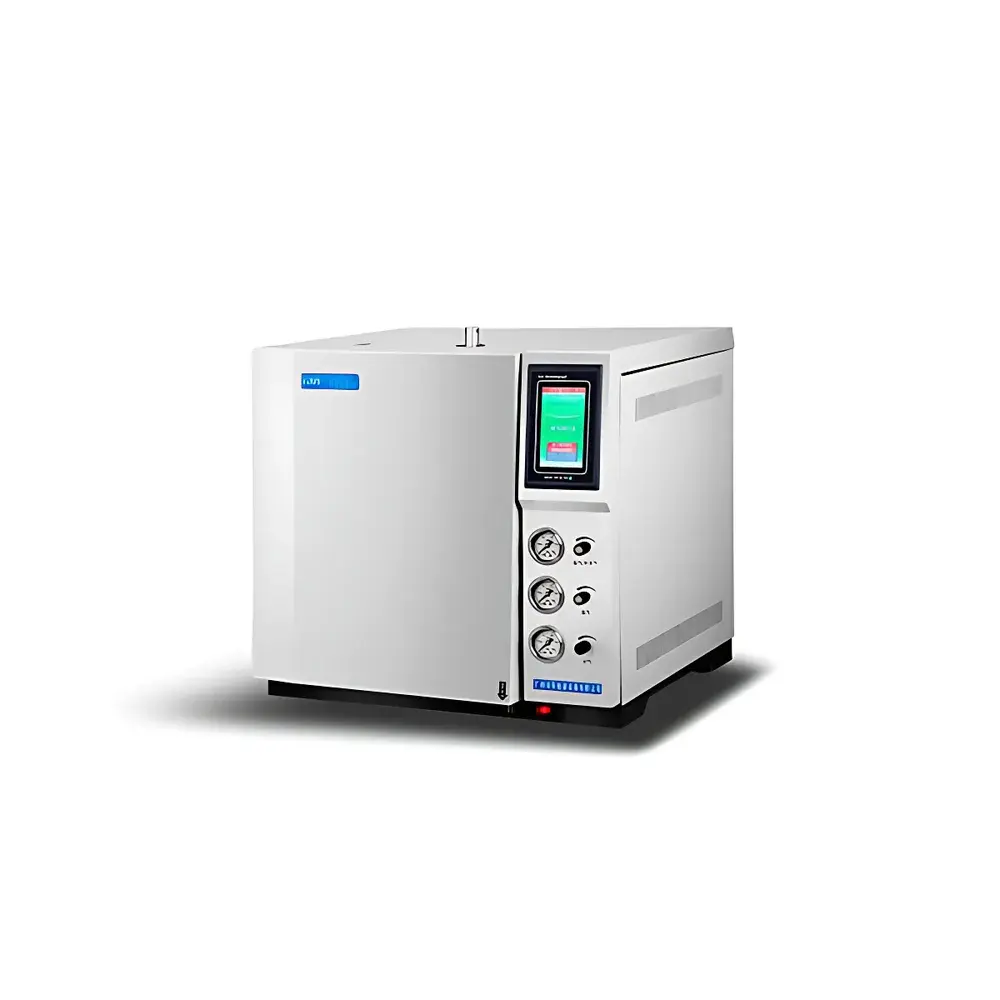
GBPI GC-9802A Laboratory Gas Chromatograph
| Brand | GBPI |
|---|---|
| Model | GC-9802A |
| Origin | Guangdong, China |
| Manufacturer Type | Direct Manufacturer |
| Instrument Type | Laboratory Gas Chromatograph |
| Application Scope | General-Purpose |
| Oven Temperature Range | 40–400 °C |
| Temperature Ramp Rate | 0–40 °C/min |
| Cool-Down Time | ~6 min (450 °C → 50 °C) |
| Carrier Gas Flow Range & Control | 0–1200 mL/min |
| Carrier Gas Pressure Range & Control | 0–970 kPa |
| Injector Maximum Operating Temperature | 400 °C |
| Injector Pressure Setting Range | 0–970 kPa |
| Injector Total Flow Setting Range | 0–1200 mL/min |
| Detector | FID (Hydrogen Flame Ionization Detector), Mt ≤ 1×10⁻¹¹ g/s (n-Hexadecane), Baseline Drift ≤ 0.02 mV/h, Noise ≤ 0.02 mV |
| Column | OV-1701 Capillary Column (50 m × 0.32 mm × 0.5 µm), Max Temp 400 °C |
| Column Oven Dimensions | 240 × 210 × 240 mm |
| Temperature Resolution | 0.1 °C |
| Temperature Stability | ±0.1% of setpoint |
| Display | Integrated LCD with real-time temperature and status monitoring |
| Power Supply | 220 VAC, 50 Hz |
| Dimensions (H×W×D) | 500 × 550 × 500 mm |
| Compliance Standards | QB/T 2929, GB/T 10004–2008, YBB 00132002 |
Overview
The GBPI GC-9802A is a benchtop laboratory gas chromatograph engineered for precision separation and quantitative analysis of volatile and semi-volatile organic compounds. Based on the fundamental principle of differential partitioning between a mobile phase (inert carrier gas) and a stationary phase (capillary column coating), the instrument delivers high-resolution elution profiles under programmable thermal control. Its robust architecture supports routine operation in quality control laboratories, environmental testing facilities, pharmaceutical R&D units, and packaging material compliance labs—particularly where solvent residue analysis (e.g., residual toluene, ethyl acetate, or isopropanol in flexible laminates per GB/T 10004–2008) or purity assessment of industrial solvents is required. The system operates with nitrogen as the primary carrier gas, supplemented by high-purity hydrogen (≥99.99%) and dried compressed air for FID combustion, meeting standard gas supply specifications for flame-based detection.
Key Features
- Programmable oven with precise temperature control from 40 °C to 400 °C, resolution of 0.1 °C and stability within ±0.1% of setpoint.
- Linear ramp rate adjustable from 0 to 40 °C/min, enabling method optimization for complex multi-component mixtures.
- Dual independent gas control channels for carrier gas (N₂) and detector gases (H₂, air), each with digital pressure and flow regulation (0–970 kPa; 0–1200 mL/min).
- Capillary-optimized split/splitless injector with maximum operating temperature of 400 °C and integrated pressure/flow feedback loop.
- FID detector with proven sensitivity (Mt ≤ 1×10⁻¹¹ g/s for n-hexadecane), low baseline drift (≤0.02 mV/h), and minimal electronic noise (≤0.02 mV), ensuring reproducible quantitation down to sub-ppm levels.
- Integrated 5.7-inch LCD interface displaying real-time oven temperature, injector status, detector voltage, and active method parameters.
- Hardware-level overtemperature protection with dual safeguards: software-initiated shutdown and independent thermal cutoff circuitry.
- Modular unitized chassis design simplifies field maintenance, column replacement, and detector servicing without tools.
- Active acoustic damping system reduces operational noise to <55 dB(A), suitable for shared lab environments.
Sample Compatibility & Compliance
The GC-9802A accommodates liquid, gaseous, and headspace-derived samples via standard 10 µL syringe injection or optional auto-sampler integration. It is validated for use with common capillary columns including OV-1701 (50 m × 0.32 mm × 0.5 µm), capable of resolving polar and mid-polarity analytes such as alcohols, ketones, esters, and aromatic hydrocarbons. The system complies with Chinese national and industry standards governing packaging safety (GB/T 10004–2008 for composite films), solvent residue testing (QB/T 2929), and pharmaceutical packaging (YBB 00132002). While not pre-certified for FDA 21 CFR Part 11, its data acquisition architecture supports audit-trail-enabled software configurations aligned with GLP/GMP documentation requirements when deployed with compliant third-party chromatography data systems (CDS).
Software & Data Management
The instrument interfaces with GBPI’s dedicated chromatography workstation software, supporting full method development, sequence execution, peak integration, calibration curve generation (linear, quadratic, or multi-point), and report export in PDF, CSV, and XML formats. Real-time plotting enables dynamic zoom, pan, and overlay of multiple runs. All acquisition events—including method parameters, injection timestamps, detector voltages, and manual annotations—are timestamped and stored in a structured local database. Raw signal files (.dat) retain full 100-Hz sampling fidelity for retrospective reprocessing. Optional CDS integration allows centralized user access control, electronic signatures, and automated backup to network drives—facilitating alignment with ISO/IEC 17025 documentation workflows.
Applications
- Solvent residue analysis in food-contact packaging (e.g., BOPP, PET/AL/PE laminates) per GB/T 10004–2008.
- Purity verification of industrial-grade organic solvents used in ink formulation or cleaning processes.
- Residual monomer quantification in polymer synthesis (e.g., styrene, vinyl chloride).
- VOC profiling in indoor air or ambient environmental samples using thermal desorption or direct injection.
- Quality assurance testing of raw materials and intermediates in fine chemical manufacturing.
- Method development and validation support for academic chromatography courses and undergraduate analytical labs.
FAQ
What detection methods are supported beyond FID?
The GC-9802A platform accepts optional detector modules including TCD (Thermal Conductivity Detector) and ECD (Electron Capture Detector), subject to mechanical and electrical interface compatibility verification.
Is the instrument compatible with ASTM D3699 or USP <467> methods?
While the hardware meets core performance criteria (temperature accuracy, flow stability, detection sensitivity), method-specific validation must be performed by the end user per their SOPs and regulatory jurisdiction.
Can the system operate unattended overnight?
Yes—the oven cooling profile, autosampler scheduling (with optional add-on), and software-triggered shutdown protocols support extended unattended runs up to 24 hours, provided ambient lab conditions remain within 15–30 °C and humidity <70% RH.
What column dimensions and phases are recommended for pesticide residue analysis?
For multiresidue screening, DB-5ms or HP-5MS capillary columns (30 m × 0.25 mm × 0.25 µm) are commonly deployed; column selection must align with target analyte polarity and required resolution per SANTE/2023/2023 guidelines.
Does the system include factory calibration certificates?
Each unit ships with a traceable temperature calibration report (NIST-traceable reference thermocouples) and FID sensitivity verification record, valid upon installation and initial power-up.






