
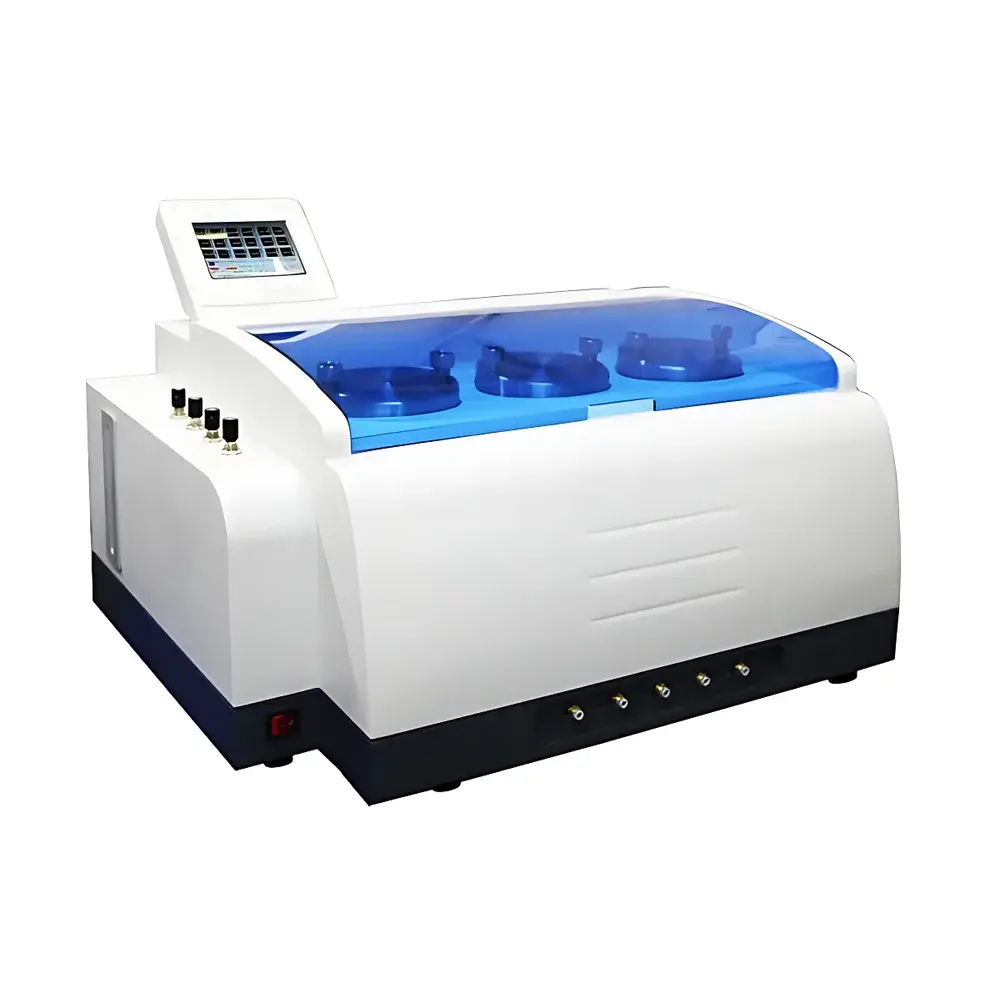
GBPI W403-F Infrared Sensor-Based Water Vapor Transmission Rate (WVTR) Tester
| Brand | GBPI |
|---|---|
| Model | W403-F |
| Origin | Guangdong, China |
| Manufacturer Type | Original Equipment Manufacturer (OEM) |
| Product Category | Packaging Industry–Specific WVTR Tester |
| Compliance Standards | GB/T 26253-2010, YBB 00092003-2015, ISO 15106-2:2005, ASTM F1249-2013, JIS K7129-2008 |
| Test Range | 0.001–100 g/m²·24h |
| Test Accuracy | ±0.001 g/m²·24h |
| Temperature Control Range | 15–45°C (optional up to 60°C) |
| Temp. Stability | ±0.1°C |
| Humidity Control Range | 0% RH (dry), 30–90% RH, and 100% RH |
| Humidity Stability | ±1% RH |
| Test Area | 50.24 cm² (down to 0.785 cm² with optional fixtures) |
| Specimen Size | Ø100 mm |
| Max. Specimen Thickness | ≤2 mm |
| Sample Capacity | 1–3 independent chambers |
| Carrier Gas | Ultra-high-purity N₂ (99.999%), pressure ≥0.1 MPa, flow rate 5–120 mL/min |
| Interface | 1/8″ stainless steel tubing |
| Dimensions | 61 × 55 × 40 cm |
| Weight | 80 kg |
| Power | 750 W, AC 220 V, 50 Hz |
Overview
The GBPI W403-F Infrared Sensor-Based Water Vapor Transmission Rate (WVTR) Tester is a precision laboratory instrument engineered for quantitative determination of water vapor permeation through polymeric films, laminates, foils, and rigid packaging structures. It operates on the principle of modulated infrared (IR) absorption spectroscopy—where water vapor molecules traversing a defined test area are carried by a dry nitrogen purge stream into a high-sensitivity IR detection cell. The instrument measures real-time absorbance at the characteristic 2.7 µm vibrational band of H₂O, enabling direct, non-destructive quantification of vapor flux without chemical reagents or desiccant saturation artifacts. Designed specifically for packaging R&D, quality control, and regulatory compliance laboratories, the W403-F meets stringent requirements for barrier performance evaluation in pharmaceutical primary packaging, medical device pouches, flexible food packaging, photovoltaic backsheet materials, and OLED encapsulation films.
Key Features
- Triple independent test chambers with dedicated IR sensors—enabling concurrent, statistically independent measurements on up to three specimens under identical or divergent environmental conditions (T/RH).
- High-resolution IR detection system with long-life, drift-compensated optical path; sensor output linear over full 0.001–100 g/m²·24h range and validated per ISO 15106-2 Annex B calibration protocols.
- Electromagnetic step-programmable temperature control achieving ±0.1°C stability across 15–45°C (extendable to 60°C); dual-stream humidity generation delivering precise, stable RH setpoints from 0% to 100% (±1% RH tolerance).
- ARM-based embedded controller architecture—supports fully autonomous operation without external PC; includes 7-inch capacitive touchscreen interface with real-time visualization of temperature, humidity, vapor concentration, and cumulative transmission curves.
- Modular hardware design with field-replaceable sensor modules, gas manifolds, and environmental chambers—minimizing downtime and simplifying preventive maintenance and ISO/IEC 17025-compliant calibration verification.
- GMP-aligned software architecture compliant with FDA 21 CFR Part 11 and EU Annex 11: role-based user access (Administrator, Operator, Reviewer), electronic signatures, and comprehensive audit trail covering system events, method changes, and raw data modifications.
Sample Compatibility & Compliance
The W403-F accommodates planar specimens up to Ø100 mm and ≤2 mm thickness—including monolayer plastics (e.g., PET, PE, PP), metallized films (AlOx, SiOx), aluminum foil laminates, rubber sheets, ceramic substrates, and composite boards. With optional container fixtures, it extends to 3D packaging forms such as blister cavities, pouches, trays, and cylindrical bottles per ASTM F1249 Annex A. All measurement protocols align with internationally recognized standards: GB/T 26253-2010 (Chinese national standard), YBB 00092003-2015 (Chinese pharmaceutical packaging guidance), ISO 15106-2:2005 (infrared detection method), ASTM F1249-2013 (standard test method for WVTR using modulated IR), and JIS K7129-2008 (Japanese industrial standard). Certified reference materials (CRM) traceable to NIM (National Institute of Metrology, China) are supplied for routine instrument verification and inter-laboratory data harmonization.
Software & Data Management
The integrated GBPI LabSuite™ software provides full lifecycle data governance—from method definition and instrument configuration to report generation and archival. Users define multi-step test protocols (e.g., baseline stabilization, ramped RH conditioning, dynamic transmission monitoring) via intuitive drag-and-drop workflow builder. Real-time curve overlays support comparative analysis across batches or material variants. All raw sensor outputs, environmental logs, and metadata are stored in an encrypted SQLite database with automatic daily backup. Reports comply with GLP/GMP documentation requirements: timestamped, digitally signed, and exportable in PDF/A-2, Excel (.xlsx), and CSV formats. Audit trails record operator ID, action timestamp, parameter values pre/post-change, and reason-for-change—fully reconstructible during regulatory inspections.
Applications
The W403-F serves critical roles across regulated and industrial sectors: evaluating moisture barrier integrity of cold-chain pharmaceutical blister packs; validating shelf-life models for low-moisture foods (e.g., snacks, powders); qualifying backsheet materials for PV modules under IEC 61215 thermal cycling stress; assessing peel strength–barrier trade-offs in transdermal patch laminates; and benchmarking nanocoated films for flexible electronics encapsulation. Its sub-mg-level resolution enables discrimination between ultra-high-barrier substrates (e.g., Al foil composites, SiNₓ-coated PET) and moderate-barrier structures (e.g., EVOH blends, acrylic coatings)—supporting both specification conformance and formulation development.
FAQ
What carrier gas is required, and why must it be ultra-high-purity nitrogen?
Ultra-high-purity nitrogen (99.999%) is mandatory to eliminate background interference from ambient moisture, CO₂, and hydrocarbons that would saturate or distort the IR detector response. Impurities compromise baseline stability and limit detection sensitivity below 0.01 g/m²·24h.
Can the W403-F measure WVTR of rigid containers like glass vials or HDPE bottles?
Yes—using optional container test fixtures conforming to ASTM F1249 Annex A geometry and sealing protocols. The system applies differential RH across the container wall and quantifies steady-state vapor ingress via headspace IR sampling.
How does the instrument ensure long-term sensor stability and calibration traceability?
Each unit ships with NIM-traceable certified reference materials (GBW(E)130543/4) and built-in temperature/humidity calibration ports. Users perform routine verification using standardized gravimetric or electrolytic reference films; all calibration events are logged with digital signatures in the audit trail.
Is remote monitoring or integration with LIMS possible?
The W403-F supports TCP/IP communication via Ethernet and provides OPC UA-compatible data streaming. RESTful API endpoints enable bidirectional LIMS integration for automated job dispatch, result ingestion, and instrument status polling.
What maintenance intervals are recommended for GMP-regulated environments?
Per ISO/IEC 17025:2017 Clause 6.4.3, sensor zero-checks are performed daily; full system verification using CRMs every 72 operational hours; and annual third-party metrological calibration—documented in the instrument’s electronic maintenance log.





