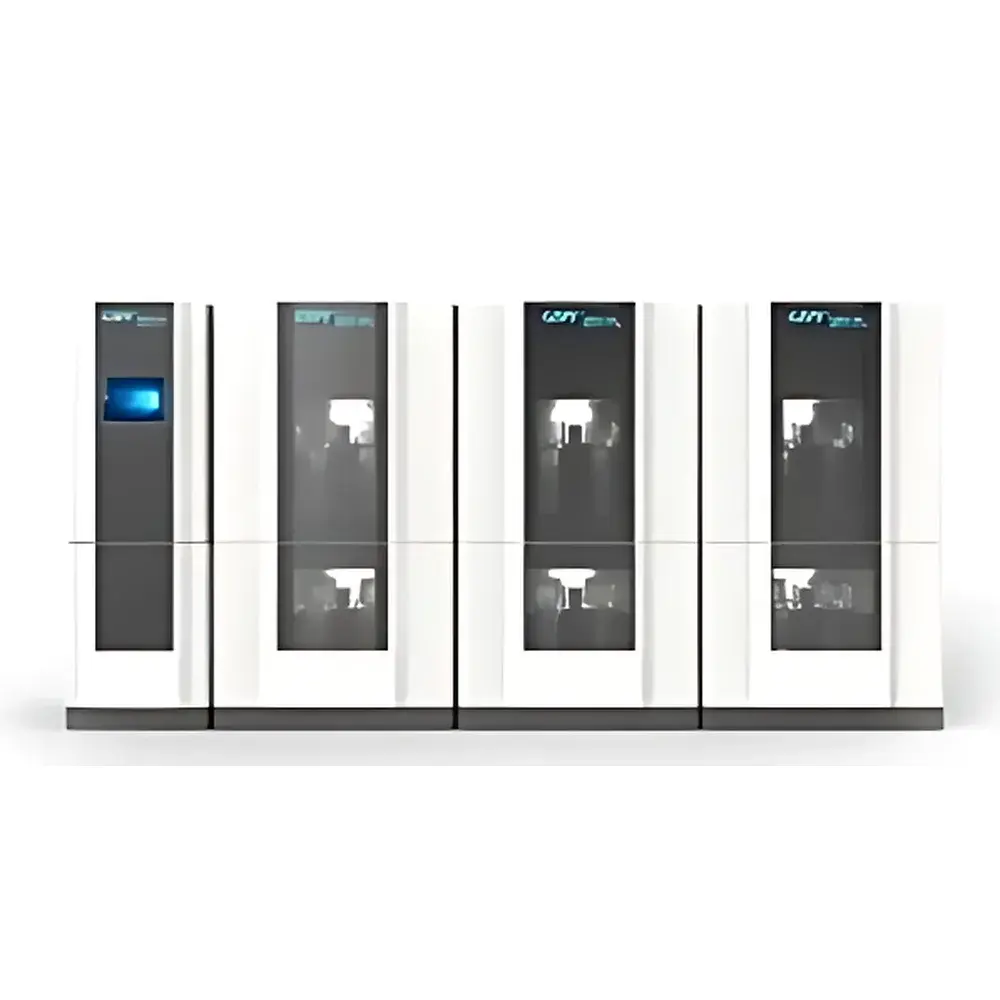
GBPI GBDA-180S Composting-Based Biodegradation Testing System
| Brand | GBPI |
|---|---|
| Origin | Guangdong, China |
| Manufacturer Type | Direct Manufacturer |
| Country of Origin | China |
| Model | GBDA-180S |
| Price Range | USD 7,000–14,000 (FOB) |
| Measurement Resolution | ±1.0% FS |
| Gas Flow Rate | 0.01–10 L/min |
| Reactor Volume | 3.5 L |
| Maximum Number of Reactors per System | 12 |
| Temperature Control Range | Ambient to 80 °C |
| Temperature Control Accuracy | ±0.5 °C |
| CO₂ Detection Range | 0–10,000 ppm |
| CO₂ Detection Accuracy | ±40 ppm (0–3,000 ppm), ±2% (3,000–10,000 ppm) |
| O₂ Detection Range | 0–25% vol |
| O₂ Detection Accuracy | ±1% FS |
| Pressure Detection Range | 0–200 kPa |
| Pressure Detection Accuracy | ±1% FS |
| Air Supply Pressure | 0.2–0.8 MPa |
| Gas Inlet Port | φ8 mm |
| Number of Test Chambers | 18 |
| Overall Dimensions | 3600 × 810 × 1930 mm |
| Weight | 1100 kg |
| Power Consumption | 3000 W |
| Power Supply | AC 220 V, 50 Hz |
Overview
The GBPI GBDA-180S Composting-Based Biodegradation Testing System is a fully automated, multi-chamber respirometric instrument engineered for standardized evaluation of ultimate aerobic biodegradability of organic materials under controlled composting conditions. It operates on the principle of dynamic respirometry: test specimens—blended with mature compost inoculum—are incubated in sealed, temperature-regulated reactors under continuous aeration. Microbial metabolism mineralizes organic carbon into CO₂, H₂O, and inorganic salts; real-time quantification of evolved CO₂ serves as the primary metric for biodegradation extent. The system complies with internationally recognized protocols including ISO 14855-1 (determination of ultimate aerobic biodegradability under controlled composting conditions), ASTM D5338 (standard test method for determining aerobic biodegradation of plastic materials under controlled composting conditions), ASTM D6400 (specification for labeling of plastics designed to be aerobically composted), and GB/T 19277.1 (Chinese national standard equivalent to ISO 14855-1). Designed for regulatory-grade testing, it supports GLP-compliant workflows and integrates hardware-level traceability for audit readiness.
Key Features
- 18 independent reaction chambers, each with dedicated gas flow control, CO₂/O₂ sensing, and thermal regulation—enabling parallel testing of samples, blanks, and references without cross-contamination or parameter coupling.
- High-fidelity gas measurement architecture: calibrated mass flow controllers (±1.0% FS accuracy) paired with certified NDIR CO₂ sensors (±40 ppm baseline accuracy) and electrochemical O₂ sensors (±1% FS), all traceable to NIST-compatible calibration standards.
- PID-based fuzzy logic temperature control across ambient to 80 °C (±0.5 °C stability), with chamber-specific setpoint programming and real-time thermal profiling.
- Integrated mechanical agitation system per reactor—programmable stirring intervals and durations ensure homogeneous mixing of substrate and inoculum while minimizing shear-induced microbial inhibition.
- Automated leak integrity verification: built-in pressure decay test routine validates gas-tightness of each reactor prior to assay initiation—critical for low-background CO₂ quantification.
- Modular hardware design facilitates field serviceability: sensor modules, flow controllers, and reactor lids are independently replaceable without system recalibration.
Sample Compatibility & Compliance
The GBDA-180S accommodates solid and semi-solid polymeric materials—including PLA, PHA, starch blends, cellulose derivatives, and composite films—within standardized 3.5 L static reactors. Each chamber accepts up to 50 g dry-weight sample mixed with 10:1 (w/w) mature compost inoculum (per ISO 14855-1 requirements). The system meets essential regulatory prerequisites for third-party certification bodies: full alignment with ISO/IEC 17025 documentation structure, dual-layer user authentication (operator/administrator/observer roles), and mandatory audit trails covering system events, method modifications, and raw data edits. All data capture adheres to FDA 21 CFR Part 11 principles—including electronic signatures, immutable timestamps, and version-controlled method definitions—ensuring defensibility in compliance audits.
Software & Data Management
Control and analysis are executed via GBPI’s proprietary RespiroSoft™ v4.x platform—a Windows-based application compliant with IEC 62304 Class B software safety standards. The interface provides real-time visualization of CO₂ evolution curves, O₂ depletion profiles, temperature gradients, and flow dynamics across all 18 channels. Automated calculation of % theoretical CO₂ release (ThCO₂) follows ISO 14855-1 Annex A algorithms, with configurable lag-phase detection and endpoint determination (e.g., 90% plateau criterion). Reporting supports export to PDF, Excel, and XML formats; all reports embed digital signatures, instrument metadata, calibration certificates, and full audit logs. Raw time-series datasets (1-second resolution) are stored in HDF5 format for long-term archival and secondary analysis using external tools such as MATLAB or Python pandas.
Applications
- Validation of compostability claims for packaging, agricultural mulch films, food service ware, and disposable textiles per EN 13432, ASTM D6400, and AS 5810.
- Comparative biodegradation kinetics studies across polymer chemistries, additive formulations, and environmental variables (temperature, moisture, inoculum source).
- Method development and interlaboratory validation for emerging standards such as ISO/CD 23597 (marine biodegradability) and OECD 310 (CO₂ headspace test).
- QC/QA testing in manufacturing facilities producing certified compostable resins—supporting batch release against internal specifications aligned with ISO 14855-1 pass/fail thresholds.
- Academic research on microbial consortia activity, substrate inhibition effects, and carbon mineralization pathways under simulated industrial composting conditions.
FAQ
Does the GBDA-180S support unattended overnight operation?
Yes—the system includes hardware watchdog timers, automatic power-fail recovery, and continuous SD-card logging. All 18 reactors maintain independent operational states during extended assays (up to 180 days).
Can I integrate external environmental sensors (e.g., humidity, pH) into the data stream?
The system features four configurable analog input channels (0–10 V / 4–20 mA) compatible with third-party transducers; sensor signals are time-synchronized and embedded in the native HDF5 dataset.
Is calibration traceable to international standards?
All factory calibrations are performed using NIST-traceable gas standards (CO₂ in N₂, O₂ in N₂) and certified flow meters; calibration certificates include uncertainty budgets per ISO/IEC 17025 requirements.
What maintenance is required between test runs?
Reactor chambers require cleaning with ethanol and drying; CO₂ sensors undergo zero-span verification every 30 days; mass flow controllers are validated quarterly using primary-standard bubble meters.
Does the software support multi-user concurrent access over LAN?
RespiroSoft™ operates in client-server mode; up to 16 remote clients can monitor live data or review historical runs via secure HTTPS, with role-based view/edit permissions enforced at the database level.