
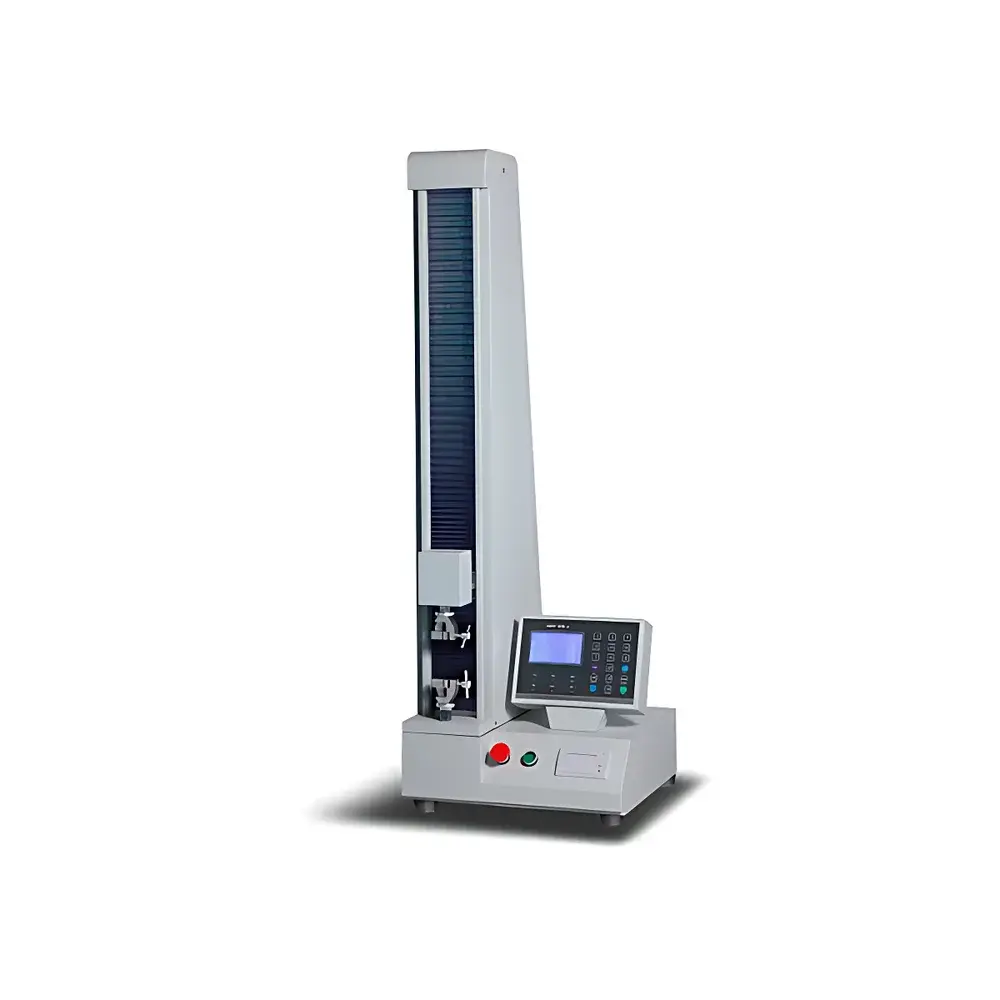
GBPI GBL-H3 Universal Electronic Tensile Tester for Film, Peel, Puncture & Seal Strength Testing
| Brand | GBPI |
|---|---|
| Origin | Guangdong, China |
| Manufacturer Type | Direct Manufacturer |
| Model | GBL-H3 |
| Instrument Type | Single-Column Electronic Tensile Testing Machine |
| Max Test Load | 0.5 kN (500 N) |
| Force Range | 0–300 N (optional 0–500 N) |
| Elongation Capacity | up to 1400% |
| Force Accuracy | ±1% of reading (Class 1) |
| Crosshead Travel | 700 mm |
| Displacement Resolution | ±1% of reading |
| Effective Sample Width | 30 mm (customizable to 50 mm) |
| Test Speed | 0–500 mm/min, continuously variable |
| Sampling Rate | 50 Hz |
| Safety | Triple-level protection with emergency stop |
| Power Supply | AC 220 V, 50 Hz, 300 W |
| Dimensions (W×D×H) | 600 × 500 × 1300 mm |
| Weight | 65 kg |
Overview
The GBPI GBL-H3 is a precision-engineered single-column universal electronic tensile tester designed for high-reproducibility mechanical property evaluation of thin, flexible packaging and functional materials. It operates on the principle of controlled uniaxial force application—measuring load vs. displacement in real time using a calibrated load cell and high-resolution encoder system. The instrument is optimized for standardized quasi-static testing per ASTM, ISO, and Chinese national standards (e.g., GB/T 1040, GB/T 2792, ASTM D882, ASTM F88), supporting deterministic characterization of tensile strength, elongation at break, peel adhesion, heat seal strength, puncture resistance, and tear propagation. Its modular architecture accommodates diverse specimen geometries—from micrometer-thin polymer films (<12 µm) to multilayer laminates, elastomeric sheets, nonwovens, pressure-sensitive adhesives, and pharmaceutical blister foils—without requiring hardware reconfiguration.
Key Features
- Single-column rigid frame with vertical load train, engineered for minimal deflection and optimal alignment during high-speed or high-elongation tests.
- High-fidelity load measurement via imported strain-gauge-based load cell, certified to Class 1 accuracy (±1% of reading) across the full 0–300 N range (extendable to 0–500 N).
- Programmable crosshead speed from 0.1 to 500 mm/min with closed-loop servo control, enabling compliance with low-strain-rate seal strength protocols (e.g., ASTM F88) and high-speed tear propagation analysis.
- Real-time data acquisition at 50 Hz sampling rate ensures capture of transient peak forces and micro-yield events in brittle or viscoelastic substrates.
- Integrated thermal printer and backlit LCD interface provide immediate access to test parameters, real-time curves, and summary statistics—no external PC required for routine operation.
- Triple-tier safety architecture: hardware-limit switches, software-defined travel boundaries, and a front-panel emergency stop button compliant with IEC 61000-6-2 EMC and EN ISO 12100 functional safety guidelines.
- Modular fixture compatibility—including standard 30 mm tensile grips, right-angle tear blades (QB/T 2358), pneumatic clamps (optional), and custom-designed puncture probes—enables rapid method switching without recalibration.
Sample Compatibility & Compliance
The GBL-H3 supports specimens with thicknesses ranging from 5 µm to 3 mm and widths up to 50 mm (with optional fixtures). It is routinely deployed for quality control and R&D validation in regulated environments, including pharmaceutical primary packaging (YBB series standards), food-grade laminates (GB/T 10004), medical device pouches (YY/T 0698), and adhesive tapes (GB/T 7122). All test methods implemented on this platform align with GLP-compliant documentation practices: force and displacement data are timestamped, traceable to NIST-traceable calibration certificates (available upon request), and fully compatible with audit-ready reporting workflows. The system meets mechanical and electrical requirements of JJG 139 (Chinese metrological verification regulation for tensile testers) and ASTM E4 for force verification procedures.
Software & Data Management
The included Windows-compatible software (delivered on 4 GB USB drive) provides full test method definition, sequence automation, and statistical post-processing. Users can configure multi-step protocols—for example, pre-tension hold → ramp-to-failure → relaxation phase—to replicate real-world service conditions. Raw ASCII data (.txt) and graphical exports (.csv, .png) support integration into LIMS or enterprise QA systems. While the base configuration operates standalone, optional RS232 connectivity enables remote command execution and centralized data logging. Software logs include operator ID, environmental notes, calibration status flags, and digital signatures—supporting partial compliance with FDA 21 CFR Part 11 when paired with organizational SOPs governing electronic records.
Applications
- Quantifying tensile modulus and yield point of biaxially oriented polypropylene (BOPP) and polyester (PET) films per GB/T 1040.3.
- Evaluating peel adhesion of aluminum foil–paper composites used in cigarette packaging per GB/T 2790 and ASTM D903.
- Validating hot-melt seal integrity of sterile barrier systems in ISO 11607-2 environments using ASTM F88-compliant fixtures.
- Measuring puncture resistance of Tyvek®-based medical packaging under ISO 11607-1 Annex B protocols.
- Characterizing tear initiation and propagation in nonwovens per ASTM D1938 and QB/T 2358.
- Supporting accelerated aging studies by tracking mechanical degradation of ethylene-vinyl acetate (EVA) encapsulants in photovoltaic modules.
FAQ
Does the GBL-H3 comply with ISO/IEC 17025 requirements for accredited testing laboratories?
Yes—when operated with documented calibration intervals (recommended annually), validated fixtures, and trained personnel, the GBL-H3 satisfies measurement uncertainty and traceability clauses of ISO/IEC 17025:2017 Annex A.
Can the system be integrated into an existing MES or SAP QA module?
Direct ERP integration is not native, but ASCII-formatted output files and COM-port command sets enable middleware-based ingestion via Python or LabVIEW scripts.
Is third-party calibration certification available?
GBPI provides factory calibration reports; NIST-traceable certificates issued by CNAS-accredited labs (e.g., Guangdong Metrology Institute) are available as a paid option.
What maintenance is required to sustain Class 1 force accuracy?
Biannual verification using certified deadweight standards and annual load cell recalibration are recommended. Mechanical guides require only periodic lubrication with silicone-free grease.
Are test method templates preloaded for common pharmacopeial standards?
Yes—the software includes preset configurations for USP , Ph. Eur. 3.2.1, and YBB 00112003 seal strength protocols, with editable parameters for dwell time, separation rate, and sample geometry.



