
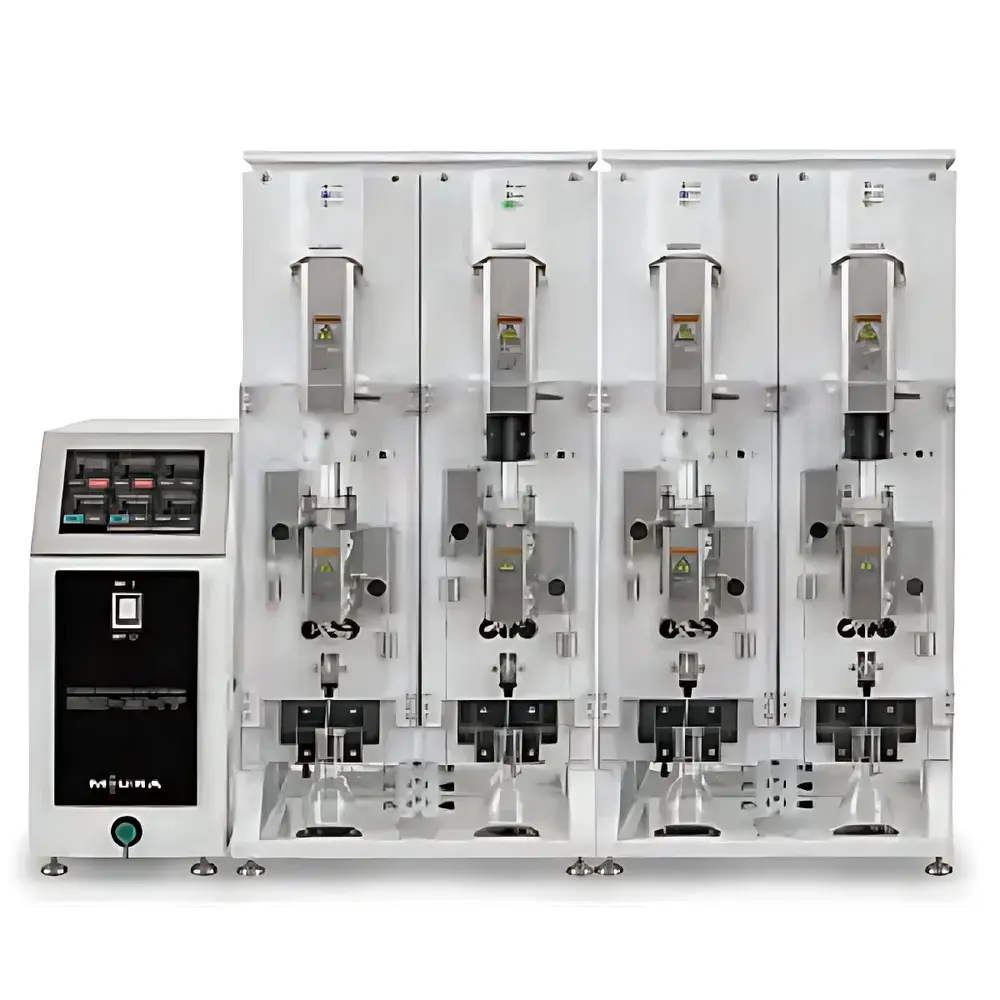
Miura GO-4EHT Four-Channel Fully Automated Dioxin/PCBs Sample Preparation System
| Brand | Miura |
|---|---|
| Origin | Japan |
| Model | GO-4EHT |
| Certification | EN 61010-1, UL 61010-1:2012, CAN/CSA C22.2 No. 61010-1-12:2012, EN 55011:2009+A1:2010, EN 61000-6-2:2005, RoHS Directive (EU) 2015/863, IEC 62321, BS EN IEC 63000:2018 |
| Purification Principle | Thermally Enhanced Solid-Phase Extraction (SPE) with Chemically Modified Silica |
| Solvent Consumption per Sample | ≤90 mL n-Hexane + 5 mL Toluene |
| Final Fraction Volume | 1–2 mL |
| Flow Path Architecture | Valve-Free, Disposable Cartridge-Based |
| Channel Configuration | Independent or Simultaneous Operation of 4 Channels |
| Method Flexibility | User-Defined Method Editing Supported |
| Compliance Context | Designed for GLP-compliant dioxin analysis workflows aligned with EPA Method 1613B, EN 1948, and ISO 18073 |
Overview
The Miura GO-4EHT is a four-channel fully automated sample preparation system engineered specifically for the rigorous purification of complex environmental and biological matrices prior to high-resolution gas chromatography–high-resolution mass spectrometry (HRGC-HRMS) analysis of polychlorinated dibenzo-p-dioxins (PCDDs), dibenzofurans (PCDFs), and dioxin-like polychlorinated biphenyls (dl-PCBs). It implements thermally assisted solid-phase extraction (SPE) using chemically modified silica-based sorbents—optimized to exploit subtle differences in polarity, steric hindrance, and π–π interactions between target congeners and co-extracted interferences. Unlike conventional manual or semi-automated cleanup methods, the GO-4EHT integrates precise temperature-controlled elution, valve-free fluidic architecture, and disposable cartridge handling to eliminate carryover, reduce analyst variability, and deliver reproducible recoveries across congener groups—including the critical 2,3,7,8-substituted isomers. Its design reflects regulatory expectations for trace-level dioxin analysis under frameworks such as EU Regulation (EC) No 1881/2006, US EPA Method 1613B Revision B, and ISO 18073:2022.
Key Features
- Four independent, programmable purification channels enabling parallel processing of up to four samples without cross-contamination risk.
- Valve-free fluidic pathway utilizing single-use, pre-packed SPE cartridges—eliminating mechanical wear, seal degradation, and solvent-induced valve fouling.
- Thermally enhanced purification: integrated column heater (range: ambient to 80 °C) promotes selective adsorption/desorption kinetics between dioxins/PCBs and matrix interferences (e.g., lipids, PCB-209, octachlorostyrene).
- Low-solvent operation: consumes only 90 mL n-hexane and 5 mL toluene per sample—avoiding hazardous chlorinated solvents such as dichloromethane while maintaining quantitative recovery.
- Direct-injection fraction collection: final purified extract volume is tightly controlled at 1–2 mL, compatible with direct volumetric adjustment and immediate HRGC-HRMS injection—no rotary evaporation or nitrogen blow-down required.
- Method configurability: supports both standardized protocols (e.g., EN 1948 Part 3, EPA 1613B Annex A) and user-defined sequences including gradient elution, multi-step washing, and temperature ramping profiles.
Sample Compatibility & Compliance
The GO-4EHT accommodates a broad range of sample types—including soil, sediment, fly ash, fish tissue, human serum, milk fat, and municipal waste incinerator stack emissions—following standard extraction procedures (e.g., Soxhlet, ASE, or pressurized liquid extraction). Each channel accepts commercially available 10–25 mL SPE cartridges filled with proprietary silica phases tailored for dioxin class separation. The system meets electrical safety and electromagnetic compatibility requirements per EN 61010-1, UL 61010-1:2012, and CAN/CSA C22.2 No. 61010-1-12:2012. Electromagnetic emissions comply with EN 55011 (Class B), EN 61000-6-2 (immunity), and FCC Part 15 Subpart B. RoHS (EU) 2015/863 and REACH SVHC screening are verified per IEC 62321-1:2013 and BS EN IEC 63000:2018. Full traceability of batch-specific performance data—including breakthrough testing and recovery validation reports—is accessible via Miura’s secure web portal for GLP audit readiness.
Software & Data Management
The GO-4EHT operates under Miura’s dedicated PC-based control software, which provides full method development, execution logging, and electronic record retention. All method parameters—including flow rate, temperature setpoints, solvent sequence, fraction timing, and cartridge identification—are digitally stored with timestamped audit trails compliant with FDA 21 CFR Part 11 (electronic signatures, role-based access, and change history). Raw log files are exportable in CSV format for integration into LIMS environments. Software updates are distributed through Miura’s validated release cycle, with version control documentation available upon request. No cloud storage or remote telemetry is enabled by default; all data remains on-site unless explicitly configured per institutional IT policy.
Applications
- Regulatory monitoring of PCDD/Fs and dl-PCBs in foodstuffs (EU Commission Regulation (EU) 2023/915), feed, and environmental media.
- Source apportionment studies in industrial emission testing and thermal process optimization.
- Human biomonitoring programs requiring ultra-trace quantification in blood serum and adipose tissue.
- Method validation and interlaboratory comparison exercises conducted under ISO/IEC 17025-accredited quality systems.
- Research applications involving non-targeted screening of halogenated aromatic contaminants using suspect screening workflows.
FAQ
Does the GO-4EHT support EPA Method 1613B Revision B?
Yes—the system implements all critical procedural elements specified in Section 7.2 (Cleanup) and Appendix A (Automated Cleanup), including sulfuric acid–silica treatment, alumina fractionation, and carbon column polishing steps, when paired with appropriate cartridge configurations.
Can I use third-party SPE cartridges with the GO-4EHT?
No—only Miura-certified, pre-conditioned, and lot-tested cartridges are supported to ensure consistent breakthrough behavior, pressure stability, and congener-specific selectivity.
Is the system compatible with HRGC-HRMS platforms from different vendors?
Yes—final fractions are delivered in standard 2-mL amber vials with PTFE-lined caps, compatible with autosamplers from Thermo Fisher, Waters, Agilent, and Shimadzu.
What maintenance is required beyond cartridge replacement?
Routine maintenance is limited to periodic inspection of tubing integrity, pump calibration verification (annually), and heater calibration (biannually); no fluidic valves or seals require servicing.
How is method transfer validated between laboratories?
Miura provides a certified reference material (CRM)-based validation kit containing NIST SRM 1946 (fish oil) and in-house spiked matrix controls, along with SOP templates for inter-lab reproducibility assessment per ISO 5725-2.



