
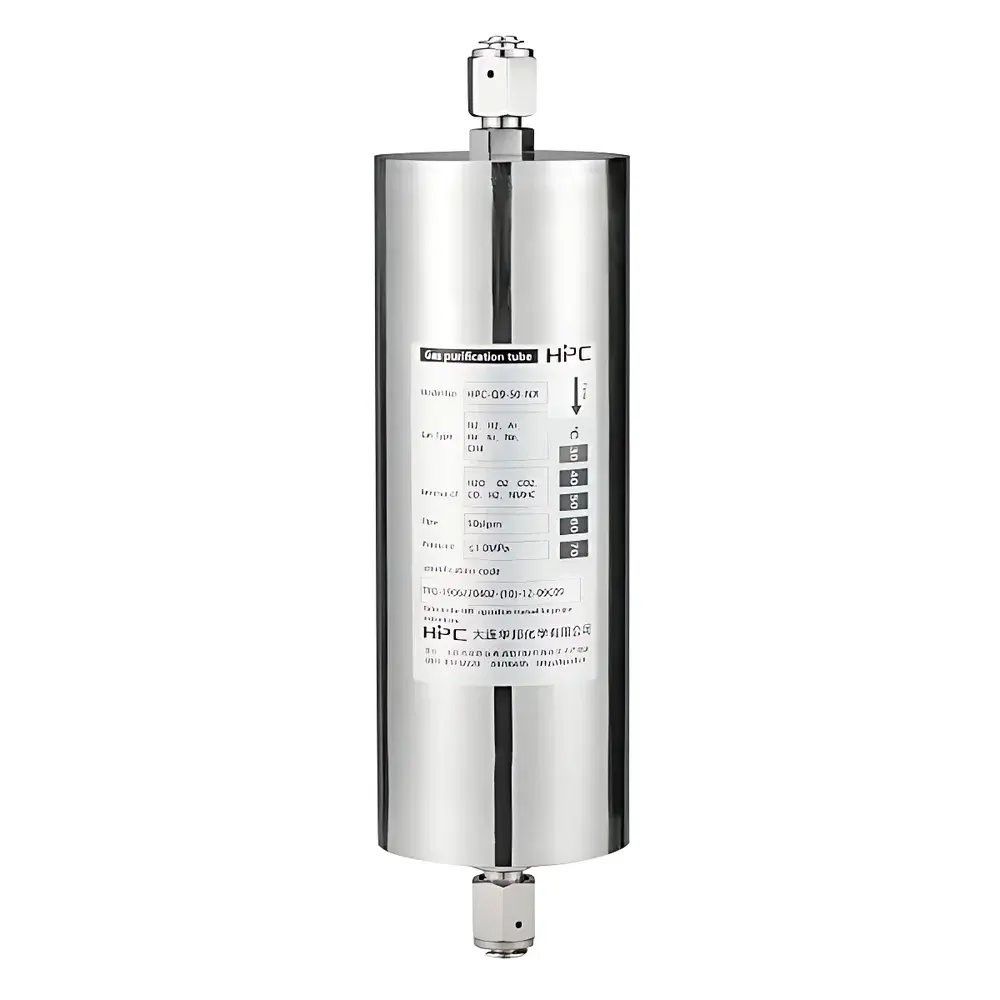
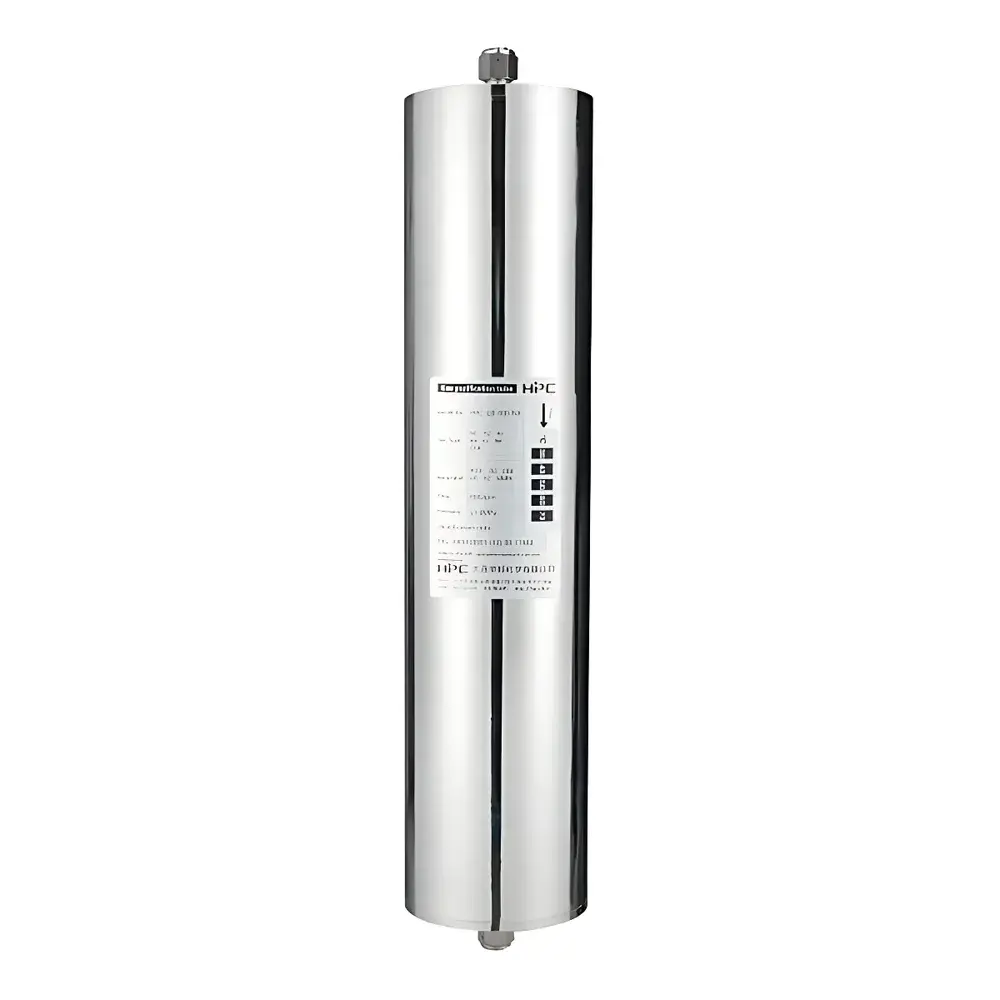

HPC HPC-Q9-120-X-V Ambient-Temperature Tubular Gas Purifier
| Brand | HPC |
|---|---|
| Origin | Liaoning, China |
| Manufacturer Type | Direct Manufacturer |
| Country of Origin | China |
| Model | HPC-Q9-120-X-V |
| Applicable Gases | N₂, Ar, He, Kr, Ne, CH₄ |
| Removed Impurities | H₂O, O₂, CO₂, CO, H₂, organic compounds |
| Purification Depth | < 1 ppb |
| Flow Rate Range | 2–2000 slpm |
| Operating Temperature | Ambient (15–35 °C) |
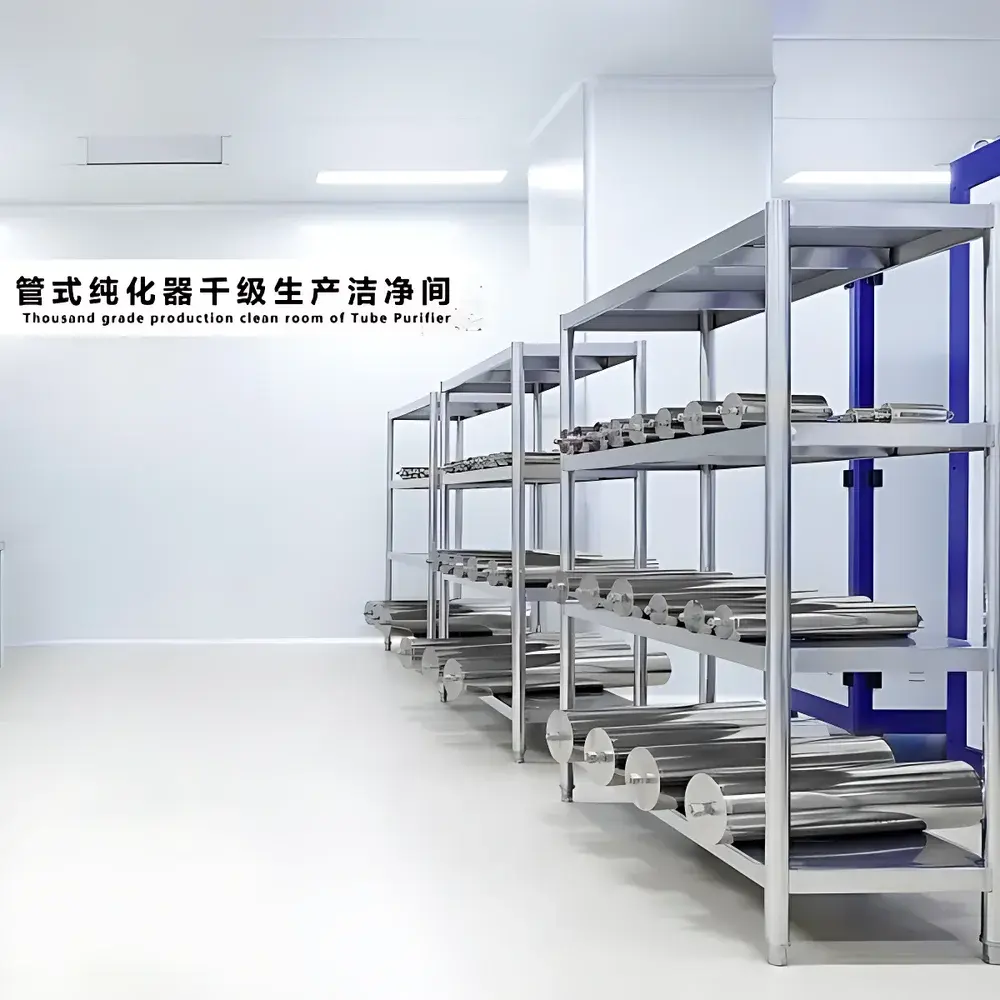
| Construction Material | 316L EP-grade stainless steel adsorption tube |
| Particulate Filtration | 0.003 µm 316L stainless steel sintered filter |
Overview
The HPC HPC-Q9-120-X-V Ambient-Temperature Tubular Gas Purifier is a high-integrity, single-pass purification system engineered for ultra-high-purity (UHP) specialty gas conditioning in semiconductor fabrication, analytical laboratory gas supply, and advanced materials research environments. It operates on a dual-mechanism principle—combining selective chemical adsorption (via proprietary catalysts and metal oxide sorbents) with high-efficiency physical adsorption (using activated alumina, molecular sieves, and carbon-based media)—to achieve sub-part-per-quadrillion (sub-ppt) removal of reactive and condensable impurities from inert and light hydrocarbon carrier gases. Unlike heated purifiers requiring external power or thermal stabilization, this unit functions reliably at ambient temperature (15–35 °C), eliminating thermal drift, reducing energy consumption, and simplifying integration into existing gas distribution networks. Its fully welded 316L electropolished (EP) tubular architecture ensures minimal particle generation, low extractables, and compliance with semiconductor-grade cleanliness standards (SEMI F57, ASTM E2482).
Key Features
- Integrated dual-stage purification: upstream catalytic conversion (e.g., O₂/H₂ → H₂O; CO → CO₂) followed by deep adsorption of residual H₂O, CO₂, CO, H₂, organics, and trace metals
- 316L EP-grade stainless steel adsorption tube with orbital TIG welding and helium leak testing (<1×10⁻⁹ mbar·L/s), validated per ASME BPE-2021 surface finish requirements (Ra ≤ 0.38 µm)
- 0.003 µm sintered 316L stainless steel particulate filter integrated upstream of the adsorbent bed to prevent downstream contamination and extend service life
- Modular, field-replaceable cartridge design enabling rapid maintenance without system venting or requalification
- Flow-rated performance across 2–2000 slpm with pressure drop <0.5 bar at 2000 slpm (N₂, 25 °C), ensuring compatibility with both low-flow analytical instruments and high-volume process lines
- Factory-tested with certified reference gas mixtures (NIST-traceable) and verified via GC-TCD/FID and cavity ring-down spectroscopy (CRDS) for H₂O/O₂/CO detection down to 0.1 ppb
Sample Compatibility & Compliance
The HPC-Q9-120-X-V is validated for continuous purification of high-purity nitrogen (N₂), argon (Ar), helium (He), krypton (Kr), neon (Ne), and methane (CH₄) at inlet purity levels ≥99.999% (5.0 grade). It meets ISO 8573-1:2010 Class 1 (solid particles), Class 2 (water), and Class 1 (oil) for compressed air/gas quality when used with appropriate pre-filtration. All wetted components comply with USP <661.1>, ASTM A270, and SEMI F57 for semiconductor tool gas delivery. The system supports GLP/GMP documentation packages—including IQ/OQ protocols, material certifications (MTRs), and full traceability of catalyst batches—and is compatible with FDA 21 CFR Part 11–compliant data logging when interfaced with third-party SCADA systems.
Software & Data Management
While the HPC-Q9-120-X-V is a passive, hardware-only purification device with no embedded microcontroller or firmware, it is designed for seamless integration into automated gas management platforms. Optional analog (4–20 mA) or digital (Modbus RTU over RS-485) output modules are available for real-time monitoring of differential pressure across the filter and adsorption bed. These signals interface directly with distributed control systems (DCS), PLCs, or lab information management systems (LIMS) to trigger maintenance alerts, log usage hours, and support predictive replacement scheduling. Comprehensive calibration certificates, batch-specific sorbent performance reports, and full material declarations (REACH/ROHS/Prop 65) are provided with each unit shipment.
Applications
- Carrier gas purification for GC, GC-MS, ICP-MS, and PTR-TOFMS systems requiring sub-ppb baseline stability
- Tool gas supply in 300 mm and advanced packaging fabs where O₂/H₂O-induced oxidation or particle nucleation must be mitigated
- Purification of calibration gas blends used in environmental monitoring (EPA Method TO-15, ASTM D6420) and emissions testing
- Research-grade gas conditioning for atomic layer deposition (ALD), chemical vapor deposition (CVD), and quantum computing cryogenic systems
- In-line polishing of bulk gas cylinders prior to point-of-use distribution in pharmaceutical cleanrooms (ISO 14644-1 Class 5)
FAQ
What impurity species does the HPC-Q9-120-X-V remove, and to what detection limit?
It removes H₂O, O₂, CO₂, CO, H₂, and volatile organic compounds (VOCs) to <1 ppb (v/v) as measured by calibrated CRDS and GC-FID under specified flow and inlet concentration conditions.
Is the unit suitable for use with corrosive gases such as Cl₂ or NH₃?
No. This model is strictly qualified for inert and non-corrosive gases (N₂, Ar, He, Kr, Ne, CH₄). Corrosive or oxidizing gases require alternative chemistries and material configurations—contact HPC engineering for custom solutions.
How often must the adsorption cartridge be replaced?
Service life depends on inlet gas quality and flow rate. Under typical semiconductor-grade N₂ (≤1 ppm H₂O, ≤100 ppb O₂) at 50 slpm, expected lifetime exceeds 12 months. Monitoring differential pressure and periodic gas analysis are recommended for condition-based replacement.
Does the purifier require electrical power or cooling water?
No. It is a fully passive, ambient-temperature device with zero power consumption and no external utilities required.
Can the unit be validated for ISO/IEC 17025 accredited laboratories?
Yes. HPC provides full validation support—including URS, FAT/SAT documentation, uncertainty budgets, and metrologically traceable test reports—to facilitate compliance with ISO/IEC 17025:2017 Clause 6.4 (equipment) and ISO 17065 for certifying bodies.







