
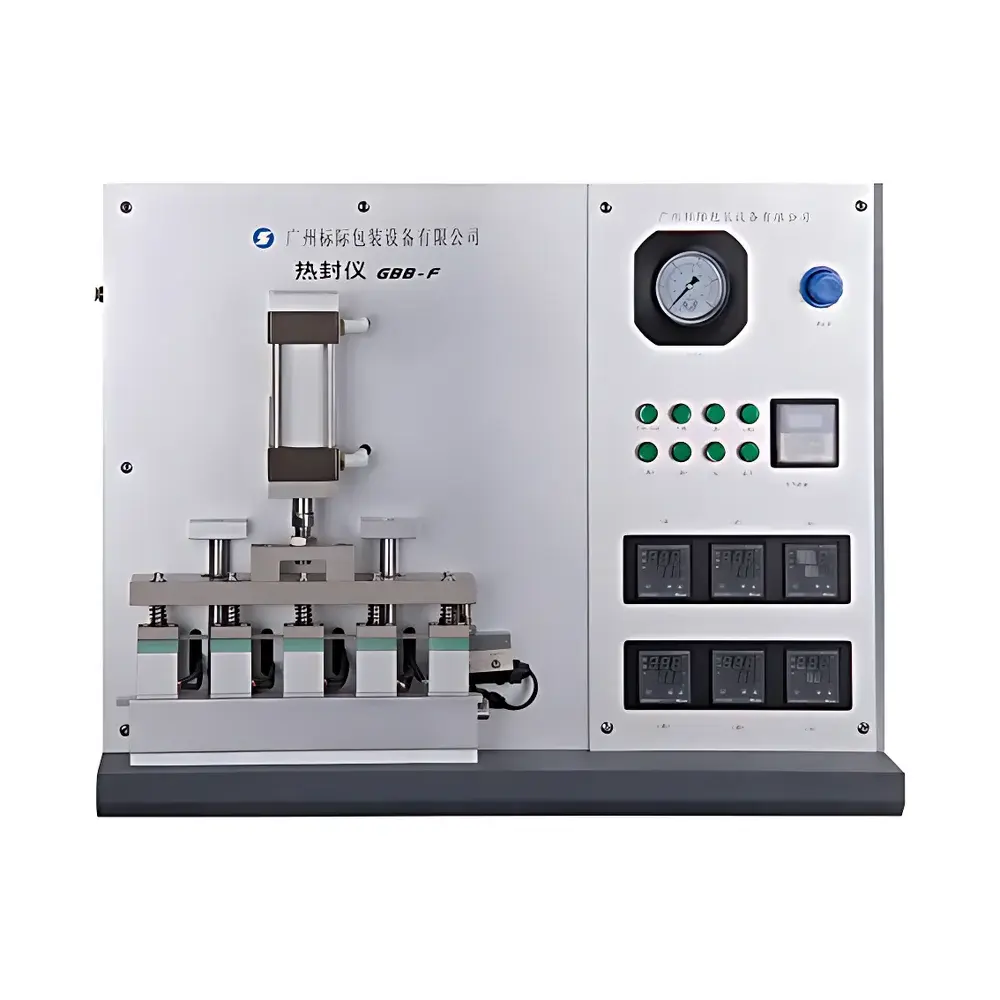
GBPI GBB-F01 Heat Sealing Tester
| Brand | GBPI |
|---|---|
| Origin | Guangdong, China |
| Manufacturer Type | Direct Manufacturer |
| Country of Origin | China |
| Model | GBB-F01 |
| Price Range | USD 4,200 – 7,000 |
| Temperature Range | Ambient to 300 °C |
| Temperature Control Accuracy | ±1 °C |
| Sealing Time Range | 0.01 s – 99.99 h |
| Sealing Pressure Range | 0.05 – 0.8 MPa |
| Sealing Surface | Upper Jaw — Five Independent 35 mm × 10 mm Segments |
| Heating Method | Dual-Sided Resistive Heating (Upper & Lower) |
| Actuation | Pneumatic (Compressed Air, 0.5–0.8 MPa) |
| Dimensions (W×D×H) | 700 × 400 × 540 mm |
| Weight | 55 kg |
| Power Consumption | 2000 W |
| Electrical Supply | AC 220 V, 50 Hz |
| Compliance Standards | QB/T 2358–1998, ASTM F2029–2016, YBB 00122003–2015 |
Overview
The GBPI GBB-F01 Heat Sealing Tester is an engineered precision instrument designed for quantitative evaluation of heat seal integrity in flexible packaging materials. It operates on the principle of controlled thermal, mechanical, and temporal input to replicate industrial sealing conditions under laboratory settings. By applying calibrated temperature, pressure, and dwell time across defined sealing surfaces, the tester enables objective determination of optimal sealing parameters—critical for ensuring package integrity, shelf-life stability, and compliance with regulatory requirements in pharmaceutical, food, medical device, and consumer goods packaging. Its dual-jaw resistive heating architecture, coupled with independent five-zone upper jaw control, supports systematic parametric mapping of seal strength as a function of localized thermal profile—making it suitable for both routine quality control and advanced material development studies.
Key Features
- Five independently controllable sealing zones on the upper jaw (35 mm × 10 mm each), enabling multi-point thermal profiling across a single seal line;
- Separate PID-controlled temperature regulation for upper jaw segments and lower heated bar with silicone elastomer pad, ensuring thermal uniformity and reproducible interface contact;
- Pneumatic actuation system (0.5–0.8 MPa compressed air) delivering consistent, repeatable sealing force without mechanical hysteresis;
- Dual operating modes: automated programmable sequence mode for standardized testing protocols, and manual foot-switch-activated mode for rapid parameter iteration during method development;
- Modular sealing tooling design—customizable jaw geometry, surface finish (e.g., polished, matte, engraved), and optional anti-adhesion coating (e.g., ceramic-reinforced PTFE) for challenging substrates such as aluminum-laminates or high-additive PE films;
- Integrated temperature sensor calibration port and traceable reference point access—facilitating routine verification per ISO/IEC 17025-mandated metrological maintenance schedules;
- Robust structural frame with vibration-damped base and linear-guided jaw motion, minimizing lateral deviation and ensuring orthogonal force application during sealing.
Sample Compatibility & Compliance
The GBB-F01 accommodates a broad spectrum of thermoplastic packaging substrates including polyethylene (LDPE, HDPE, LLDPE), polypropylene (CPP, BOPP), polyester (PET), ethylene-vinyl acetate (EVA), ionomers, and multilayer laminates used in blister, pouch, sachet, and cold-form foil applications. Its sealing surface configuration and pressure range are optimized for film gauges from 20 µm to 300 µm. The instrument conforms to internationally recognized test standards including ASTM F2029–2016 (Standard Test Method for Making Heat-Sealed Packages for Testing), QB/T 2358–1998 (Chinese national standard for plastic film heat seal strength), and YBB 00122003–2015 (Chinese pharmaceutical packaging standard). All operational parameters—including time, temperature, pressure, and actuation status—are timestamped and logged internally, supporting GLP/GMP-aligned data integrity practices and audit readiness.
Software & Data Management
While the GBB-F01 operates via intuitive front-panel controls with real-time parameter display, optional PC-based software (GBPI SealLab Suite v3.2) extends functionality for protocol management, statistical process control (SPC), and raw data export. The software supports creation of multi-step sealing sequences with conditional branching (e.g., ramp-hold-cool cycles), automatic pass/fail evaluation against user-defined thresholds, and generation of compliant test reports with electronic signature fields. Audit trails record all parameter modifications, operator IDs, and system events in accordance with FDA 21 CFR Part 11 requirements when configured with appropriate access controls and digital certificate integration.
Applications
- Optimization of heat seal parameters for new packaging formulations or process transitions;
- Comparative evaluation of seal strength across supplier batches or alternative film structures;
- Accelerated aging correlation studies linking seal parameter shifts to post-storage delamination or leakage;
- Validation of packaging line settings prior to production ramp-up;
- Root cause analysis of seal failures in complaint investigations (e.g., channel leaks, incomplete fusion, scorching);
- Supporting regulatory submissions requiring documented seal process characterization (e.g., FDA Drug Master Files, EU Annex 15 validation dossiers).
FAQ
What standards does the GBB-F01 comply with for pharmaceutical packaging validation?
The instrument implements test methodologies aligned with YBB 00122003–2015 and ASTM F2029–2016, both widely accepted in pharmaceutical packaging qualification and stability study protocols.
Can the sealing jaws be recalibrated in-house without sending the unit to service?
Yes—the integrated PT100 sensor interface allows field verification using NIST-traceable dry-block calibrators; full calibration procedures are documented in the user manual and supported by GBPI’s technical training program.
Is compressed air supply mandatory, or can the unit operate with alternative actuation?
Pneumatic actuation is integral to the mechanical design; no hydraulic or electromechanical alternatives are supported. A clean, oil-free, desiccated air source meeting ISO 8573–1 Class 3 is recommended.
How is data integrity maintained during long-duration seal tests (e.g., >24 hours)?
Internal non-volatile memory retains all parameter logs and timestamps even during power interruption; battery-backed real-time clock ensures chronological continuity across sessions.
Does GBPI provide IQ/OQ documentation packages for GMP environments?
Yes—validated installation and operational qualification templates, along with risk assessments and URS alignment documents, are available upon request for regulated laboratories.






