
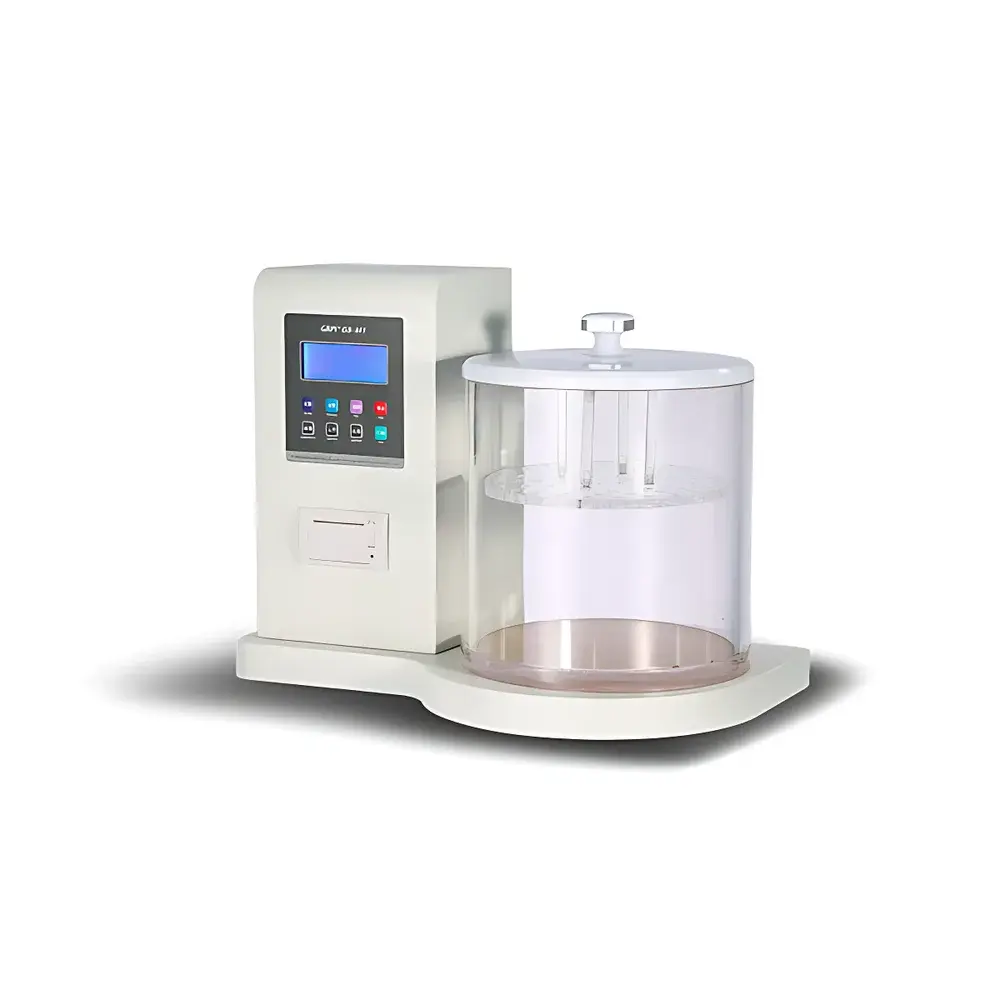
GBPI GB-M1D Vacuum Decay Leak Tester
| Brand | GBPI (Guangzhou Biaoji) |
|---|---|
| Origin | Guangdong, China |
| Manufacturer Type | Direct Manufacturer |
| Region Classification | Domestic (China) |
| Model | GB-M1D |
| Price Range | USD 4,200 – 7,000 |
| Vacuum Range | 0 to −90 kPa |
| Vacuum Accuracy | ±1 kPa |
| Vacuum Hold Time | 0.1–9999.9 s |
| Test Chamber Dimensions | Ø300 × 350 mm |
| Vacuum Chamber Internal Diameter | Ø270 × 270 mm (Effective) |
| Compressed Air Supply | 0.6–0.8 MPa |
| Air Consumption | 20 L/min |
| Power Supply | 220 V, 50 Hz |
| Control Unit Dimensions | 580 × 350 × 440 mm (L×W×H) |
| Net Weight | 10.2 kg |
| Rated Power | 100 W |
Overview
The GBPI GB-M1D Vacuum Decay Leak Tester is an engineered solution for non-destructive, quantitative assessment of seal integrity in flexible and semi-rigid packaging—primarily used for pouches, blister packs, sachets, and rigid containers in pharmaceutical, food, medical device, and consumer goods manufacturing environments. It operates on the principle of vacuum decay testing: a sealed test chamber containing the sample is evacuated to a user-defined negative pressure; the system then monitors pressure change over a precisely controlled dwell time. A statistically significant rise in chamber pressure indicates leakage, with sensitivity calibrated to detect defects as small as 50–100 µm in equivalent leak diameter under optimized conditions. Unlike dye penetration or bubble emission methods, vacuum decay is objective, repeatable, and compliant with regulatory expectations for process validation and routine quality control. The GB-M1D implements a closed-loop pneumatic architecture, eliminating reliance on mechanical vacuum pumps and reducing maintenance intervals while ensuring high reproducibility across shifts and operators.
Key Features
- Pneumatically actuated vacuum generation using clean, regulated compressed air—no oil-lubricated vacuum pump required.
- Full automation sequence: auto-evacuation to target vacuum level, programmable hold time (0.1–9999.9 s), automatic venting and return to atmospheric pressure.
- Manual intervention capability: real-time pause/resume and emergency abort functions for operator control during qualification or troubleshooting.
- Backlit LCD interface with intuitive menu navigation, displaying real-time vacuum curve, setpoints, elapsed time, pass/fail status, and error codes.
- Integrated thermal printer producing audit-ready test reports—including date/time stamp, operator ID (if configured), vacuum setpoint, hold duration, measured pressure drift, and final verdict.
- Modular vacuum chamber design: standard Ø300 × 350 mm chamber with effective internal sealing zone of Ø270 × 270 mm; optional custom chambers available for specialized container geometries.
Sample Compatibility & Compliance
The GB-M1D accommodates a broad range of package formats, including flat-bottom pouches, stand-up pouches, aluminum foil laminates, Tyvek®-based medical trays, and HDPE/PP bottles with induction-sealed caps. Its chamber geometry supports both submerged and non-submerged test configurations, enabling evaluation of both seal edges and body integrity. The instrument complies with key international standards governing package integrity verification: GB/T 15171–1994 (Chinese national standard for soft package seal strength), ASTM D3078–2002 (reapproved 2013) for detection of gross leaks in flexible packaging by bubble emission—used here as a functional reference for vacuum decay correlation—and aligns with ISO 11607-2:2019 requirements for package integrity testing in sterile barrier systems. While not inherently 21 CFR Part 11–compliant out-of-the-box, the device supports GLP/GMP-aligned documentation when paired with validated SOPs and external electronic record systems.
Software & Data Management
The GB-M1D operates via embedded firmware without dependency on external PCs. All test parameters, results, and timestamps are stored locally in non-volatile memory (retaining ≥1,000 test records). Export functionality is limited to printed hardcopy output; however, users may integrate the instrument into broader MES/QMS platforms via analog signal outputs (0–10 V or 4–20 mA vacuum feedback) or digital I/O triggers for pass/fail signaling. For full traceability, GBPI recommends pairing the GB-M1D with a documented calibration schedule (including annual verification against NIST-traceable pressure standards) and maintaining logs of chamber seal inspections, filter replacements, and air supply quality monitoring (per ISO 8573-1 Class 3 for particulates, oil, and moisture).
Applications
- Pharmaceutical: Verification of peel seals on blister cards, pouches for oral solids, and Tyvek® lids on sterilization trays prior to gamma or EtO processing.
- Food & Beverage: Detection of micro-leaks in retort pouches, vacuum-packed meats, and coffee bags where oxygen ingress compromises shelf life.
- Medical Devices: Final QC release testing of sterile barrier packaging per ISO 11607-1 and -2 protocols.
- Consumer Health: Seal validation for single-dose sachets containing vitamins, probiotics, or topical gels.
- R&D Labs: Comparative evaluation of heat-seal parameters (temperature, dwell time, pressure) across film structures and sealing equipment.
FAQ
What compressed air specifications are required for reliable operation?
A minimum 2.5 HP air compressor delivering 0.6–0.8 MPa (6–8 bar) at ≥20 L/min free air delivery is required. Air must be filtered to ISO 8573-1 Class 3 (≤5 µm particles, ≤1 mg/m³ oil, dew point ≤−20 °C) to prevent pneumatic valve clogging.
Can the GB-M1D quantify leak rate in standard units (e.g., Pa·m³/s)?
No. The GB-M1D provides pass/fail classification based on pressure rise over time. Quantitative leak rate calculation requires additional chamber volume input and temperature compensation—functions not implemented in the base firmware.
Is calibration certification included with shipment?
A factory calibration report is provided. Optional third-party accredited calibration (e.g., CNAS or A2LA) is available upon request and incurs additional lead time and cost.
What maintenance is recommended for long-term stability?
Monthly inspection of O-rings and chamber seals; quarterly replacement of coalescing air filters; annual verification of vacuum sensor linearity using certified deadweight testers or reference manometers.
Does the instrument support multi-language UI or network connectivity?
The standard interface is English-only. No Ethernet, USB, or Wi-Fi connectivity is built-in; data export is exclusively via thermal printout.






