
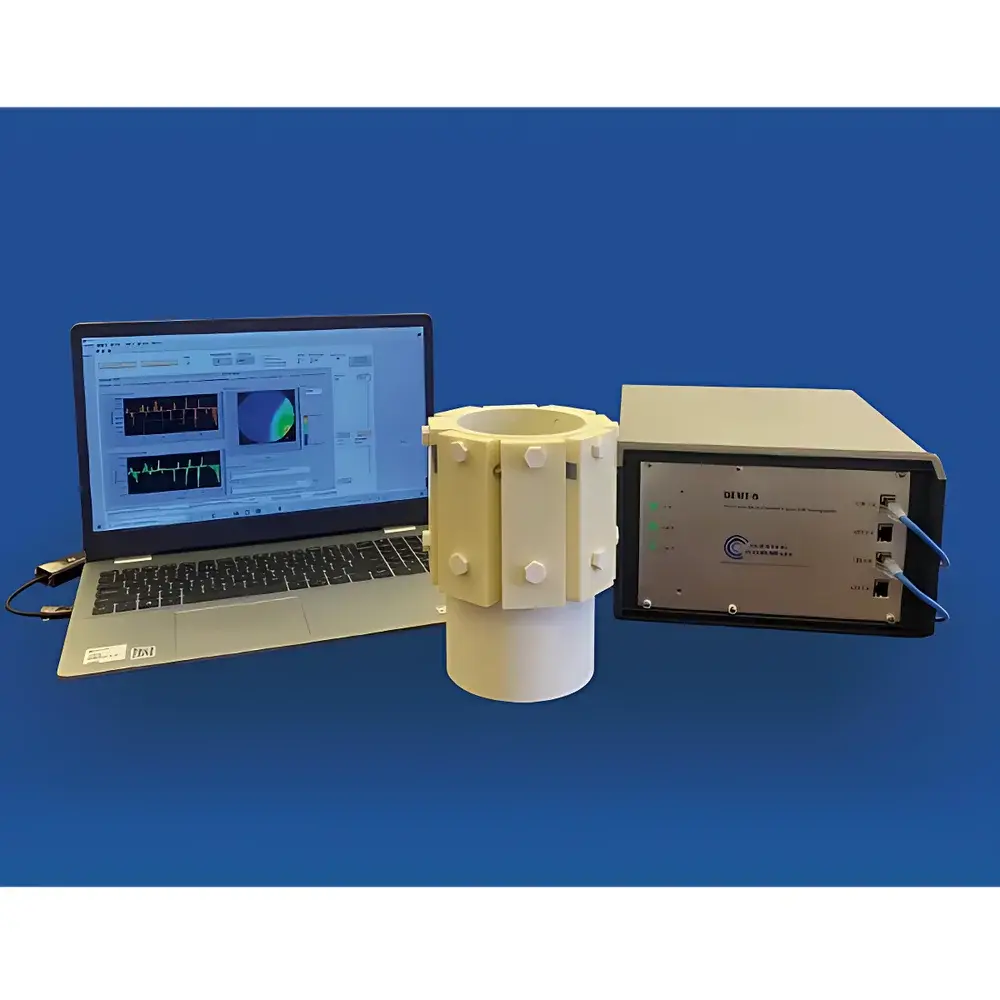
EMT Electromagnetic Tomography System MAIERIC DEMT-8/16
| Brand | MAIERIC |
|---|---|
| Origin | Anhui, China |
| Model | DEMT-8/16 |
| Detector Type | Custom Electromagnetic Sensor Array |
| Spatial Resolution | 5% of cross-sectional diameter |
| Density Resolution | Configurable (system-dependent) |
| Penetration Capability | Customizable per application |
| Measurement Range | Configurable (up to Ø300 mm cross-section) |
| Dimensional Accuracy | ±5% of cross-sectional dimension |
| Density Measurement Accuracy | Configurable |
| Operating Temperature | Up to 300 °C (non-contact probe interface) |
| Imaging Modes | Dual-mode (Eddy Current Tomography & Metal Flaw Detection) |
| Signal-to-Noise Ratio (SNR) | 60–90 dB |
| Frequency Range | 1 kHz–200 kHz (standard) |
| Channel Configuration | 8 or 16 independently configurable channels |
| Sampling Rate | Up to 100 kS/s per channel (flaw detection mode) |
| Reconstruction Grid | Up to 32×32 pixels (1% cross-sectional area resolution) |
| Front-End Signal Processing | Programmable 3-stage gain amplifier (1×–8×), with optional expansion |
| Data Output | Complex impedance components (real, imaginary, magnitude, phase), full complex-plane representation |
| Core Platform | FPGA-based digital acquisition and real-time processing architecture |
Overview
The MAIERIC DEMT-8/16 Electromagnetic Tomography System is a dual-mode, FPGA-driven industrial imaging platform engineered for non-invasive, contactless characterization of conductive and ferromagnetic media within cylindrical cross-sections. Unlike optical or X-ray modalities, electromagnetic tomography (EMT) operates on the principle of low-frequency eddy current perturbation and boundary-sensitive magnetic field reconstruction. By injecting multi-frequency alternating currents into an array of excitation coils and measuring the resulting secondary field responses across a ring of receive sensors, the system reconstructs spatial distributions of electrical conductivity and magnetic permeability—enabling both functional process tomography (e.g., phase distribution in multiphase flows) and structural integrity assessment (e.g., subsurface crack localization in metallic components). Its operational envelope spans temperatures up to 300 °C, making it suitable for in-situ monitoring in high-temperature industrial environments such as metallurgical furnaces, polymer extrusion lines, and chemical reactor vessels.
Key Features
- FPGA-based real-time digital signal processing architecture ensures deterministic latency, synchronized multi-channel acquisition, and field-upgradable firmware for algorithmic enhancements.
- Dual operational modes: Electromagnetic tomography mode (reconstructing 2D conductivity/permeability maps at up to 400 frames/s) and high-speed metal flaw detection mode (supporting single-channel sampling rates of 100 kS/s with sub-0.1 mm crack resolution).
- Configurable 8- or 16-channel electromagnetic sensor ring with programmable excitation sequencing and adaptive coil coupling compensation.
- Wideband frequency synthesis (0.1 kHz–500 kHz) enables depth-of-penetration tuning and material-specific contrast optimization—critical for distinguishing aluminum from stainless steel or detecting intergranular corrosion in austenitic alloys.
- Onboard 3-stage programmable gain amplifier (1×–8×) with selectable filter profiles supports dynamic range adaptation across heterogeneous sample conditions without hardware reconfiguration.
- Full complex-impedance output per channel (real part, imaginary part, magnitude, phase angle) preserves phase-coherent information required for advanced inverse modeling and dispersion analysis.
Sample Compatibility & Compliance
The DEMT-8/16 is designed for non-destructive evaluation of electrically conductive or magnetically permeable solids and liquids confined within circular geometries—such as pipes, rods, ingots, or fluidized beds. It accommodates samples with diameters up to 300 mm and tolerates ambient probe-side temperatures up to 300 °C via thermally isolated sensor housings and high-temperature cabling. While not an X-ray or gamma-based modality, the system complies with IEC 61000-6-2 (immunity) and IEC 61000-6-4 (emission) standards for industrial electromagnetic environments. Its measurement traceability aligns with ASTM E3097 (Standard Guide for Electromagnetic Testing Methods) and supports GLP/GMP-aligned data integrity when integrated with compliant software workflows (see Software & Data Management section).
Software & Data Management
Bundled MAIERIC EMT Studio software provides a modular environment for system configuration, real-time visualization, offline reconstruction, and quantitative analysis. The platform supports multiple inversion algorithms—including linear back-projection (LBP), Tikhonov regularization, and iterative Gauss-Newton methods—with user-selectable regularization parameters and mesh discretization. All raw and processed datasets are stored in HDF5 format with embedded metadata (timestamp, calibration ID, sensor geometry, excitation profile), ensuring FAIR (Findable, Accessible, Interoperable, Reusable) data principles. Audit trails, user authentication, and electronic signature capability are available under optional FDA 21 CFR Part 11 compliance modules—enabling deployment in regulated manufacturing QA/QC environments requiring documented verification and change control.
Applications
- Process tomography: Real-time mapping of solid-liquid or liquid-gas distributions in stirred tanks, pneumatic conveying pipelines, and fluidized bed reactors.
- High-temperature metallurgy: Monitoring melt pool dynamics, inclusion distribution, and solidification front progression in continuous casting or induction heating processes.
- Non-destructive testing (NDT): Detection and sizing of surface-breaking and near-surface cracks, voids, and delaminations in turbine blades, weld joints, and rail components.
- Material characterization: Quantitative assessment of alloy homogeneity, heat treatment uniformity, and residual stress-induced permeability gradients in ferromagnetic steels.
- Research instrumentation: Validation of computational electromagnetics models (e.g., COMSOL Multiphysics® or ANSYS Maxwell® simulations) and development of novel reconstruction algorithms.
FAQ
What physical properties does the DEMT-8/16 measure?
It reconstructs two-dimensional spatial distributions of electrical conductivity (σ) and magnetic permeability (μ) within a circular cross-section, derived from multi-frequency eddy current response measurements.
Can the system be integrated into an automated production line?
Yes—the FPGA core supports TTL-triggered acquisition, Ethernet/IP and Modbus TCP interfaces, and real-time streaming of reconstructed images or feature vectors (e.g., defect location, phase fraction) to SCADA or MES systems.
Is calibration required between measurements?
A one-time geometric and electrical calibration is performed during installation; subsequent drift compensation is handled automatically via reference coil monitoring and adaptive baseline correction algorithms.
Does the system require radiation safety licensing?
No—EMT uses non-ionizing, low-energy electromagnetic fields well below ICNIRP exposure limits; no regulatory licensing is required for operation.
How is spatial resolution defined, and what limits it?
Spatial resolution is specified as 5% of the measured cross-sectional diameter (e.g., ~15 mm for a 300 mm pipe), governed by sensor count, excitation wavelength relative to object size, and ill-posedness of the inverse problem—not by detector pixel pitch.



