
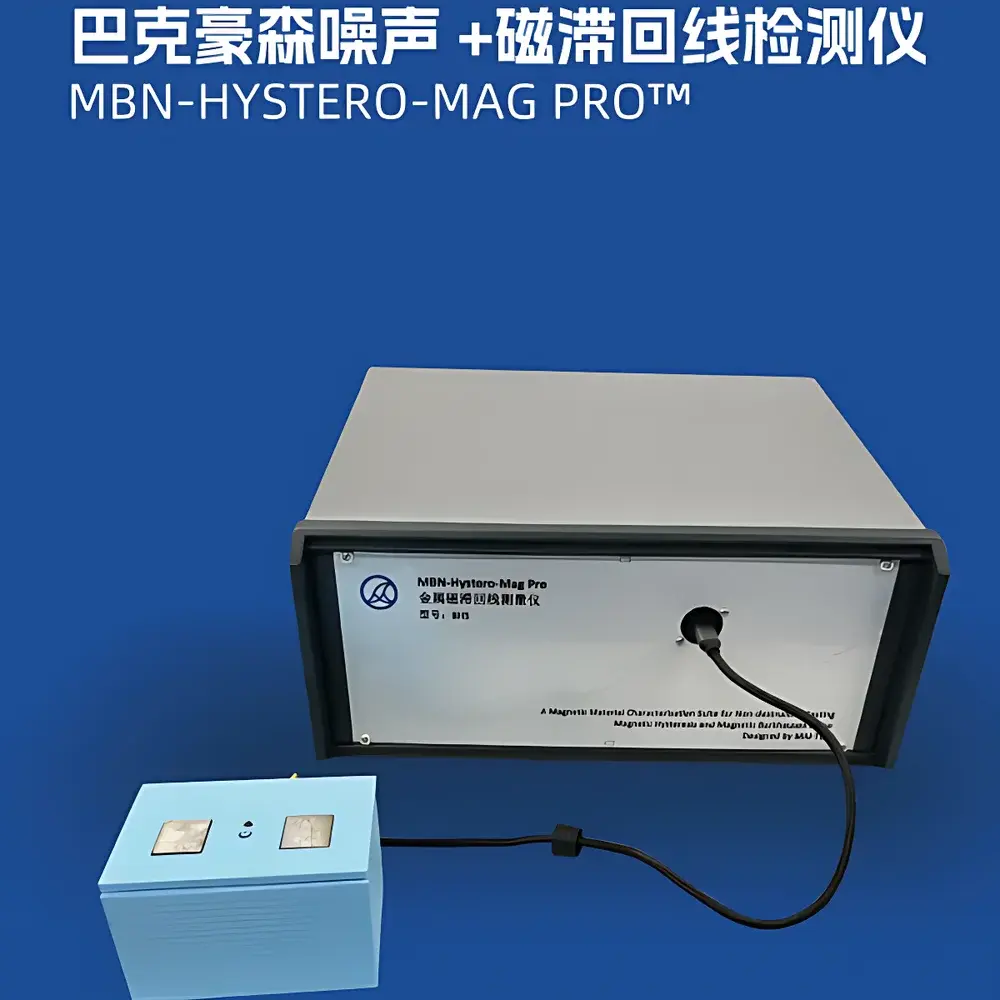
MAIERIC MBN-BH Hybrid Magnetic Analyzer for Grinding Burn Detection
| Brand | MAIERIC |
|---|---|
| Model | MBN-BH Grinding Burn Detector |
| Measurement Principle | Magnetostrictive Barkhausen Noise (MBN) + Quasi-Static B-H Hysteresis Loop Analysis |
| Core Components | U-Core Excitation/Detection Probe with Integrated Hall Sensor & Miniature MBN Pickup Coil |
| Signal Acquisition | Simultaneous Real-Time MBN, B(t), and H(t) Waveforms |
| Data Output | .db Binary Format with Timestamped Raw Signals |
| Connectivity | Wi-Fi Enabled PC-Based Control Interface |
| Software Features | Programmable Excitation Frequency/Amplitude, Adjustable MBN Bandpass Filter, Configurable Pre-Amplifier Gain, Dual-Axis Scalable XY Plotting (B vs. H, MBN vs. Time, H vs. Time) |
| Compliance Context | Designed for GLP-aligned magnetic property evaluation per ASTM A342/A342M (Permeability), ISO 643 (Metallographic Hardness Correlation), and internal QC protocols for aerospace & automotive component manufacturing |
Overview
The MAIERIC MBN-BH Hybrid Magnetic Analyzer is an integrated non-destructive testing (NDT) instrument engineered for concurrent Barkhausen Noise (MBN) emission analysis and quasi-static B-H hysteresis loop acquisition on ferromagnetic components. It operates on the physical principle that localized plastic deformation, residual stress gradients, and microstructural alterations—such as those induced by thermal damage during grinding—directly influence domain wall mobility and magnetization reversal kinetics. By applying a controlled, low-frequency (<10 Hz) sinusoidal or triangular excitation field via a U-shaped laminated magnetic core, the system simultaneously captures three synchronized analog signals: magnetic flux density (B) via a pickup coil wound on the core base, magnetic field strength (H) via a calibrated Hall-effect sensor positioned at the pole gap, and high-frequency MBN transients (50–500 kHz) through a miniature differential coil centered between the poles and in direct proximity to the sample surface. This tri-channel acquisition enables quantitative correlation between macroscopic hysteresis parameters (coercivity Hc, remanence Br, permeability μ) and microscopic noise statistics (peak amplitude, RMS energy, count rate), providing traceable metrics for subsurface grinding burn severity.
Key Features
- U-core probe architecture with dual-arm excitation windings, bottom-mounted B-coil, integrated Hall sensor (±2 kA/m range, ±0.5% FS linearity), and center-positioned MBN pickup coil (100 µm standoff tolerance)
- Fully programmable excitation: frequency adjustable from 0.1 to 10 Hz, amplitude controllable from 0.1 to 100 mT peak-to-peak, with real-time waveform monitoring
- Digital signal conditioning: user-configurable bandpass filtering (10–100 kHz default, extendable to 500 kHz), 4-stage programmable pre-amplification (gain ×1 to ×1000), and 16-bit ADC sampling at 2 MS/s
- Real-time multi-parameter visualization: synchronized time-domain plots of MBN envelope, B(t), and H(t); scalable X-Y hysteresis loops (B vs. H) with independent axis scaling and cursor-based parameter extraction
- Wi-Fi-enabled remote control and data streaming to Windows-based host software; no USB or Ethernet cables required for field deployment
- Native .db binary file format storing raw time-series data (MBN, B, H), metadata (excitation settings, calibration IDs), and computed hysteresis parameters (Hc, Br, μmax) with timestamp precision to 1 ms
Sample Compatibility & Compliance
The analyzer supports flat or gently curved ferromagnetic surfaces (steel, nickel alloys, cobalt-chrome) with minimum thickness ≥2 mm and surface roughness Ra ≤3.2 µm. Probe contact pressure is mechanically regulated to ≤2 N to prevent indentation artifacts. While not certified to EN 1369 or ASTM E1444 for full NDT accreditation, its measurement methodology aligns with established correlations defined in ASTM A342/A342M (DC magnetic properties of soft magnetic materials), ISO 643 (microstructure–hardness relationships), and SAE AMS 2750E Annex G (thermal processing verification). Data audit trails—including operator ID, session timestamp, probe calibration certificate number, and excitation parameter logs—are retained within each .db file to support internal GLP documentation and supplier qualification audits.
Software & Data Management
The Windows-native control suite provides intuitive GUI-driven operation without requiring scripting expertise. All signal processing—including Hilbert transform for MBN envelope detection, numerical integration for B-field derivation, and least-squares fitting for coercivity calculation—is performed in real time. Export options include CSV (for MATLAB/Python post-processing), PNG/SVG vector graphics, and PDF reports embedding hysteresis loops, MBN histograms, and pass/fail flags based on user-defined thresholds. The software maintains a local database of historical measurements linked to part IDs, enabling longitudinal trend analysis across production lots. Audit log entries comply with FDA 21 CFR Part 11 requirements for electronic records when deployed on validated systems (e.g., domain-joined PCs with role-based access control).
Applications
- Grinding burn assessment in bearing races, gear teeth, and turbine shafts—detecting martensitic rehardening or untempered zones beneath the surface
- Residual stress mapping in welded joints and shot-peened components, leveraging MBN amplitude sensitivity to compressive/tensile states
- Hardness estimation in heat-treated steels where conventional Rockwell testing is impractical (e.g., thin-walled parts, finished surfaces)
- Quality gate screening for incoming raw material coils, correlating hysteresis loop shape anomalies with prior cold working history
- Research into magneto-mechanical coupling in advanced high-strength steels and additive-manufactured ferromagnetic alloys
FAQ
What is the minimum detectable grinding burn depth?
Detection sensitivity depends on material composition and probe coupling, but typical resolution for subsurface white-layer formation is 20–50 µm below the surface under optimal contact conditions.
Can the system differentiate between thermal and mechanical grinding damage?
Yes—thermal damage typically suppresses MBN amplitude while increasing coercivity; mechanical overload shows elevated MBN count rate with minimal Hc shift. Multivariate pattern recognition in post-processed data enables classification.
Is probe calibration traceable to national standards?
Hall sensor calibration is performed against NIST-traceable reference magnets; B-coil sensitivity is verified using Helmholtz coil-generated fields with ±0.2% uncertainty.
Does the software support automated pass/fail decision logic?
Users can define threshold ranges for Hc, Br, and MBN RMS energy; the interface generates color-coded alerts and exports compliance status to CSV or SQL databases.
What maintenance is required for long-term stability?
Annual recalibration of Hall sensor and B-coil sensitivity is recommended; probe core laminations require periodic demagnetization using a degaussing coil to prevent magnetic memory effects.



