
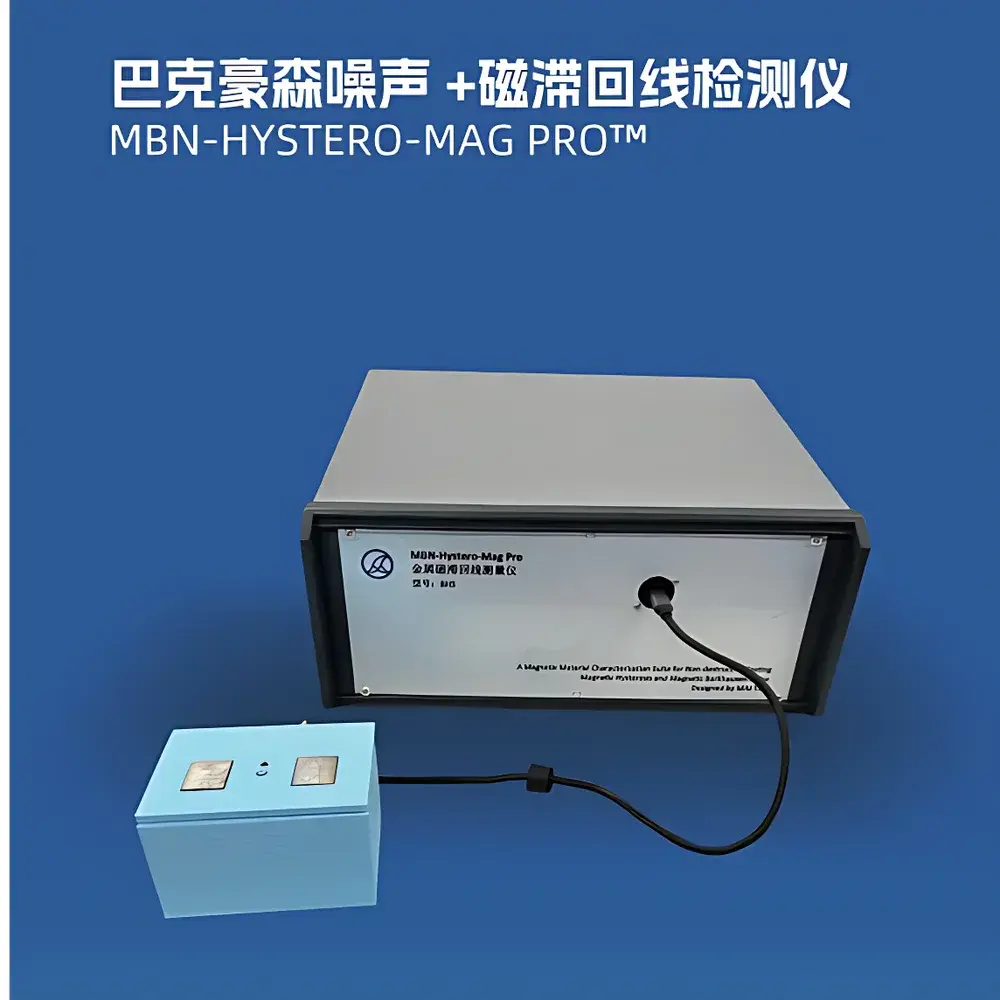
MAIERIC TEST Magnetic Barkhausen Noise (MBN) & BH Hysteresis Loop Analyzer
| Brand | MAIERIC |
|---|---|
| Origin | Anhui, China |
| Model | TEST |
| Measurement Principle | Electromagnetic Induction + Hall Effect + High-Frequency Eddy Current Coupling |
| Core Functions | Simultaneous MBN Signal Acquisition, Quasi-Static BH Loop Tracing, Coercivity & Remanence Calculation |
| Connectivity | Wi-Fi (IEEE 802.11 b/g/n), USB 2.0 |
| Signal Bandwidth | MBN Channel: 50 kHz – 1.2 MHz (programmable bandpass filter), B/H Channels: DC – 10 kHz |
| Data Output Format | SQLite .db (timestamped raw MBN, B, H waveforms + calculated hysteresis parameters) |
| Software Interface | Windows-based GUI with real-time XY scaling, parameter sweep capability, and export to CSV/MAT |
Overview
The MAIERIC TEST Magnetic Barkhausen Noise (MBN) & BH Hysteresis Loop Analyzer is a dual-mode electromagnetic characterization system engineered for non-destructive evaluation (NDE) of ferromagnetic materials. It operates on two complementary physical principles: (1) quasi-static magnetic hysteresis loop tracing via controlled magnetization of the sample using a U-shaped yoke core with excitation windings, and (2) high-frequency transient emission detection—Barkhausen noise—arising from irreversible domain wall jumps under applied field gradients. The instrument integrates a precision Hall-effect sensor for direct H-field measurement, a secondary pickup coil for B-field induction, and a miniaturized, surface-coupled detection coil optimized for broadband MBN capture (50 kHz–1.2 MHz). This architecture enables synchronized acquisition of time-resolved MBN bursts and full-cycle BH loops under identical magnetization conditions—critical for correlating microstructural state (e.g., dislocation density, residual stress, phase distribution) with macroscopic magnetic response.
Key Features
- Simultaneous dual-channel acquisition: Real-time synchronization of MBN transients, B(t), and H(t) waveforms with timestamp alignment at 10 MS/s sampling rate.
- Programmable excitation control: Adjustable sinusoidal or triangle-wave excitation frequency (0.01–10 Hz) and amplitude (0–200 A·turns), enabling controlled minor-loop analysis and coercivity mapping.
- Configurable signal conditioning: Digital bandpass filtering (center frequency and bandwidth user-selectable), programmable preamplification (gain range: 20–80 dB), and adaptive noise floor suppression.
- Wireless operational flexibility: IEEE 802.11-compliant Wi-Fi interface supports remote instrument control and live data streaming to Windows workstations without physical cabling constraints.
- Quantitative hysteresis analysis: Automated calculation and display of coercivity (Hc), remanent flux density (Br), saturation magnetization (Bs), and loop area (energy loss per cycle) in compliance with IEC 60404-4 and ASTM A773/A773M.
- Raw data integrity: All acquired signals—including unprocessed MBN voltage transients, integrated B-field, and Hall-measured H-field—are stored in a timestamped SQLite database (.db) with metadata (excitation parameters, probe position, ambient temperature).
Sample Compatibility & Compliance
The analyzer is validated for flat or gently curved ferromagnetic specimens with thickness ≥1 mm and surface roughness Ra ≤ 6.3 µm. Compatible material classes include low-carbon steels, case-hardened alloys, martensitic stainless steels, and nickel-iron soft magnetic laminations. Probe geometry permits measurements on components up to 300 mm in width and unlimited length. The system adheres to electromagnetic compatibility (EMC) requirements per EN 61326-1 and meets safety standards under EN 61010-1 for laboratory electrical equipment. Data handling protocols support audit-ready workflows compliant with GLP and GMP documentation frameworks; SQLite output format facilitates integration into LIMS environments and satisfies traceability requirements under ISO/IEC 17025.
Software & Data Management
The Windows-based control software provides a calibrated graphical interface supporting real-time overlay of MBN envelope, dM/dH derivative, and BH loop trajectories. Users may define multi-step parameter sweeps (e.g., varying peak H-field across 5–200 kA/m) and export processed metrics—including MBN RMS amplitude, peak count rate, and loop-derived coercivity—to CSV or MATLAB-compatible MAT files. Built-in FFT spectral analysis enables frequency-domain MBN signature comparison between reference and test samples. Database queries allow retrospective extraction of historical measurements by sample ID, date range, or process parameter set. No proprietary runtime dependencies are required; software installation includes Microsoft Visual C++ Redistributables and SQLite DLLs.
Applications
- Grinding burn assessment: Detection of subsurface tensile residual stress and microstructural alterations (e.g., untempered martensite, rehardened layers) in aerospace bearing races, gear teeth, and turbine shafts.
- Heat treatment verification: Correlation of MBN amplitude decay and coercivity increase with tempering degree in quenched-and-tempered steels.
- Weld quality screening: Identification of heat-affected zone (HAZ) embrittlement through localized MBN suppression and anomalous Hc elevation.
- Material sorting: Discrimination of alloy grades (e.g., 4140 vs. 4340) and hardness states (HRC 35 vs. HRC 55) based on statistically significant shifts in MBN spectral centroid and loop squareness ratio.
- Process monitoring: In-line validation of shot peening intensity and coverage via MBN amplitude recovery kinetics post-treatment.
FAQ
What standards does this system comply with for magnetic measurements?
It conforms to IEC 60404-4 for DC magnetic property measurement methods and ASTM A773/A773M for quasi-static hysteresis loop characterization. MBN signal acquisition follows best practices outlined in ISO 20497 for non-destructive testing of ferromagnetic materials.
Can the system be used on coated or painted components?
Yes—non-contact operation allows measurements through non-magnetic coatings ≤150 µm thick (e.g., epoxy, zinc, paint) without recalibration, provided coating uniformity is verified.
Is raw MBN waveform data accessible for third-party analysis?
Yes—full-resolution time-series data (MBN voltage, B, H) is stored in open-format SQLite databases with documented schema, enabling import into Python (pandas), MATLAB, or custom signal processing pipelines.
Does the software support automated pass/fail decision logic?
User-defined thresholds can be assigned to Hc, Br, or MBN RMS amplitude; the interface flags deviations in real time and logs results with timestamp and operator ID for SPC charting.
What calibration certificates are provided with the instrument?
Each unit ships with NIST-traceable calibration reports for Hall sensor linearity (±0.5% FS), B-coil sensitivity (±1.2% FS), and MBN channel gain accuracy (±0.8 dB), valid for 12 months from shipment date.



