
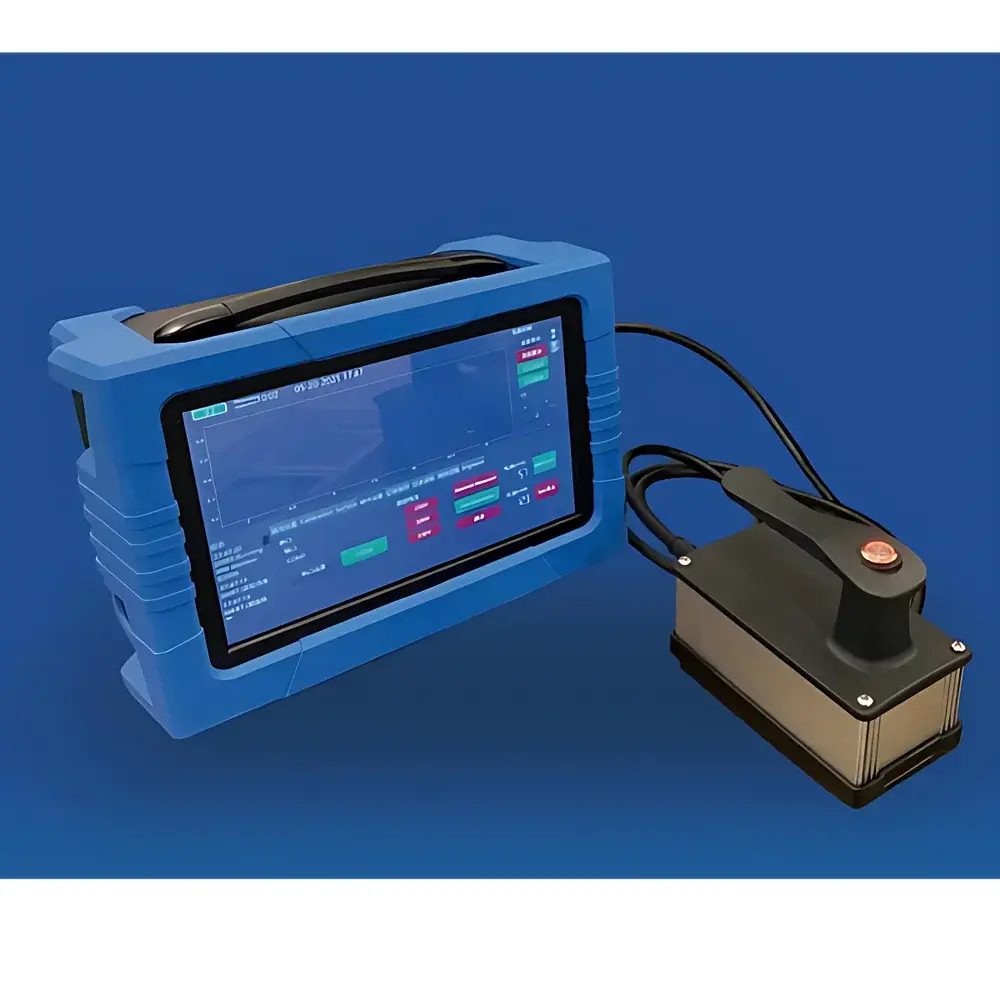
MAIERIC CFT-Series Portable Coercivity Tester for Ferromagnetic Material Aging & Fatigue Assessment
| Brand | MAIERIC |
|---|---|
| Origin | Anhui, China |
| Manufacturer Type | Authorized Distributor |
| Product Category | Domestic |
| Model | CFT-Series |
| Pricing | Upon Request |
| Excitation Levels | 3 Adjustable Steps |
| Lift-off Tolerance | Up to 6 mm |
| Measurement Speed | 3.5 s per reading |
| Penetration Depth | 30 mm |
| Coercivity Range | 1–50 A/cm |
| Display | 2K Full-Touch LCD |
| Storage Capacity | 32 GB (DB + CSV export) |
| Measurement Modes | Manual Keypad / Continuous Auto-Scan |
| Calibration | Intelligent Auto-Calibration Routine |
| Imaging | Built-in 1D/2D Mapping Visualization |
| Data Export | Standard DB & CSV formats |
| Compliance | Designed for ASTM E1444/E709-compliant magnetic particle inspection workflows and ISO 10893-1 non-destructive testing requirements |
Overview
The MAIERIC CFT-Series Portable Coercivity Tester is an electromagnetic non-destructive evaluation (NDE) instrument engineered for rapid, in-situ assessment of microstructural degradation in ferromagnetic metallic components. It operates on the principle that coercivity (Hc)—the magnetic field strength required to reduce residual magnetization to zero—is a sensitive, quantitative indicator of lattice-level changes induced by thermal aging, cyclic mechanical fatigue, plastic deformation, and phase transformations. Unlike conventional hardness or ultrasonic testing, coercivity measurement provides a direct, physics-based correlation with dislocation density, precipitate distribution, and domain wall pinning behavior in steels, nickel alloys, and other ferromagnetic engineering metals. This makes the CFT-Series particularly valuable for condition-based maintenance of pressure vessels, turbine discs, rail axles, weld joints, and aerospace structural components where early-stage fatigue accumulation must be quantified without surface preparation or material removal.
Key Features
- Three-step adjustable excitation field intensity enables optimized signal-to-noise ratio across varying component thicknesses—from thin-walled piping (≥3 mm) to massive castings (up to 30 mm penetration depth).
- Lift-off tolerant probe design supports reliable measurements through paint layers, oxide films, or minor surface irregularities, with consistent performance up to 6 mm air gap.
- Single-point measurement completed in ≤3.5 seconds; continuous scanning mode supports line-wise or grid-based mapping at user-defined step intervals.
- Integrated 1D profile plotting and 2D heat-map visualization allow immediate spatial interpretation of coercivity gradients—critical for identifying localized over-tempering, decarburization zones, or fatigue-prone regions near stress concentrators.
- Intelligent calibration algorithm reduces operator dependency: reference standards are auto-recognized via embedded ID tags; gain, offset, and temperature drift compensation are applied in real time.
- 2K-resolution capacitive touchscreen interface ensures intuitive navigation under industrial lighting conditions; all menus, settings, and results are fully bilingual (English/Chinese) but default-configured for English-language operation.
Sample Compatibility & Compliance
The CFT-Series is validated for use on carbon steels, low-alloy steels (e.g., ASTM A105, A182 F22), stainless steels (AISI 410, 420, 440C), and precipitation-hardened nickel alloys (e.g., Inconel 718). It complies with fundamental electromagnetic NDE principles outlined in ASTM E1444 (Standard Practice for Magnetic Particle Testing) and ISO 10893-1 (Non-destructive testing of steel tubes — Part 1: Magnetic particle testing of seamless and welded steel tubes). While not a replacement for full-scale hysteresis loop analysis (e.g., BH analyzers with closed-loop feedback), the CFT-Series delivers traceable coercivity values calibrated against NIST-traceable secondary standards. Its measurement uncertainty is characterized per ISO/IEC 17025 guidelines and supports GLP/GMP audit trails when used in regulated manufacturing environments.
Software & Data Management
Data acquisition and post-processing are managed via the proprietary MAIERIC CFT-Studio software suite (Windows-compatible, USB-C or Wi-Fi sync). Each measurement record includes timestamp, GPS coordinates (optional external module), probe orientation angle, lift-off distance estimate, ambient temperature, and raw waveform capture. The 32 GB onboard storage accommodates >500,000 single-point readings or >2,000 full 2D maps. Export formats include relational database (.db) for integration with CMMS platforms and comma-separated values (.csv) for statistical process control (SPC) analysis in Minitab, JMP, or Python-based toolchains. Firmware updates and calibration certificate uploads are performed securely via encrypted OTA channels compliant with IEC 62443-3-3 cybersecurity requirements.
Applications
- Verification of heat treatment uniformity across large forged components—detecting under-tempered or over-tempered zones before final machining.
- In-service monitoring of boiler tubes, steam generator headers, and reactor coolant system piping for thermal aging-induced embrittlement.
- Weld integrity screening: correlating coercivity anomalies with residual stress fields and HAZ (heat-affected zone) microstructure evolution.
- Railway axle and wheelset life extension programs—quantifying cumulative fatigue damage prior to mandatory retirement.
- Quality gate check for additive-manufactured metal parts where rapid microstructure verification is needed pre-CT scanning.
FAQ
Does the CFT-Series require surface preparation before measurement?
No. The probe operates effectively through non-conductive coatings up to 6 mm thick, eliminating the need for grinding, blasting, or solvent cleaning.
Can it distinguish between fatigue damage and hydrogen embrittlement?
Coercivity elevation occurs in both cases, but combined interpretation with ultrasonic velocity or Barkhausen noise data improves diagnostic specificity—CFT-Series output is designed for multi-modal correlation.
Is the coercivity range traceable to international standards?
Yes. Factory calibration uses certified reference samples with NIST-traceable Hc values; calibration certificates include uncertainty budgets per ISO/IEC 17025 Annex A.
What environmental conditions affect measurement stability?
Ambient temperature drift beyond 15–35°C requires re-zeroing; strong AC magnetic fields (>10 A/m) or RF interference may induce transient noise—probe shielding meets IEC 61000-4-3 Level 3 immunity.
How does the instrument handle curved or complex geometries?
The ergonomic probe head features a conformal contact surface with tilt-compensated sensor alignment; curvature radius down to 25 mm is supported without loss of accuracy.



