
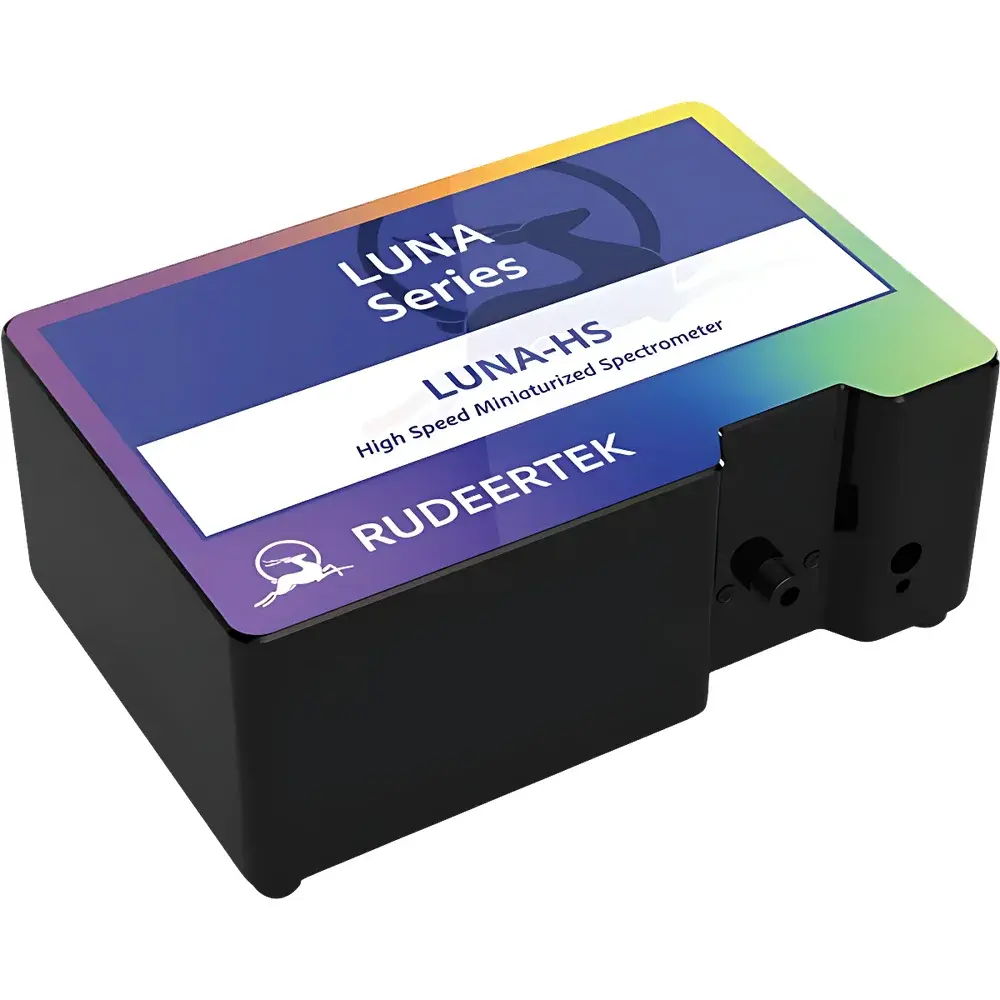
LUNA-HS High-Speed Miniature Fiber Optic Spectrometer
| Brand | Luqi Technology |
|---|---|
| Origin | Anhui, China |
| Manufacturer Type | OEM/ODM Producer |
| Origin Category | Domestic (China) |
| Model | LUNA-HS / UV-Enhanced |
| Detector | Linear CMOS Array |
| Spectral Range | 200–1100 nm |
| Optical Resolution | 0.39–6.6 nm (FWHM) |
| Signal-to-Noise Ratio | 320:1 (full signal) |
| Dynamic Range | 1500:1 (single acquisition) |
| Stray Light | <1% |
| Integration Time | 1 ms – 10 s |
| Linearity | ≥0.998 |
| A/D Resolution | 16-bit |
| F-number | f/4 |
| Optical Design | Crossed Czerny-Turner |
| Slit Options | 10 / 25 / 50 / 75 / 100 µm |
| Pixel Array | 2048 × 1 pixels |
| Pixel Size | 14 µm × 200 µm |
| Interface | USB 2.0 Type-B, Digital I/O, SMA905 fiber port |
| Weight | 460 g |
| OS Compatibility | 32/64-bit Windows 7/10/11 |
Overview
The LUNA-HS High-Speed Miniature Fiber Optic Spectrometer is an engineered solution for real-time, high-throughput spectral acquisition in industrial and laboratory environments requiring compact footprint, robust optical performance, and deterministic timing control. Based on a crossed Czerny-Turner optical architecture with f/4 throughput efficiency, the instrument delivers calibrated spectral data across a broad UV-VIS-NIR range (200–1100 nm), optimized for applications where ultraviolet sensitivity—particularly down to 200 nm—is critical. Its linear CMOS detector (2048 × 1 pixels, 14 µm pitch) enables rapid frame rates without compromising photometric fidelity, while the modular slit selection (10–100 µm) allows users to balance resolution and light throughput according to application-specific signal constraints. Designed for integration into automated systems, the LUNA-HS supports hardware-triggered synchronization, enabling precise temporal alignment across multi-spectrometer configurations—essential for spatially resolved or multi-channel spectral mapping.
Key Features
- UV-enhanced optical path with quartz-coated optics and UV-grade transmission gratings for stable responsivity from 200 nm
- High-speed acquisition: minimum integration time of 1 ms with full-frame readout via USB 2.0 interface (up to 500 spectra/s typical)
- Modular spectral resolution: selectable entrance slits (10/25/50/75/100 µm) yield nominal FWHM resolution between 0.39 nm and 6.6 nm across the spectral range
- Low stray light (<1%) achieved through optimized baffling, coated mirrors, and precision-aligned optical train—critical for quantitative absorbance and reflectance measurements
- Onboard digital I/O interface supports TTL-level trigger input/output, external shutter control, and synchronized start/stop for multi-device operation
- Compact, ruggedized aluminum housing (460 g) with SMA905 fiber coupling and passive thermal stabilization for field-deployable reliability
Sample Compatibility & Compliance
The LUNA-HS is compatible with standard 400 µm core silica optical fibers and accepts collimated or fiber-coupled illumination sources including deuterium-halogen lamps, LEDs, and pulsed lasers. Its spectral calibration traceability follows NIST-traceable reference standards (e.g., HG/Ne and HgAr lamps), and factory calibration reports include wavelength accuracy (±0.2 nm typical), pixel-to-wavelength mapping, and relative intensity correction coefficients. While not certified to ISO/IEC 17025, the system meets functional requirements for routine QC/QA workflows aligned with ASTM E308 (computing colorimetric values), ISO 13406-2 (display uniformity), and USP (spectrophotometric system suitability). Data integrity is preserved via timestamped spectral records and metadata embedding (integration time, slit width, grating position), supporting GLP-compliant documentation when integrated with validated third-party software platforms.
Software & Data Management
The spectrometer operates with Luqi’s cross-platform SDK (C/C++, Python, LabVIEW, MATLAB APIs) and includes a native Windows GUI for real-time visualization, baseline correction, peak detection, and export in CSV, TXT, or HDF5 formats. All spectral acquisitions retain embedded EXIF-style metadata—including hardware configuration, temperature drift compensation status, and trigger source—enabling reproducible analysis pipelines. The SDK supports asynchronous acquisition queues, memory-mapped buffers for low-latency streaming, and callback-driven event handling for embedded control systems. For regulated environments, optional audit trail logging and user-access controls can be implemented at the application layer to meet FDA 21 CFR Part 11 requirements when deployed with validated LIMS or MES integrations.
Applications
- Inline semiconductor process monitoring: wafer reflectance mapping, thin-film thickness estimation via interference fringe analysis
- Mineral sorting and ore grade assessment using spectral signature classification (e.g., Fe, Cu, Al hydroxides in 400–900 nm region)
- Food quality inspection: detection of adulteration, moisture content estimation, and pigment quantification (e.g., chlorophyll, anthocyanins)
- High-speed sorting systems: real-time spectral binning for pharmaceutical tablet coating uniformity or plastic polymer identification
- Industrial machine vision integration: spectral feature extraction for robotic guidance in heterogeneous material handling
- Research-grade UV-VIS kinetics: stopped-flow or flash-photolysis experiments requiring sub-millisecond spectral snapshots
FAQ
What is the typical wavelength accuracy and stability over temperature?
Wavelength calibration accuracy is ±0.2 nm (RMS) at 25 °C; thermal drift is compensated via onboard temperature sensor and polynomial correction (±0.005 nm/°C typical residual error).
Can the LUNA-HS operate in continuous streaming mode without host PC buffering?
Yes—the USB 2.0 interface supports isochronous bulk transfers with ring-buffer management in firmware, enabling sustained >300 spectra/s acquisition without frame loss under optimized host DMA settings.
Is spectral radiometric calibration available as an option?
NIST-traceable irradiance and radiance calibration kits are available as configurable add-ons, including cosine correctors and calibrated tungsten halogen standards (250–2500 nm).
How many LUNA-HS units can be synchronized simultaneously?
Up to 8 units can be daisy-chained via shared trigger line with sub-microsecond jitter (<200 ns RMS) using external master clock distribution.
Does the device support dark current subtraction and pixel defect correction?
Yes—real-time dark frame acquisition (user-definable or auto-captured) and pixel masking are implemented in firmware, with non-uniformity correction applied prior to A/D scaling.
Related Products






