
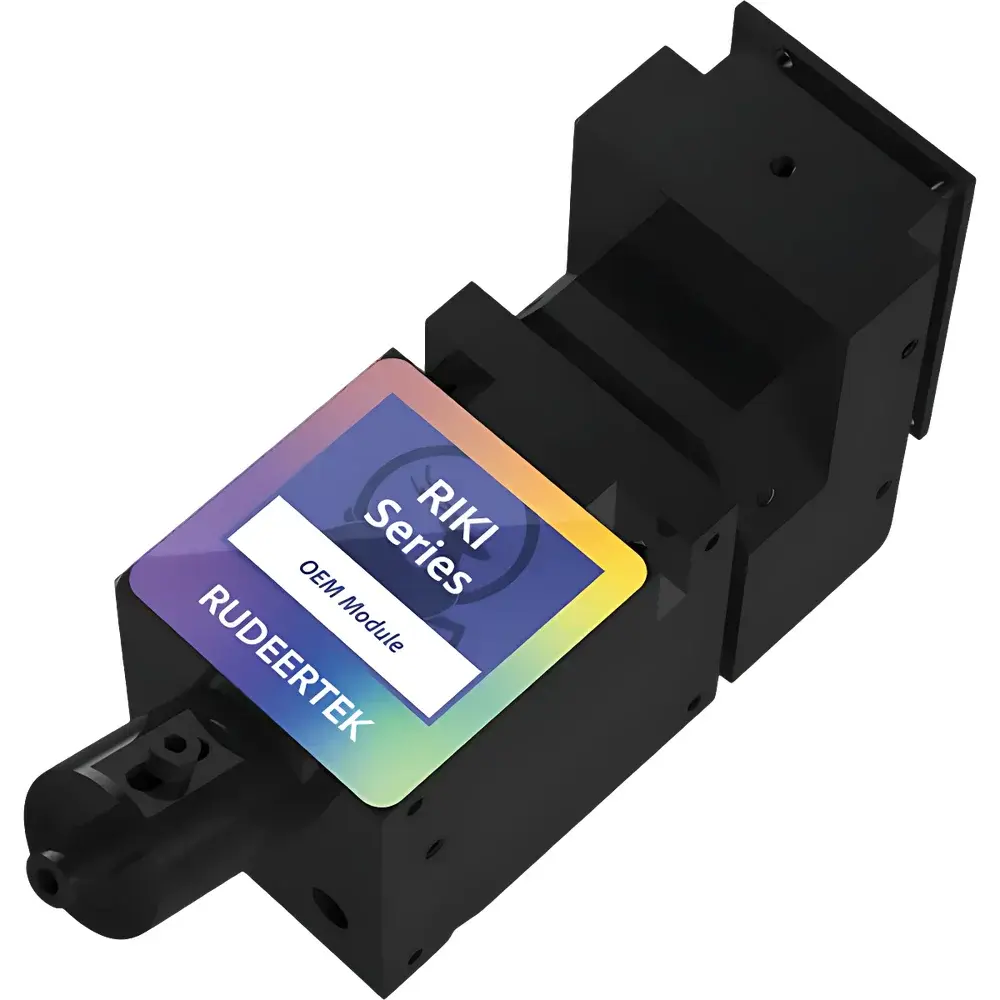
RIKI Transmission-Style OEM Optical Platform
| Brand | Lùqǐ Technology |
|---|---|
| Origin | Anhui, China |
| Manufacturer Type | Original Equipment Manufacturer (OEM) |
| Country of Origin | China |
| Model | RIKI |
| Pricing | Upon Request |
| Spectral Range | 200–1100 nm |
| Stray Light | <1% |
| Optical Architecture | Transmission-based |
| F-number | f/4.4 |
| Slit Width Options | 10, 25, 50, 75, or 100 µm |
| Grating | Standard 600 lines/mm |
| Weight | 350 g |
| Communication Interfaces | USB 2.0 Type-B, Digital I/O |
| Fiber Optic Connector | Standard SMA 905, customizable |
Overview
The RIKI Transmission-Style OEM Optical Platform is a compact, high-throughput optical engine engineered for integration into custom spectroscopic and photometric instrumentation. Designed around a collimated transmission optical path—distinct from reflective or folded configurations—the platform delivers superior light throughput and minimal optical path deviation, enabling stable signal coupling across variable detector geometries. Its core architecture follows the principles of Czerny-Turner or modified Littrow layouts depending on grating orientation and detector alignment, supporting wavelength dispersion with predictable linearity and low aberration across the UV-VIS-NIR range (200–1100 nm). The f/4.4 focal ratio balances étendue and resolution requirements, making it suitable for applications where sensitivity, signal-to-noise ratio (SNR), and system-level miniaturization are jointly constrained. As an OEM-grade module, the RIKI platform is not a turnkey spectrometer but a foundational optical subassembly intended for integration by instrument designers, embedded systems engineers, and industrial OEMs building analytical hardware for process monitoring, inline inspection, or portable field devices.
Key Features
- Transmission-based optical layout optimized for high optical throughput and reduced path-length-induced phase errors
- Selectable entrance slit widths (10–100 µm) to trade spectral resolution against irradiance sensitivity per application requirement
- Pre-aligned 600 lines/mm diffraction grating offering consistent dispersion characteristics and broad-band coverage
- Low stray light performance (<1%) achieved via internal blackened baffling, non-reflective surface treatments, and optimized beam containment geometry
- Modular mechanical interface with standardized mounting holes and optical axis reference marks for repeatable integration
- Native USB 2.0 Type-B interface for firmware updates and basic configuration; optional digital I/O lines support TTL-level trigger synchronization and status feedback
- SMA 905 fiber port as standard; alternative connectors (e.g., FC/PC, ST, or custom ferrule designs) available upon engineering review
Sample Compatibility & Compliance
The RIKI platform itself does not perform sample analysis but serves as the optical backbone for end-user instruments that may interface with liquid flow cells, gas absorption cells, solid-state reflectance adapters, or free-space transmission stages. Its spectral response supports compliance-driven measurement protocols in environmental monitoring (e.g., EPA Method 418.1 for hydrocarbon detection), colorimetry (CIE 15:2018-compliant illuminant simulation), and semiconductor wafer inspection (ASTM F39-22 for thin-film thickness estimation via spectral interference). While the platform carries no standalone regulatory certification, its mechanical and electrical design adheres to IEC 61326-1 (EMC for laboratory equipment) and RoHS 3 directives. Integration partners are responsible for final system-level validation under ISO/IEC 17025, FDA 21 CFR Part 11 (if used in regulated data acquisition), or relevant GLP/GMP documentation frameworks.
Software & Data Management
The RIKI platform operates in conjunction with host-side software developed by the integrator. No proprietary driver suite is bundled; instead, open USB HID or vendor-class descriptors allow direct access via libusb or VCP-based stacks. Example firmware exposes register-mapped control over shutter state, integration time (when paired with compatible CMOS/CCD sensors), and basic diagnostic flags. Raw spectral data is delivered as 16-bit intensity arrays aligned to user-defined wavelength calibration vectors. Calibration files (wavelength, intensity, pixel-to-wavenumber mapping) are stored externally and loaded at runtime—supporting NIST-traceable lamp-based recalibration workflows. Audit trails, electronic signatures, and data integrity features must be implemented at the application layer; the platform provides timestamp-ready hardware triggers and deterministic frame synchronization for alignment with external PLCs or motion controllers.
Applications
- Real-time water quality analyzers measuring nitrate, dissolved organic carbon (DOC), or turbidity via UV-VIS absorption
- In-line color sorting systems for plastics recycling, food grading, or pharmaceutical tablet verification
- Portable NIR spectrometers for agricultural soil nutrient profiling and grain moisture assessment
- Wafer-level metrology tools performing multi-angle transmission analysis for photoresist thickness and uniformity
- Custom fluorescence excitation/emission engines where excitation source and emission collection paths share a common transmission axis
- Edge-deployed environmental sensors monitoring airborne particulate composition via differential optical absorption spectroscopy (DOAS)
FAQ
Is the RIKI platform supplied with a detector or sensor?
No. The RIKI is an optical engine only. Users must integrate their own linear array sensor (e.g., Hamamatsu S11639, Sony ILX511B) or area-scan detector compatible with the specified focal plane geometry and pixel pitch.
Can I modify the grating or replace it with a custom ruled or holographic version?
Yes—mechanical and optical interfaces support grating swaps within the same physical footprint and blaze angle constraints. Engineering consultation is required for spectral recalibration and stray light recharacterization.
Does the platform include wavelength calibration data?
A baseline calibration file is provided with each unit, derived from Hg-Ar lamp measurements. End users are expected to perform application-specific recalibration using traceable standards appropriate to their measurement domain.
What level of thermal stability does the optical bench provide?
The aluminum alloy baseplate exhibits a coefficient of thermal expansion (CTE) of ~23 × 10⁻⁶ /°C. For sub-pixel wavelength stability over ±5°C ambient variation, active thermal management or software-based drift compensation is recommended.
Is mechanical housing customization available for volume OEM orders?
Yes—custom cutouts, EMI shielding enhancements, conformal coating, and hermetic sealing options are supported under NDA and minimum order quantity agreements.




