
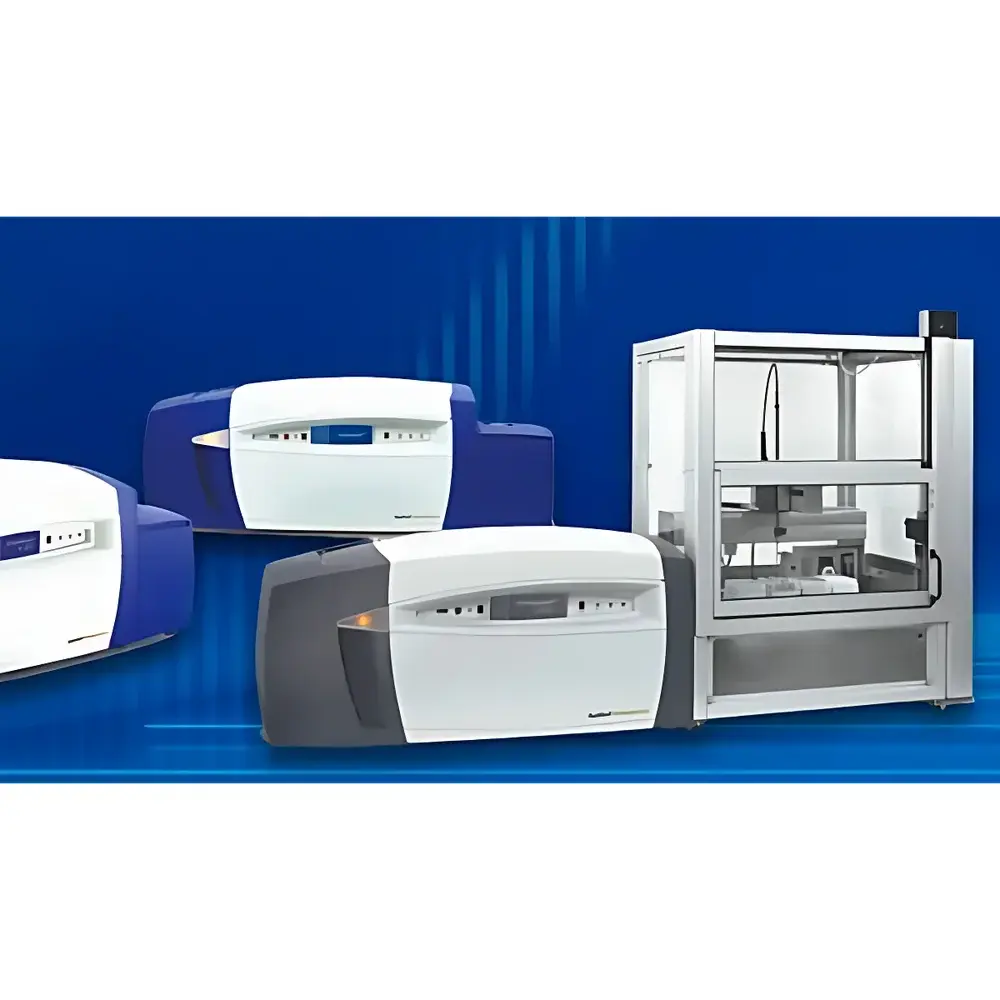
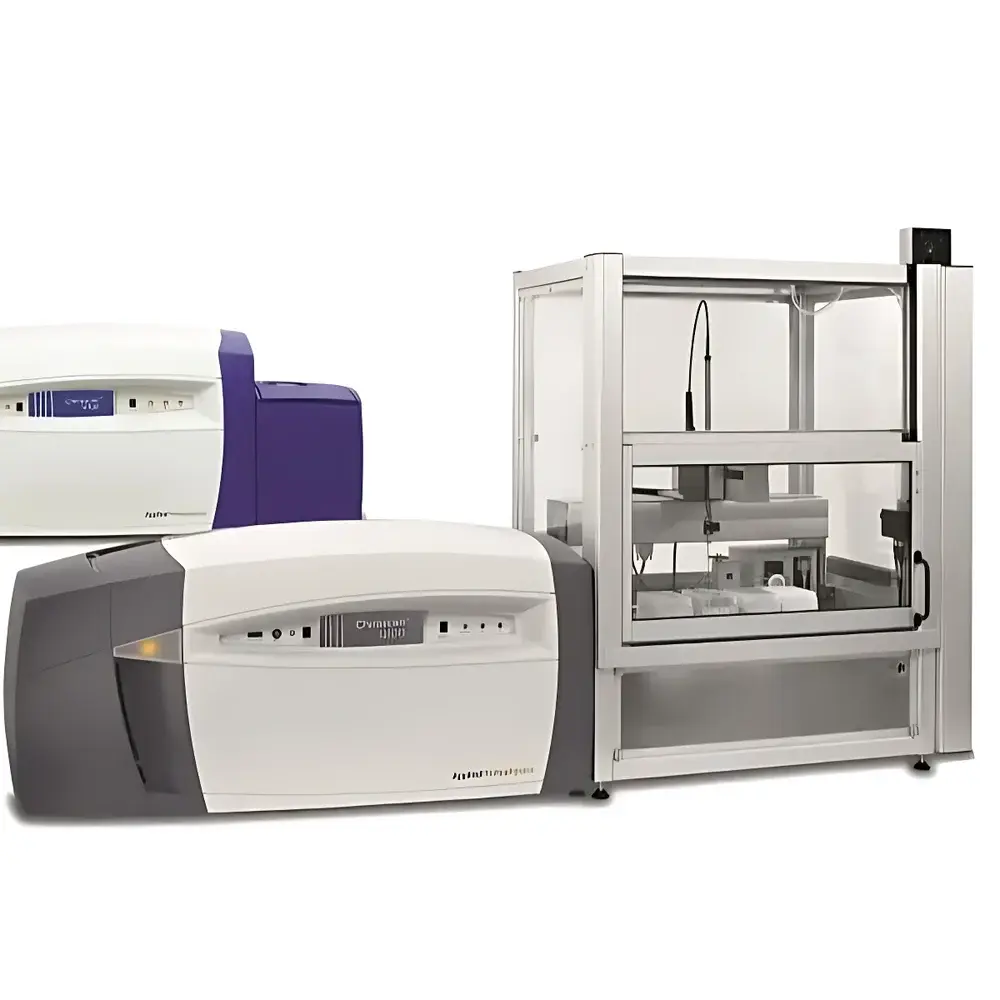
Applied Photophysics Chirascan Plus Circular Dichroism and Fluorescence Spectrometer
| Brand | Applied Photophysics |
|---|---|
| Origin | United Kingdom |
| Manufacturer Type | Authorized Distributor |
| Instrument Type | Circular Dichroism (CD) and Synchronous Fluorescence Spectrometer |
| Model | Chirascan Plus |
| Detection Technology | Large-Area Avalanche Photodiode (LAAPD) Detector |
| Wavelength Range | 170–900 nm (CD), 200–900 nm (Fluorescence) |
| Sensitivity | Enhanced vs. standard Chirascan (LAAPD-enabled) |
| Automation | Optional unattended high-throughput configuration |
Overview
The Applied Photophysics Chirascan Plus Circular Dichroism and Fluorescence Spectrometer is a dual-mode, research-grade spectroscopic platform engineered for the quantitative analysis of chiral molecular structure and conformational dynamics in solution. It operates on the physical principle of circular dichroism—differential absorption of left- and right-circularly polarized light—enabling direct interrogation of asymmetric electronic transitions in biomolecules and synthetic chiral compounds. Complementing CD measurement, the instrument integrates synchronous fluorescence detection using a large-area avalanche photodiode (LAAPD) detector, permitting simultaneous or sequential acquisition of CD and fluorescence spectra under identical experimental conditions. This co-registered spectral capability supports rigorous correlation of secondary/tertiary structural changes (via CD) with local environmental perturbations or binding-induced fluorophore responses (via fluorescence). Designed and manufactured in the United Kingdom, the Chirascan Plus maintains mechanical and optical compatibility with the established Chirascan platform while delivering significantly improved signal-to-noise ratio, extended spectral coverage, and enhanced photometric stability—attributes critical for low-concentration protein studies, kinetic titrations, and temperature-controlled folding experiments.
Key Features
- Dual-mode operation: Simultaneous or interleaved CD and fluorescence spectroscopy within a single optical bench
- LAAPD detector: Provides superior quantum efficiency across 200–900 nm, enabling high-sensitivity fluorescence detection with minimal afterpulsing and dark current
- Broad spectral range: 170–900 nm for CD measurements; 200–900 nm for fluorescence—with vacuum UV capability down to 170 nm enabled by nitrogen-purged or evacuated optical path
- High-precision J-stop monochromator: Delivers wavelength accuracy ±0.1 nm and reproducibility <0.02 nm over time
- Temperature-controlled sample compartment: Compatible with Peltier-based cuvette holders (−10 °C to +110 °C) and flow cells for stopped-flow kinetics
- Modular automation interface: Supports integration with liquid handlers, autosamplers, and robotic platforms for unattended multi-sample screening
Sample Compatibility & Compliance
The Chirascan Plus accommodates standard 0.1–10 mm pathlength quartz cuvettes, capillary cells, and microvolume adapters (down to 5 µL volume), supporting aqueous, organic, and mixed solvent systems—including TFE, DMSO, and trifluoroethanol formulations commonly used in peptide folding studies. Its optical design minimizes stray light and polarization artifacts, ensuring compliance with ISO 17025 requirements for method validation in accredited laboratories. Data acquisition and processing workflows are structured to support GLP and GMP environments: audit-trail-enabled software logging, user-access controls, electronic signatures, and full traceability of instrument parameters, calibration records, and raw spectral files align with FDA 21 CFR Part 11 expectations. The system meets electromagnetic compatibility (EMC) standards per EN 61326-1 and safety requirements per IEC 61010-1.
Software & Data Management
Controlled via the proprietary CDTools™ software suite, the Chirascan Plus provides a validated, scriptable environment for method development, real-time data visualization, and post-acquisition analysis. CDTools supports baseline correction using reference spectra or polynomial fitting, secondary structure deconvolution (e.g., CONTIN/LL, SELCON3, CDSSTR), thermal denaturation curve fitting (two- or three-state models), and global analysis of multi-wavelength kinetic datasets. All raw data are stored in vendor-neutral, self-documenting HDF5 format—including metadata such as lamp intensity, slit width, response time, and purge gas status. Export options include ASCII, CSV, and JCAMP-DX for interoperability with third-party chemometrics packages (e.g., MATLAB, Origin, Python-based SciPy stacks). Software validation documentation (IQ/OQ/PQ protocols) and 21 CFR Part 11 compliance packages are available upon request.
Applications
- Secondary structure quantification of proteins and peptides (α-helix, β-sheet, random coil)
- Thermal and chemical denaturation profiling for thermodynamic parameter extraction (ΔH, Tm, ΔG)
- Binding stoichiometry and affinity determination via CD/fluorescence titration (e.g., ligand–protein, drug–DNA)
- Conformational analysis of nucleic acids, glycoproteins, and synthetic polymers with chiral backbones
- Real-time monitoring of folding/unfolding kinetics using stopped-flow or manual mixing accessories
- High-throughput structural screening in early-stage biopharmaceutical development (e.g., biosimilarity assessment, formulation stability)
FAQ
What is the minimum sample concentration required for reliable CD measurement on the Chirascan Plus?
For a 0.1 cm pathlength cell and typical globular proteins, concentrations of 0.02–0.1 mg/mL are generally sufficient due to LAAPD-enhanced sensitivity—though optimal values depend on extinction coefficient and structural signal magnitude.
Can the Chirascan Plus perform time-resolved CD measurements?
No—the instrument is optimized for steady-state CD and fluorescence. Time-resolved CD requires specialized pulsed laser excitation and gated detection not integrated into this platform.
Is the system compatible with synchrotron radiation or custom light sources?
The Chirascan Plus uses internal xenon arc and deuterium lamps; it is not designed for external beam coupling or vacuum ultraviolet synchrotron end-stations.
Does CDTools support batch processing of large spectral datasets?
Yes—scripting via Python API and macro-driven workflows enable automated processing of hundreds of spectra, including normalization, averaging, and structure analysis pipelines.
What maintenance is required to ensure long-term photometric stability?
Routine lamp replacement (every 1,000–2,000 hours), quarterly alignment verification using NIST-traceable holmium oxide filters, and annual calibration by certified service engineers are recommended.






