
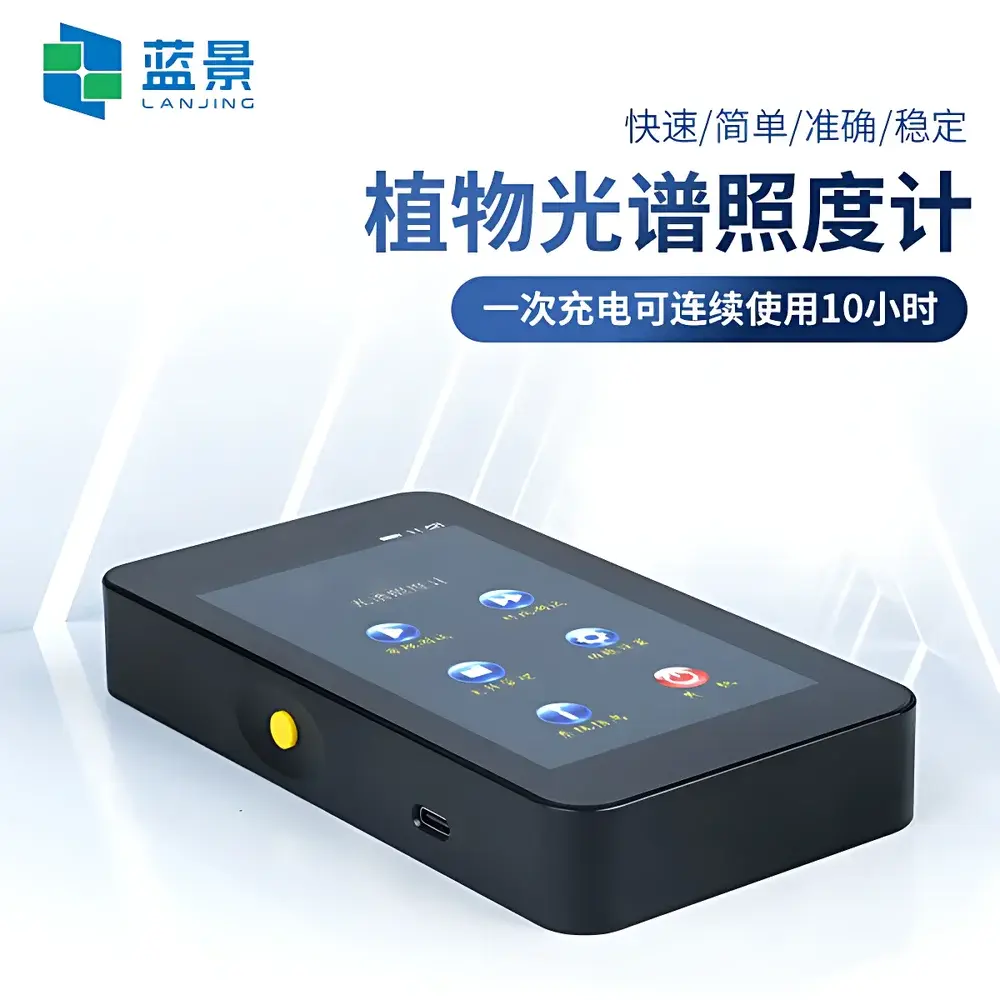
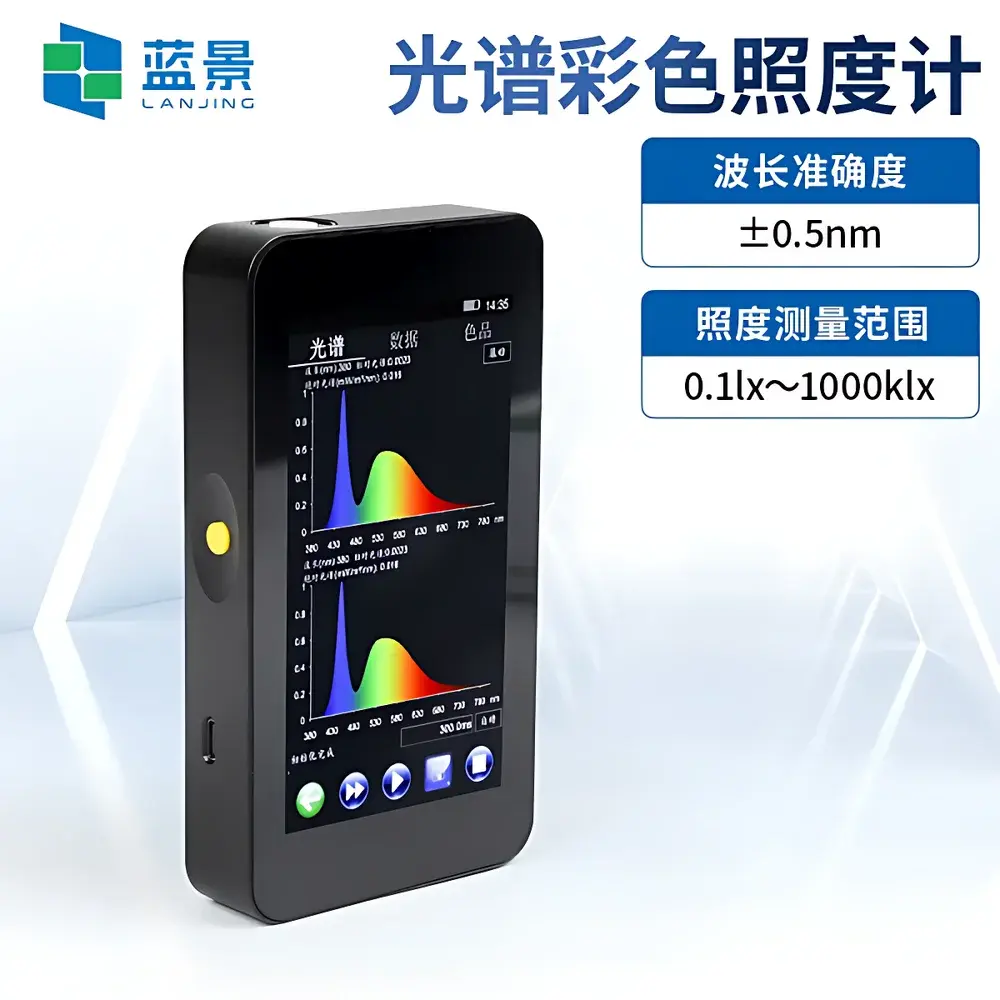
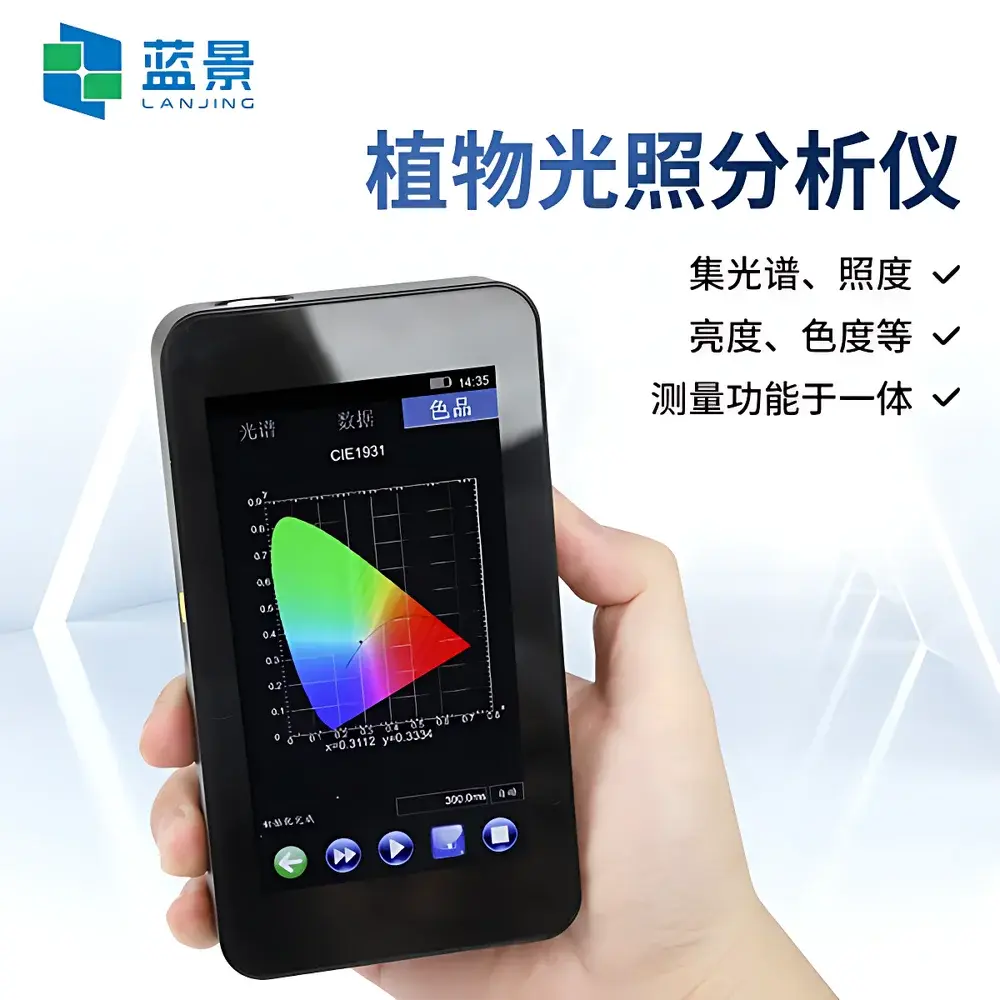
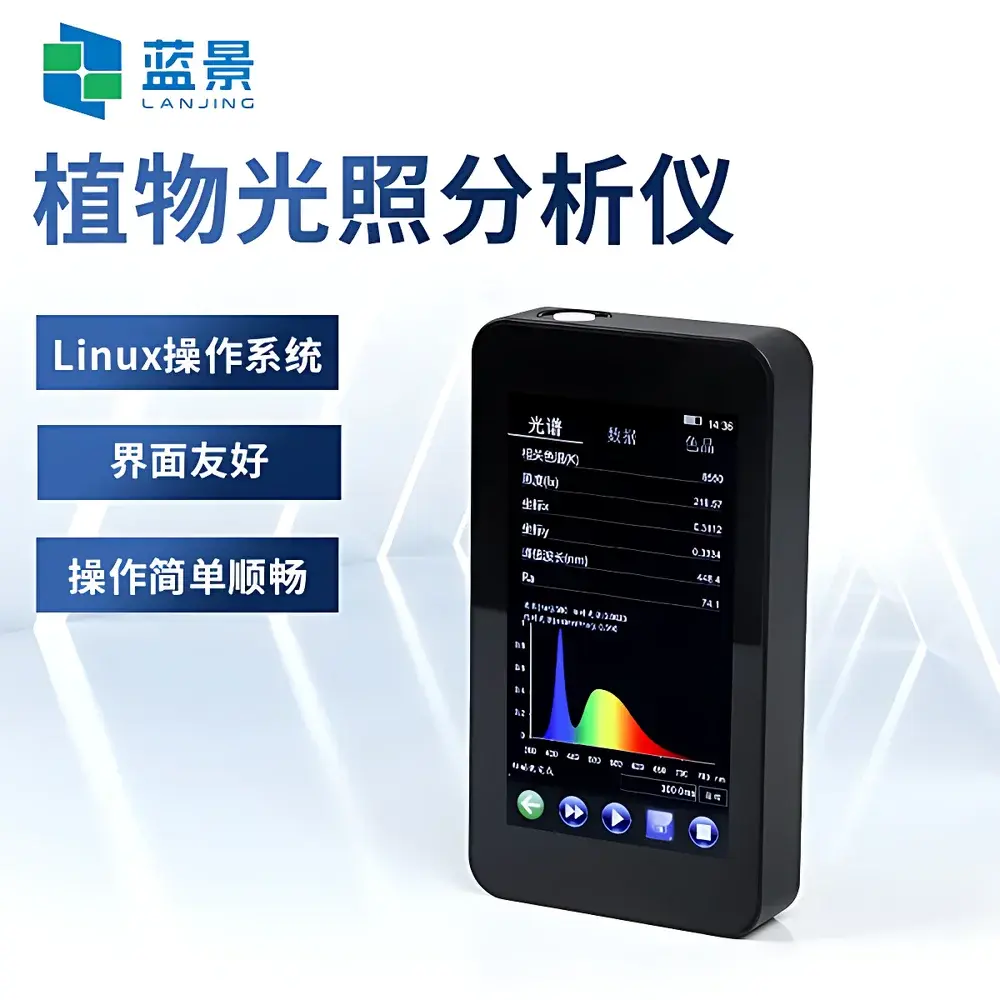
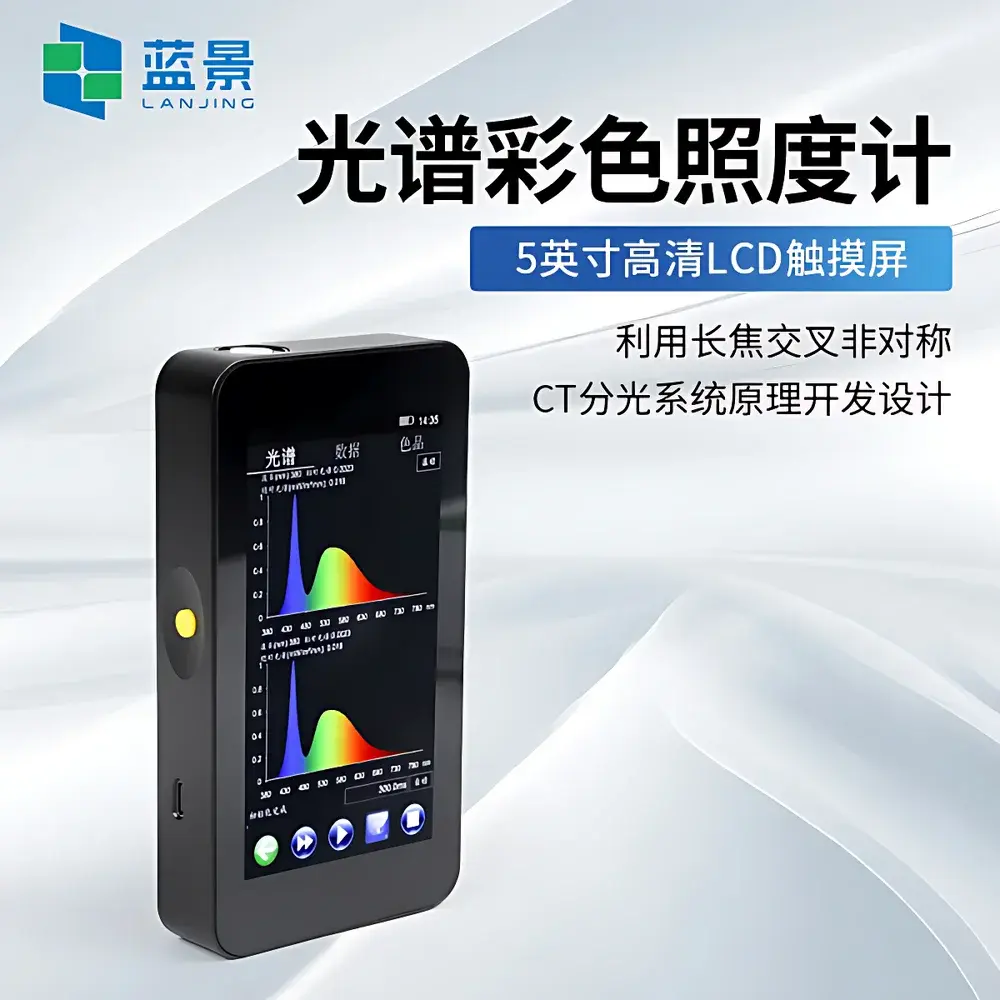
Lanjing LJ350UV UV Spectroradiometer
| Brand | Lanjing |
|---|---|
| Origin | Shandong, China |
| Manufacturer Type | Direct Manufacturer |
| Product Origin | Domestic (China) |
| Model | LJ350UV |
| Price | USD 1,390 (FOB Qingdao) |
| Wavelength Range | 200–400 nm (UV-C to UV-A) |
| Spectral Bandwidth (FWHM) | 2 nm |
| Optical Resolution | 0.2 nm |
| Wavelength Accuracy | ±0.5 nm |
| Detector | High-precision CCD array |
| Input Aperture | Ø10 mm |
| Display | 5.0" IPS capacitive touchscreen |
| Operating System | Embedded Linux |
| Battery | 4000 mAh Li-ion, 10 h continuous operation |
| Data Storage | 4 GB microSD (≥60,000 records) |
| Interface | USB Type-C (≥1 A current rating) |
| Illuminance Accuracy | Class I (±4% reading ±1 digit) |
| Chromaticity Repeatability | ±0.0005 in CIE 1931 (x,y) |
| CCT Range | 1,000–100,000 K |
| Stray Light | ≤0.3% |
| Operating Temp. | −10 to +40 °C, RH <70% (non-condensing) |
| Storage Temp. | −20 to +45 °C, RH <70% (non-condensing) |
| Dimensions | 146 × 81 × 22.8 mm |
| Weight | ~300 g (body only, with battery) |
Overview
The Lanjing LJ350UV UV Spectroradiometer is a portable, high-fidelity spectroradiometric measurement instrument engineered for quantitative characterization of ultraviolet radiation sources across industrial, regulatory, and research environments. It employs a long-focal-length crossed asymmetric Czerny–Turner (CT) optical configuration coupled with a thermally stabilized, back-illuminated CCD sensor array—enabling high-resolution spectral acquisition from 200 nm to 400 nm with 2 nm full-width-at-half-maximum (FWHM) spectral bandwidth and ±0.5 nm wavelength accuracy. Unlike broadband UV meters, the LJ350UV delivers traceable, wavelength-resolved irradiance data (W/m²/nm), enabling precise calculation of biologically weighted quantities—including erythemal UV dose (UVery), UVA/UVB ratio, and photobiological safety metrics per IEC 62471 and ISO 15858. Its compact form factor (146 × 81 × 22.8 mm), embedded Linux OS, and 5.0″ IPS touchscreen interface support field-deployable operation without external computing hardware.
Key Features
- Long-focal-length crossed asymmetric CT monochromator architecture ensures high optical throughput, low stray light (≤0.3%), and excellent spectral linearity across the UV band.
- Back-thinned CCD detector with 0.2 nm spectral resolution and ±0.0005 chromaticity repeatability (CIE 1931 x,y) under ambient thermal drift conditions.
- Integrated auto-zero compensation algorithm mitigates temperature-induced baseline drift—eliminating manual zero calibration before each use.
- On-device spectral irradiance (Ee,λ) acquisition at 100 µs–10 s integration times; real-time calculation of weighted irradiance (e.g., UV-A, UV-B, UV-C, actinic), effective irradiance (Eeff), and maximum permissible exposure (MPE) time per ICNIRP and ACGIH guidelines.
- USB Type-C interface supports high-speed data transfer, firmware updates, and direct power supply (DC 5 V / 2 A); compatible with Windows/macOS/Linux host systems via vendor-provided SDK and PC software.
- 4 GB onboard microSD storage retains ≥60,000 full-spectrum records with timestamp, GPS metadata (optional), and measurement context tags.
Sample Compatibility & Compliance
The LJ350UV is validated for measuring UV-emitting sources including low-pressure mercury lamps, UV-LED arrays (265–395 nm), excimer lamps, sunlight (via cosine-corrected diffuser), and germicidal irradiation (UVC) systems. It complies with key international standards governing UV radiometry and photobiological safety: IEC 62471 (Photobiological Safety of Lamps), ISO 15858 (UV-C disinfection validation), CIE S 019/E:2020 (UV spectral weighting functions), and ASTM E2933 (Standard Practice for UV Radiometer Calibration). Its spectral irradiance measurements are traceable to NIM (National Institute of Metrology, China) reference standards with chromaticity uncertainty <±0.0025 (x,y) and irradiance uncertainty <±5% (k=2) in the 250–380 nm range. The instrument meets GLP documentation requirements for audit-ready test records, including full spectral data export, operator ID, calibration certificate ID, and environmental condition logging.
Software & Data Management
The bundled SpectraView Pro software (v3.2+) provides comprehensive post-processing capabilities: spectral smoothing, weighted integrals (e.g., UV-A: 315–400 nm, UV-B: 280–315 nm), comparison against user-defined reference spectra, and automated report generation compliant with ISO/IEC 17025 laboratory documentation frameworks. All raw .spc files include embedded EXIF-like metadata (integration time, aperture setting, temperature, battery level, firmware version). The SDK supports Python, MATLAB, and LabVIEW integration for automated QA/QC workflows in production lines. Audit trails record all parameter modifications, calibration events, and data exports—fully satisfying FDA 21 CFR Part 11 electronic record requirements when configured with user authentication and digital signature modules.
Applications
- UV disinfection system validation and routine performance monitoring in healthcare, water treatment, and HVAC applications.
- Phototherapy lamp characterization for dermatology and neonatal care devices.
- R&D and QC of UV-LEDs, fluorescent UV tubes, and solar simulators used in material degradation testing (ISO 4892, ASTM G154).
- Environmental UV monitoring: solar UV index forecasting, ozone layer impact assessment, and alpine/high-altitude irradiance profiling.
- Regulatory compliance testing for consumer UV products (e.g., nail curing lamps, insect traps) per IEC TR 62778 and EN 62471.
- Educational laboratories requiring hands-on spectroradiometric training with metrologically sound instrumentation.
FAQ
Is the LJ350UV calibrated traceable to national standards?
Yes—each unit ships with a factory calibration certificate traceable to NIM (China) reference sources. Optional annual recalibration services include uncertainty budgets and ISO/IEC 17025-accredited reports.
Can it measure pulsed UV sources (e.g., flash lamps)?
Yes, using single-shot mode with user-selectable integration time down to 100 µs; synchronization via external trigger input (TTL) is supported via optional adapter.
Does it support cosine correction for diffuse-field irradiance measurements?
The standard Ø10 mm input port accepts optional detachable cosine correctors (LJ-CC10UV) meeting CIE 13.3:1995 angular response specifications (f2 error <±3%).
What spectral weighting functions are preloaded?
Erythemal (CIE 1987), UVA, UVB, UVC, Actinic, Plant Growth (PAR), and ICNIRP occupational exposure curves are embedded; custom weightings can be imported via CSV.
Is remote operation possible over Wi-Fi or Bluetooth?
No—wireless connectivity is not implemented for electromagnetic interference immunity reasons. All communication occurs via shielded USB Type-C to ensure signal integrity during high-frequency UV source measurements.




