
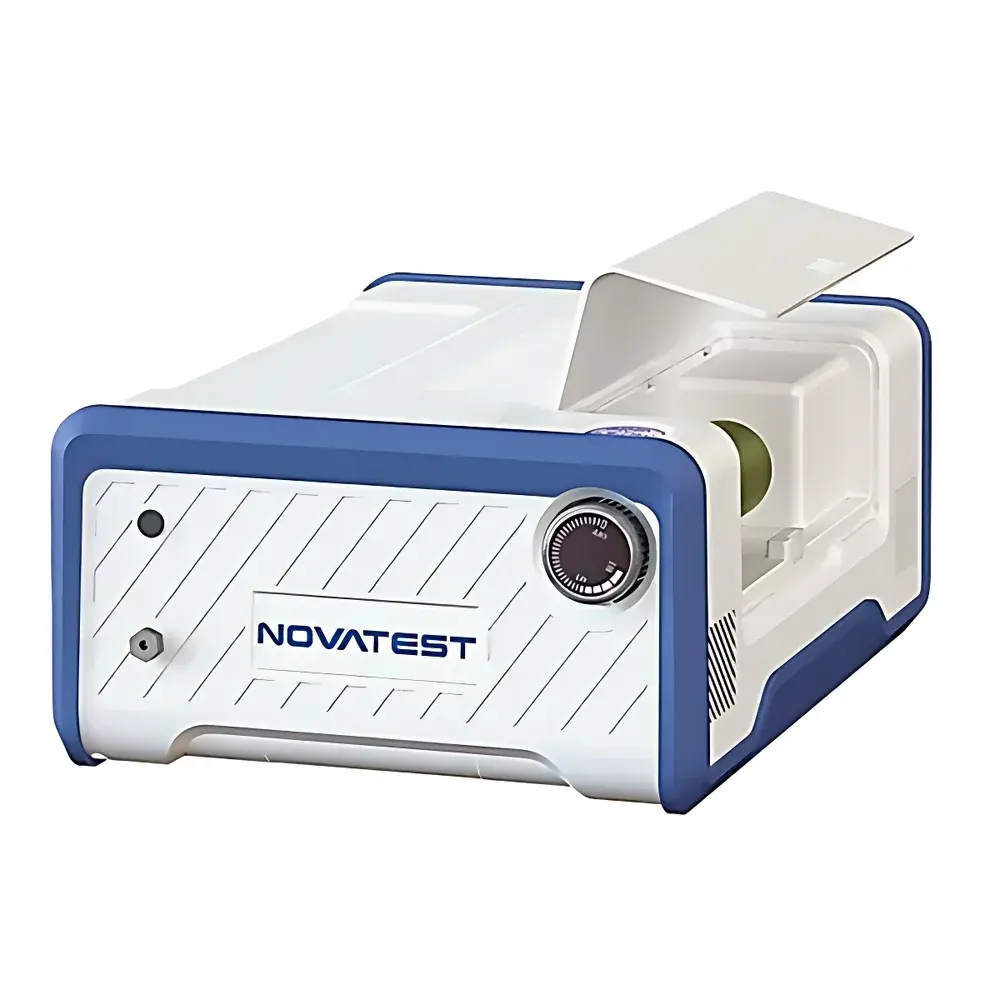
Nanova P100 Portable Gas Chromatograph
| Brand | Nanova |
|---|---|
| Origin | USA |
| Manufacturer Type | Authorized Distributor |
| Product Origin | Imported |
| Model | P100 |
| Price Range | USD 14,000 – 42,000 (FOB) |
| Detection Principle | Gas Chromatography (GC) |
| Instrument Type | Portable |
| Typical Configuration | Modular GC with Integrated Micro-Preconcentrator and FID Detector |
Overview
The Nanova P100 Portable Gas Chromatograph is a field-deployable analytical instrument engineered for real-time, on-site separation and quantification of volatile organic compounds (VOCs) in ambient air, industrial stack emissions, soil headspace, and confined-space atmospheres. Built upon proven capillary gas chromatographic principles, the P100 employs temperature-programmed elution across a fused-silica column with selective stationary phase chemistry, coupled to a flame ionization detector (FID) optimized for hydrocarbon sensitivity and linear dynamic range (10⁶). Its compact, battery-operated architecture enables operation in unconditioned environments—ranging from −10 °C to +50 °C—with internal pressure and flow control ensuring retention time stability within ±0.02 min over 8-hour continuous runs. Unlike benchtop GC systems requiring lab infrastructure, the P100 integrates carrier gas generation (zero-air or nitrogen via electrochemical membrane), sample introduction (automated 6-port valve with loop injection), and data acquisition into a single ruggedized enclosure compliant with IP54 ingress protection.
Key Features
- Ruggedized portable chassis with shock-absorbing polymer housing and MIL-STD-810G certified mechanical durability
- Integrated micro-preconcentrator (0.1–100 mL sample volume) enabling sub-ppbv detection limits for C₂–C₁₂ VOCs
- Temperature-controlled oven (35–220 °C, ramp rate up to 30 °C/min) with dual-zone thermal management for precise column and detector conditioning
- Onboard FID with auto-ignition, flame monitoring, and digital signal processing for noise-limited baseline stability (RMS < 0.1 pA)
- Internal rechargeable Li-ion battery pack supporting ≥6 hours of continuous analysis; optional external 12–24 V DC input for vehicle-mounted deployment
- Real-time chromatogram display and peak integration via integrated 7-inch capacitive touchscreen running embedded Linux OS
Sample Compatibility & Compliance
The P100 accepts gaseous samples directly via stainless-steel sampling probe or Tedlar® bag interface, and supports headspace analysis using heated vial autosampler accessories (sold separately). It is validated for compliance with EPA Method TO-17 (for sorbent tube desorption) and ASTM D6348 (for gaseous emission testing), with calibration traceability to NIST-traceable VOC standards. All firmware and data handling protocols conform to ISO/IEC 17025:2017 requirements for testing laboratories, and audit trail functionality—including user login logs, method versioning, and raw data immutability—meets FDA 21 CFR Part 11 criteria for electronic records in regulated environments.
Software & Data Management
Instrument control, method development, and post-run analysis are performed through Nanova GC-Link™ software (Windows/macOS compatible), which provides full method scripting, spectral library matching (NIST MS Search 2.7g compatible), and automated report generation in PDF/CSV formats. Raw chromatographic data (.ncdf binary format) is stored with embedded metadata (operator ID, GPS coordinates, ambient T/P, calibration status). The system supports secure cloud synchronization via TLS 1.2–encrypted MQTT protocol, enabling remote fleet monitoring and centralized QA/QC review across multi-site environmental monitoring programs.
Applications
- Leak detection and repair (LDAR) surveys in petrochemical facilities per EPA 40 CFR Part 60 Subpart VV
- Indoor air quality (IAQ) assessment in commercial buildings and schools following ASHRAE Standard 62.1
- Soil vapor intrusion screening at brownfield sites in accordance with ASTM E2600
- Emergency response for chemical release incidents (e.g., railcar derailments, storage tank breaches)
- Continuous fence-line monitoring when paired with automated air intake manifolds and weather station integration
FAQ
What is the typical detection limit for benzene using the P100 with standard configuration?
Benzene detection limit is 0.2 ppbv (signal-to-noise ratio ≥3) under EPA TO-17-equivalent sampling conditions (200 mL air, 10× preconcentration).
Can the P100 be calibrated using external gas standards?
Yes—calibration is performed via direct injection of certified gas mixtures (e.g., Scotty-Mix, UltraZero) using the built-in 6-port valve; calibration curves support up to 12-point nonlinear regression.
Is the instrument suitable for use in explosive atmospheres?
The base P100 is not ATEX/IECEx certified; however, an intrinsically safe variant (P100-IS) with CSA Class I, Division 1 rating is available upon request.
How often does the FID require maintenance?
FID jet cleaning and collector electrode inspection are recommended every 200 analysis cycles or quarterly—whichever occurs first—using manufacturer-supplied maintenance kits.
Does the system support regulatory reporting formats such as EPA Form 7500-1?
Yes—report templates aligned with EPA, EEA, and provincial environmental agency submission requirements are preloaded and customizable within GC-Link™ software.
Related Products







